




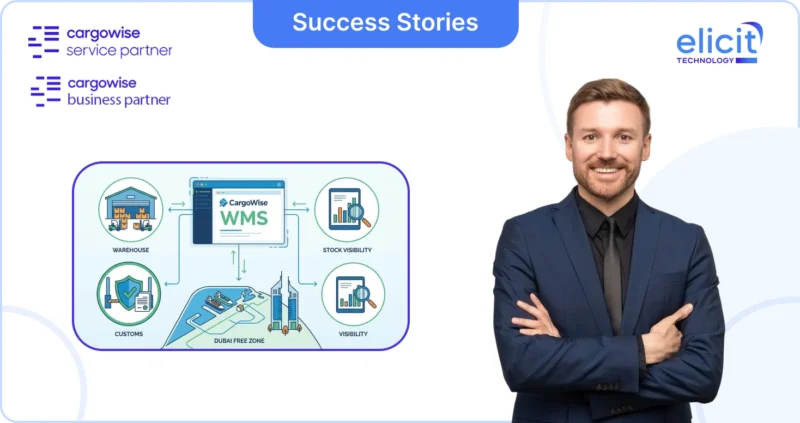




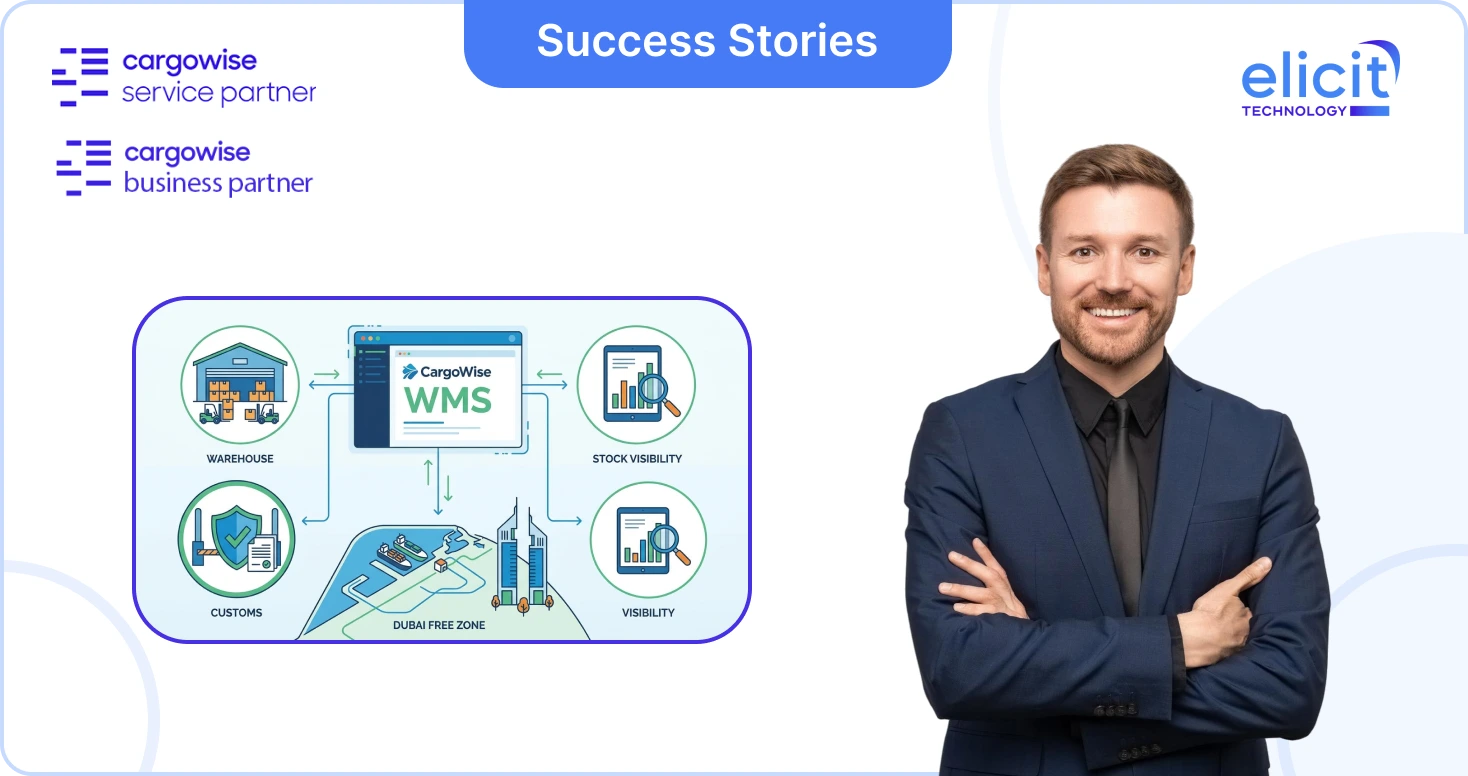
A Dubai-based 3PL and warehousing service provider approached Elicit with a complex Free Zone operational challenge. The company manages imported cargo on behalf of multiple customers and stores the goods within a Free Zone warehouse environment.
Although the cargo belongs to different customers, the imports are filed under the 3PL’s name as the consignee. This made the process highly sensitive from a customs, inventory, and customer reporting perspective.
The client needed a system that could manage warehouse stock, customer ownership, customs records, Bill of Entry details, and movement history in one connected environment. Their existing local system was not strong enough to support this level of operational control.
That was when they started exploring CargoWise WMS and approached Elicit for expert implementation support.
The Challenge: Free Zone Operations Needed More Than Basic Warehouse Management
The client’s business was heavily import-driven, with nearly 90% of its operations linked to imported goods entering the Dubai Free Zone.
In a Free Zone environment, goods can be imported and stored without immediate customs duty. However, the next movement of the cargo determines how duty, documentation, and customs reporting must be handled.
For this client, the main challenge was not only receiving and storing goods. They needed to manage four different operational scenarios after import:
1. Free Zone Import and Domestic Release
Goods are imported duty-free into the Free Zone. Later, when the goods are moved into the UAE domestic market, customs duty becomes applicable. The client needed proper tracking of the original Bill of Entry, duty status, stock movement, and domestic release update.
2. Free Zone Import and Re-export
Some goods are imported into the Free Zone and later exported directly to another country. In this case, local duty may not apply, but export documentation and linkage to the original import record must be maintained.
3. Free Zone to Free Zone Transfer
Goods may be transferred from one Free Zone warehouse to another Free Zone facility. Although duty may not be applicable, movement traceability, BOE linkage, and stock accountability remain important.
4. Stock Holding Inside the Free Zone
Some goods remain stored in the warehouse for a longer period. The client needed accurate inventory visibility, customer-wise stock reporting, and periodic reconciliation with Dubai Customs records.
The existing system could not manage these scenarios efficiently. Data was scattered, customs references were not always linked properly, and customer statements required too much manual checking.
The Core Problem: CargoWise Data Had to Match Dubai Customs Records
For this 3PL, accuracy was not optional.
Since imports were filed under the company’s name as consignee, every customs-related data point had to be captured correctly. This included:
- Bill of Entry details
- Customs declaration numbers
- Customer or cargo owner details
- HS code, item details, quantity, and value
- Warehouse and location details
- Stock reference linked to BOE
- Movement type and transaction date
The biggest risk was a mismatch.
If CargoWise stock records did not match Dubai Customs records, the client could face customer disputes, reconciliation issues, audit concerns, and operational delays.
Customer statements also had to be highly accurate. When a customer requested a stock report, the client needed to show exact inventory balances, BOE-wise stock details, movement history, and customs-linked status without spending hours on manual validation.
Elicit’s Approach: Building a Practical CargoWise WMS Workflow
Elicit reviewed the client’s Free Zone warehouse process in detail before proposing the CargoWise WMS implementation structure.
The goal was not to simply move the client from a local system to CargoWise. The goal was to create a workflow that reflected how Free Zone operations actually work.
Elicit focused on three major areas:
- Operational workflow mapping
- Customs and BOE data capture
- Customer-wise stock visibility and reporting
The implementation approach started with understanding how cargo enters the Free Zone, how BOE details are recorded, how goods are received into the warehouse, how stock is assigned to customers, and how different post-import movements are handled.
Once the process was mapped, Elicit designed a CargoWise WMS structure that could support all four Free Zone scenarios.
How CargoWise WMS Was Customized for the Client?
Elicit configured the CargoWise WMS workflow to ensure that every stock movement could be connected back to the original customs and import reference.
When goods arrived in the Free Zone, the Bill of Entry and customs declaration details were captured in CargoWise. Once Dubai Customs cleared the goods under duty-free status, the warehouse receipt process was completed in CargoWise WMS.
Stock was then made available under the 3PL’s warehouse account, while still maintaining clear customer ownership details.
For domestic release, Elicit structured the workflow so that stock movement from Free Zone to the UAE domestic could be recorded properly, including duty payment capture and BOE update.
For direct exports, the system was set up to maintain a linkage between the original import BOE and the export declaration.
For Free Zone transfers, the workflow allowed inter-warehouse transfer recording with stock traceability and no-duty movement logic.
For stock holding, the system supported accurate stock maintenance, periodic reconciliation, and customer-wise reporting.
This helped the client move from manual tracking to a more structured, system-driven process.
The Results: Better Control, Better Reporting, and Better Compliance
After the CargoWise WMS workflow was implemented, the client gained much stronger control over their Free Zone warehouse operations.
The most important improvement was visibility. The team could now track imported stock from the original BOE through warehouse receipt, customer ownership, movement type, and final stock status.
Customer statements became easier to prepare because the required data was already available in CargoWise. Instead of manually checking stock records against customs documents, the team could generate more reliable customer-wise inventory reports.
The client also improved their ability to reconcile stock with Dubai Customs records. This reduced the risk of mismatch, penalties, audit concerns, and customer disputes.
Key outcomes included:
- Improved BOE-wise stock tracking
- Clear customer-wise inventory visibility
- Better reconciliation with Dubai Customs records
- Reduced manual effort in preparing customer statements
- More accurate stock movement history
- Stronger control over Free Zone import and export scenarios
- Improved warehouse reporting for internal teams and customers
- Scalable WMS structure for future growth
Business Impact
Before the implementation, the client’s local system was creating operational gaps. It could store basic information, but it did not provide the level of customs-linked stock traceability required for Free Zone 3PL operations.
After working with Elicit, the client had a more reliable CargoWise WMS workflow that supported both warehouse execution and customs compliance.
Warehouse teams gained better stock control. Operations teams could manage different movement scenarios with more confidence. Finance and customer service teams could prepare accurate customer statements. Management gained better visibility over import-based warehouse activity.
Most importantly, the client could now operate with a stronger connection between physical stock, CargoWise records, and Dubai Customs data.
Why Elicit Made the Difference?
Free Zone warehousing is not the same as standard warehouse management.
It requires a clear understanding of customs documentation, BOE linkage, duty-free stock handling, domestic release, re-export, Free Zone transfer, and customer-wise inventory control.
Elicit’s value came from combining CargoWise WMS knowledge with real logistics process understanding.
Instead of implementing a generic warehouse setup, Elicit helped the client build a workflow that matched their actual business model as a 3PL operating inside a Dubai Free Zone.
This ensured the system was not only technically configured but also operationally useful.
Conclusion
This success story shows how the right CargoWise WMS implementation can help Free Zone 3PL operators manage warehouse stock, customs records, and customer reporting with better accuracy.
The client needed more than a warehouse system. They needed a connected operational platform where every import, BOE, stock movement, customer statement, and customs reconciliation activity could be managed properly.
With Elicit’s expert CargoWise service partner support, the client moved toward a more scalable, compliant, and visible Free Zone warehouse operation.
For 3PLs handling import-heavy Free Zone business, accurate stock control is not just about inventory. It is about compliance, customer trust, and long-term operational efficiency.
Are you managing Free Zone warehouse operations, customs-linked inventory, or customer-wise stock reporting in CargoWise? Schedule a call with Elicit’s CargoWise specialists today and build a smarter WMS workflow that improves visibility, compliance, and stock control from import to final movement.