





CargoWise Value Packs have opened the door to more functionality, more automation, and more operational possibilities for logistics companies. But access alone does not create return on investment.
The real question for freight forwarders, customs brokers, warehouse operators, and logistics providers is simple: Are you actually getting measurable value from your CargoWise Value Pack investment?
Many businesses now have access to a wider range of CargoWise capabilities across forwarding, customs, warehousing, transport, automation, visibility, reporting, and finance workflows. But if teams are still relying on manual work, disconnected spreadsheets, slow reporting, duplicate data entry, and underused modules, the ROI may not be where it should be.
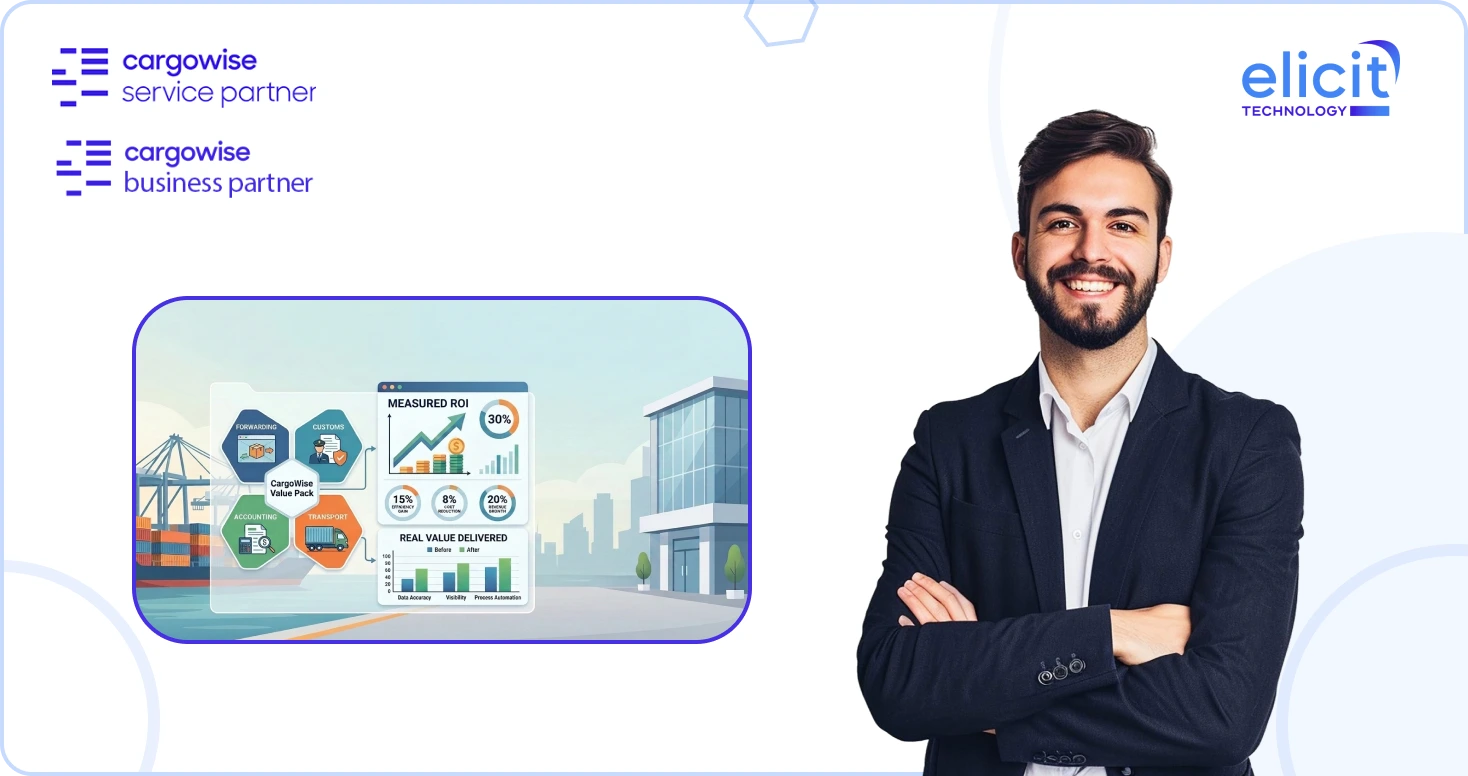
That is why measuring CargoWise ROI is not just about checking system usage. It is about understanding how CargoWise improves productivity, reduces costs, increases visibility, strengthens financial control, and helps your business scale smarter.
Why CargoWise ROI Matters More After Value Packs?
Before Value Packs, many businesses viewed CargoWise functionality through cost limitations. Some modules, features, or workflows may have been avoided because of separate access considerations.
Now, with more capability available, the focus has shifted from “What do we have access to?” to “How well are we using what we already have?”
This is where many companies struggle. They may have access to automation, reporting, workflow tools, container visibility, accounting functionality, customs capabilities, and operational enhancements, but they do not fully activate or optimize them.
That means the investment is already there, but the return is still waiting to be unlocked.
What should You Measure in CargoWise ROI?
CargoWise ROI should be measured across practical business outcomes, not just software usage. The most important areas include productivity, cost reduction, automation, accuracy, financial visibility, customer service, and scalability.
For example, if your team can process more shipments without adding more headcount, that is ROI. If AP invoice processing becomes faster through automation, that is ROI. If reporting improves decision-making and reduces manual Excel work, that is ROI. If container tracking reduces customer follow-up emails, that is ROI.
The best ROI indicators usually include:
- Reduction in manual data entry
- Faster shipment processing
- Lower operational dependency
- Improved invoice turnaround time
- Fewer billing and accrual errors
- Better reporting accuracy
- Increased use of automation
- Reduced support and rework
- Improved customer visibility
- Better team productivity
The Hidden ROI Gap Many CargoWise Users Miss
A lot of CargoWise users assume they are getting value because the system is running. Jobs are created, invoices are posted, shipments are managed, and operations continue.
But system activity is not the same as system optimization.
The real ROI gap appears when teams are still doing work that CargoWise could automate or simplify. This includes manual shipment creation, repeated data entry, invoice matching, reporting exports, customer updates, milestone tracking, charge validation, and document processing.
If your team is working around CargoWise instead of working through CargoWise, your ROI is likely lower than it should be.
How CargoWise Value Packs can Improve ROI?
CargoWise Value Packs create more opportunities for businesses to use the platform as a complete operational ecosystem. When used properly, the Value Pack can help teams move beyond basic usage and start improving real business performance.
The ROI potential can come from areas such as:
- Workflow automation across forwarding, customs, finance, and transport
- Container Automation and shipment visibility
- Market Intelligence and operational dashboards
- Document automation and invoice processing
- Better accounting configuration and charge code control
- Stronger reporting and business intelligence
- Improved use of CargoWise Neo and customer-facing workflows
- Integration with external ERP, WMS, finance, and customer systems
The key is not simply having these features available. The key is implementing them in a way that matches your business process.
How to Calculate CargoWise ROI in a Practical Way?
You do not need to make ROI measurement complicated. Start by identifying where time, cost, and errors currently exist.
Ask questions like:
How many hours does your team spend on manual data entry every week?
How long does it take to create shipments, bookings, transport jobs, or warehouse entries?
How many invoices require manual matching or correction?
How many reports are still prepared manually in Excel?
How often do users raise support requests because workflows are unclear?
How many customer update emails could be automated?
How much revenue leakage happens because charges are missed or incorrectly configured?
Once you identify these areas, you can compare the current effort against optimized CargoWise workflows. This helps you build a practical ROI picture based on real operational savings.
Why Configuration has a Direct Impact on ROI?
CargoWise ROI depends heavily on configuration quality.
A poorly configured CargoWise environment can reduce value even when the platform has strong functionality. Incorrect charge codes, weak workflows, unoptimized reports, incomplete automation, poor milestone setup, and underused integrations can all reduce ROI.
Strong configuration helps ensure:
- Charge rate and post correctly
- Workflows trigger at the right time
- Reports show accurate data
- Automation reduces manual work
- Finance and operations stay aligned
- Users follow consistent processes
- Management gets reliable visibility
This is why ROI is not only a financial calculation. It is also a configuration and operational performance issue.
Why Team Capability Also Affects CargoWise ROI?
Your CargoWise investment is only as strong as the people using it.
If users do not understand available functionality, they may continue using old manual habits even when better options exist. This is especially common in companies that implemented CargoWise years ago and never revisited training, optimization, or new feature adoption.
Team capability affects ROI because knowledgeable users make better system decisions. They raise better support requests, use workflows more consistently, reduce errors, and adopt more functionality.
That is why CargoWise ROI should include both system optimization and team adoption.
Common Signs You are not Getting Full CargoWise ROI
Your business may not be getting full ROI from CargoWise Value Packs if:
- Teams still rely heavily on spreadsheets
- Users manually update milestones or customer statuses
- AP invoice processing is still mostly manual
- Reports take too long to prepare
- Charge codes frequently create billing issues
- Teams do not use available automation features
- CargoWise data is duplicated across external systems
- Customer visibility depends on manual emails
- Users are unaware of newer CargoWise capabilities
- Management cannot clearly measure operational performance
These signs do not mean CargoWise is failing. They usually mean the system needs better optimization.
How Elicit Helps Measure and Improve CargoWise ROI?
Elicit helps logistics companies move from CargoWise access to measurable CargoWise value.
As a certified CargoWise Service and Business Partner, Elicit supports businesses with implementation, configuration, customization, workflow optimization, automation, integration, reporting, accounting setup, warehouse workflows, forwarding processes, customs support, global rollouts, and ongoing CargoWise support.
Elicit helps organizations review current CargoWise usage, identify underused Value Pack functionality, reduce manual work, improve automation, optimize reporting, strengthen accounting configuration, and align CargoWise with operational and financial goals.
The focus is not just on using more features. The focus is on turning CargoWise into a stronger business performance engine.
What a Strong CargoWise ROI Strategy Looks Like?
A strong CargoWise ROI strategy should focus on practical improvement areas that directly affect the business.
This includes reviewing current workflows, identifying manual bottlenecks, mapping Value Pack functionality to business needs, improving user adoption, optimizing system configuration, and measuring performance before and after changes.
A strong ROI strategy should also connect operations and finance. For example, faster shipment creation helps operations, but faster invoicing improves cash flow. Better charge code configuration helps finance, but it also reduces operational corrections. Better visibility helps customer service, but it also reduces internal follow-up.
When CargoWise is optimized correctly, ROI appears across the whole business.
Conclusion
CargoWise Value Packs create a major opportunity for logistics companies to unlock more value from the platform. But ROI does not happen automatically.
To measure CargoWise ROI properly, businesses need to look at productivity, automation, cost reduction, reporting accuracy, financial control, customer visibility, and scalability.
If your team has access to more CargoWise functionality but still works manually, the opportunity is clear. Your business may already have the tools needed to improve performance. What you need is the right strategy, configuration, and expert guidance to activate them properly.
Schedule a call with Elicit, which helps CargoWise users identify where value is being missed and how to turn CargoWise Value Pack access into measurable business results.
With the right CargoWise service partner, your investment can move beyond access and become a real operational advantage.