







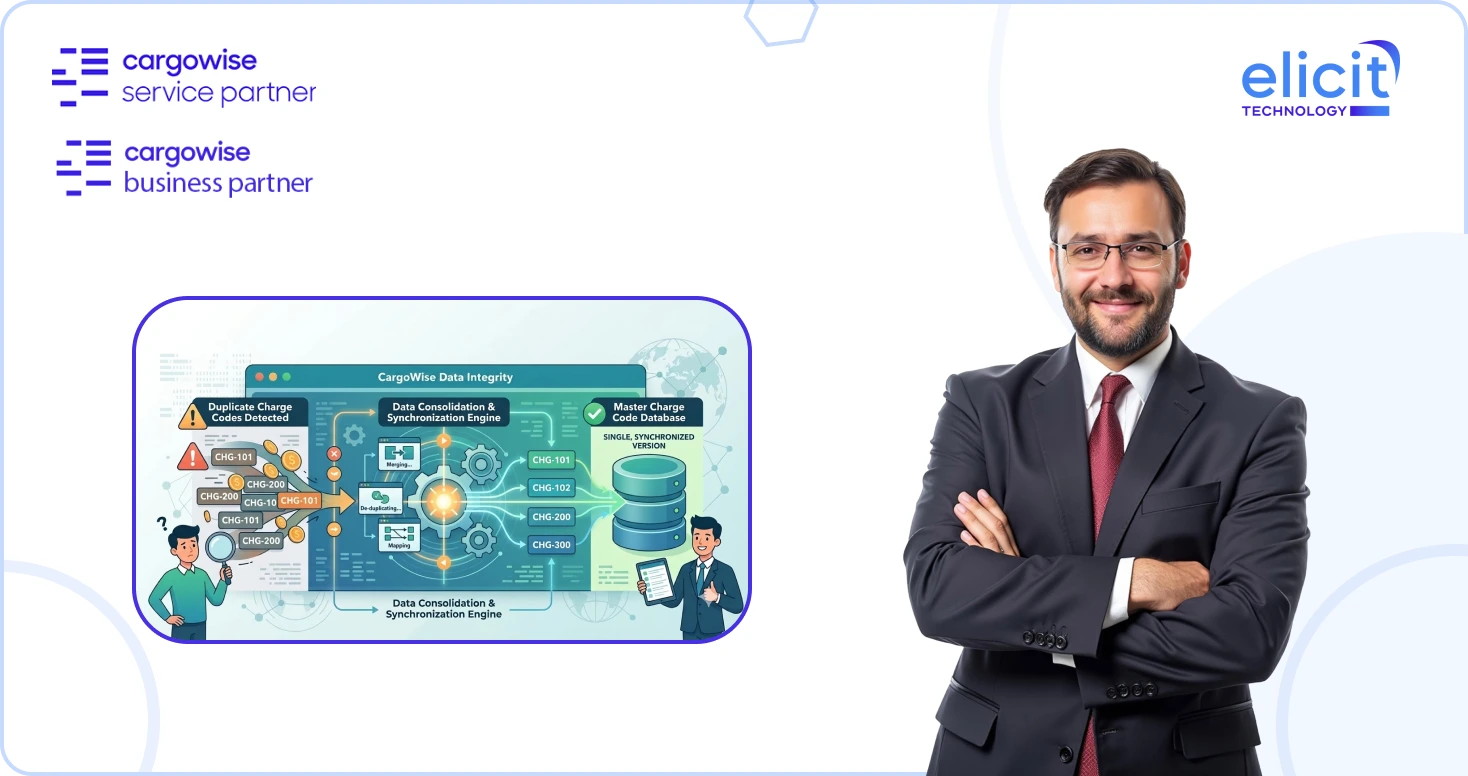
Duplicate charge codes may seem like a small issue, but they can quietly create major problems across your CargoWise environment. One branch uses one charge code, another creates a new one for the same service, and before long, your finance team is reconciling reports that don’t quite match. Revenue becomes fragmented, profitability reporting loses accuracy, and users spend more time deciding which charge code to select than completing the actual job.
The problem isn’t CargoWise, it’s how charge codes are managed over time. As businesses grow, add new services, or expand into multiple branches, duplicate charge codes often accumulate without a proper governance strategy. This guide explains why duplicate charge codes occur, how they affect your business, and what you can do to prevent them permanently.
Why are Charge Codes so Important in CargoWise?
Every financial transaction inside CargoWise begins with a charge code. Whether you’re creating a quotation, posting an Accounts Payable invoice, generating an Accounts Receivable invoice, recording job costs, or producing financial reports, charge codes determine how revenue and costs are classified throughout the system.
Because charge codes influence billing, profitability, General Ledger postings, reporting, automation, and integrations, they form one of the most important components of a well-configured CargoWise environment.
When charge codes are standardized, financial data remains consistent across departments. When duplicate charge codes exist, that consistency quickly disappears.
What are Duplicate Charge Codes in CargoWise?
Duplicate charge codes occur when multiple codes are created to represent the same service, cost, or revenue item.
For example, one office may create SEA FREIGHT, another uses OCEAN FREIGHT, while a third creates OFRT EXPORT. Although each code represents the same service, CargoWise treats them as separate financial records.
Over time, these duplicate entries begin affecting every part of the business, from invoicing and reporting to profitability analysis and management dashboards.
Duplicate charge codes are especially common in organizations that:
- Have multiple branches
- Operate across different countries
- Have expanded services over many years
- Completed mergers or acquisitions
- Have multiple administrators creating configurations
- Have used CargoWise for a long time without periodic configuration reviews
Why do Duplicate Charge Codes Happen?
Duplicate charge codes rarely result from a single mistake. They usually develop gradually as businesses evolve.
One common reason is decentralized administration. Different users or branches create their own charge codes without checking whether an existing one already serves the same purpose.
Another reason is business growth. As companies introduce new services, business units, or customers, new charge codes are often created instead of reviewing and expanding the existing structure.
Legacy configurations also contribute significantly. Many organizations implemented CargoWise ten or fifteen years ago and have continued adding new codes without retiring outdated ones or standardizing naming conventions.
Lack of documentation, inconsistent governance, and insufficient configuration reviews all increase the likelihood of duplicate charge codes accumulating over time.
The Hidden Business Impact of Duplicate Charge Codes
At first glance, duplicate charge codes may appear to be nothing more than an administrative inconvenience. In reality, they create operational and financial challenges throughout the business.
Revenue for identical services becomes spread across multiple charge codes, making financial reports less meaningful. Profitability analysis becomes more difficult because the same service appears under several different categories. Finance teams spend additional time reconciling transactions, while management struggles to gain a clear picture of business performance.
Duplicate charge codes can also affect:
- Accounts Receivable billing
- Accounts Payable processing
- Job profitability
- Financial reporting
- General Ledger mapping
- Revenue recognition
- Business intelligence dashboards
- Workflow automation
- API and EDI integrations
- Customer pricing consistency
The larger the organization becomes, the greater the impact these inconsistencies create.
Seven Signs Your CargoWise Environment has Duplicate Charge Code Issues
Many businesses don’t realize duplicate charge codes exist until reporting becomes increasingly difficult. Common warning signs include:
- Multiple charge codes describing the same service.
- Different branches using different billing codes for identical work.
- Finance regularly correcting invoice allocations.
- Revenue reports showing fragmented income categories.
- Users frequently asking which charge code they should select.
- Profitability reports requiring manual consolidation.
- Multiple charge codes mapped to the same General Ledger account.
If your business experiences several of these issues, your charge code structure may need review.
Why Deleting Duplicate Charge Codes isn’t the Right Solution?
A common misconception is that duplicate charge codes can simply be deleted. Unfortunately, it’s rarely that straightforward.
Charge codes are connected to historical invoices, customer contracts, job costing, tariffs, financial reports, General Ledger mappings, workflows, and integrations. Removing them without understanding these relationships can create reporting inconsistencies and disrupt ongoing operations.
Instead of deleting charge codes individually, businesses should develop a structured governance strategy that standardizes future usage while protecting historical financial data.
The goal isn’t simply reducing the number of charge codes, it’s ensuring every charge code has a clear purpose within your CargoWise environment.
How Standardized Charge Codes Improve Business Performance?
A standardized charge code structure creates benefits across the entire organization.
Operations teams spend less time deciding which charge code to use.
Finance teams process invoices more efficiently because billing remains consistent.
Management gains greater confidence in financial reporting and profitability analysis.
Automation workflows become easier to configure because standardized data produces more predictable results.
System integrations also become more reliable since external applications receive consistent financial information rather than multiple variations of the same transaction.
Ultimately, standardized charge codes improve operational efficiency while reducing administrative complexity.
Best Practices for Preventing Duplicate Charge Codes
Preventing duplicate charge codes requires more than occasional system cleanup. It requires ongoing governance supported by well-defined configuration standards.
Some recommended practices include:
- Establish organization-wide charge code naming conventions.
- Centralize responsibility for creating new charge codes.
- Regularly review inactive or duplicate codes.
- Align charge codes with General Ledger mappings.
- Document configuration standards for future administrators.
- Train users on approved billing structures.
- Periodically audit CargoWise financial configuration.
- Review charge code usage before implementing new services or business units.
Organizations that treat charge code management as an ongoing governance process experience fewer reporting issues and significantly lower maintenance costs over time.
Why CargoWise Configuration Matters More than Ever?
CargoWise continues to evolve with new automation capabilities, AI-driven workflows, integrations, financial enhancements, and reporting functionality. As these capabilities expand, the quality of your underlying configuration becomes even more important.
Poorly managed charge codes can reduce the effectiveness of automation, complicate reporting, and introduce unnecessary manual work into finance and operations.
A clean, standardized configuration creates the foundation needed to fully benefit from CargoWise’s advanced capabilities while supporting future business growth.
How Elicit Helps Standardize CargoWise Charge Codes?
Managing duplicate charge codes is rarely just a finance issue, it requires a broader review of your CargoWise configuration, workflows, and operational processes.
As an official CargoWise Service and Business Partner, Elicit Technology helps freight forwarders optimize their CargoWise environment by reviewing existing charge code structures, identifying duplication, standardizing billing configurations, and aligning finance, operations, and reporting with industry best practices.
Our CargoWise specialists support organizations through:
- Charge code standardization
- CargoWise finance configuration
- Accounts Payable and Accounts Receivable optimization
- General Ledger mapping
- Workflow automation
- Reporting customization
- API and EDI integrations
- CargoWise implementation and system reviews
- User training and ongoing support
Rather than applying generic configurations, we tailor CargoWise around your business processes, helping you reduce complexity while improving financial accuracy and operational efficiency.
Conclusion
Duplicate charge codes may seem like a minor configuration issue, but their impact extends across invoicing, reporting, profitability, automation, and financial decision-making. Left unmanaged, they increase administrative effort, reduce reporting accuracy, and create unnecessary complexity throughout your CargoWise environment.
The most effective solution isn’t simply removing duplicate codes, it’s implementing a standardized charge code strategy supported by proper CargoWise governance and ongoing configuration reviews.
If your organization has been using CargoWise for years and your charge code library has grown without regular review, now is the ideal time to optimize your finance configuration.
As an official CargoWise Service Partner, Elicit Technology helps logistics companies simplify CargoWise configuration, standardize financial processes, improve reporting, and maximize the value of their CargoWise investment. Contact us, whether you’re reviewing an existing environment or planning future growth, our experts can help you build a cleaner, more scalable CargoWise platform that supports long-term business success.