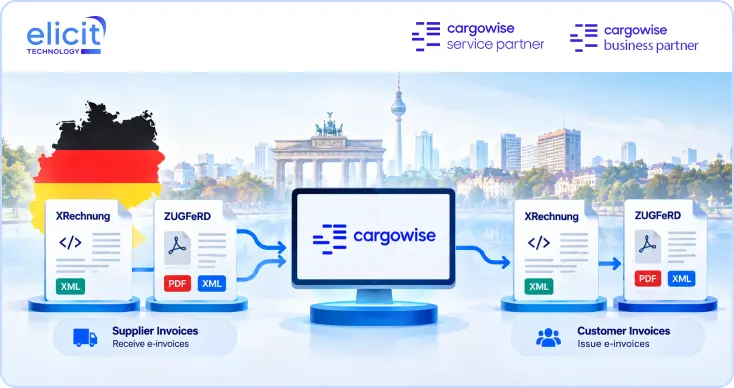
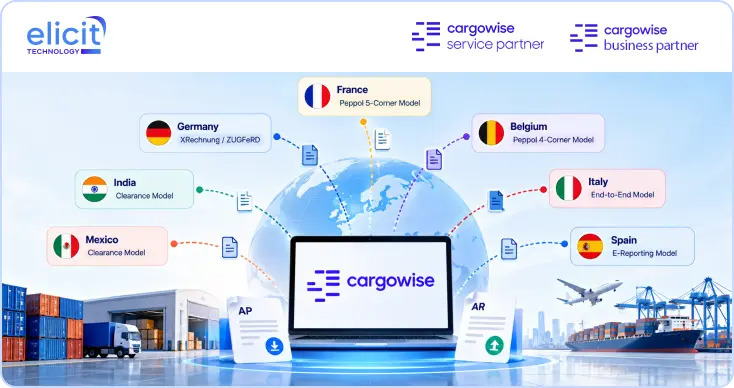
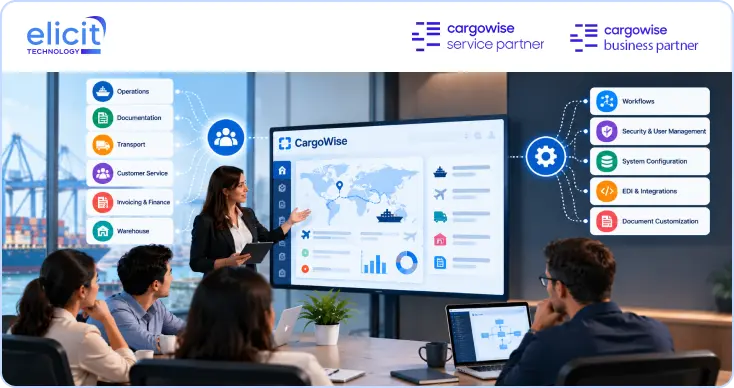
System Scanning & Health Check

Find risks before they hit operations.

Operations Audit & Optimization

Improve performance with measurable operational gains.

User Training

Train teams to work smarter every day.

This and other consulting & optimization services in CargoWise

We are always ready with the solution you need.

Share your goals with us — we'll optimize CargoWise to deliver measurable results.

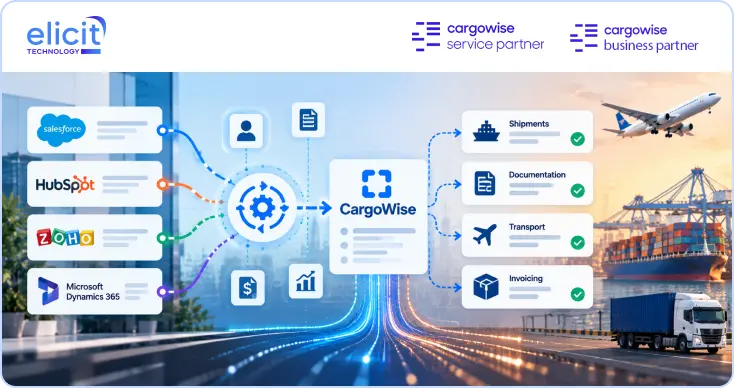
Salesforce

Sync Salesforce data with live shipments.

HubSpot

Align sales activity with operational shipment data.

Zoho CRM

Connect Zoho deals with CargoWise operations.

Microsoft Dynamics CRM

Unify CRM and logistics on one workflow.

This and other CRM integrations in CargoWise

We are always ready with the solution you need.

Share your requirements with us — we'll integrate CRM into CargoWise to fit the way you work.

ICEGATE Integration

Accelerate ICEGATE integration delivery for efficiency, connecting CargoWise to India's national customs gateway for automated declaration filing.

ACE Integration

Accelerate ACE integration delivery for efficiency, connecting CargoWise to the US CBP's Automated Commercial Environment for import filings.

AMS Integration

Optimize AMS integration delivery at scale, automating advance cargo manifest submissions into the US Automated Manifest System.

AES Integration

Accelerate AES integration delivery for efficiency, automating US export declaration filing through the Automated Export System.

CDS Integration

Accelerate CDS integration delivery for efficiency, connecting CargoWise to the UK's Customs Declaration Service.

DMS Integration

Streamline Netherlands customs declaration delivery, connecting CargoWise to Dutch Customs' current DMS platform, which fully replaced AGS in 2024.

MPCI Integration

Automate UAE pre-loading manifest filing, connecting CargoWise to MPCI for mandatory cargo information submission before loading.

ICS2 Integration

Accelerate ICS2 integration delivery for efficiency, meeting the EU's mandatory Entry Summary Declaration requirements across all transport modes.

ASM Sequoia Integration

Accelerate ASM Sequoia integration for efficiency, connecting CargoWise to Sequoia's customs filing platform.

TradeNet Integration

Streamline Singapore customs filing, connecting CargoWise to TradeNet's single window for permits, duties, and Certificate of Origin declarations.

ASYCUDA Integration

Accelerate ASYCUDA integration delivery for efficiency, linking CargoWise to the customs automation system used widely across Africa.

SARS Integration

Accelerate SARS integration delivery for efficiency, connecting CargoWise to South Africa's national customs system.

SISCOMEX Integration

Accelerate SISCOMEX integration delivery for efficiency, connecting CargoWise to Brazil's Integrated Foreign Trade System.

VUCEM Integration

Optimize VUCEM integration delivery at scale, connecting CargoWise to Mexico's single window for foreign trade.

NZCS Integration

Accelerate NZCS integration delivery for efficiency, connecting CargoWise to New Zealand Customs Service's filing platform.

About Us

Discover who powers your CargoWise success.

Careers

Join our global logistics technology team.

Contact Us

Talk to CargoWise experts about your goals.

CargoWise Resources

Your Complete CargoWise Support Destination

From implementation to automation, optimize every process with expert CargoWise guidance.

CargoWise Shortcuts

Work faster with practical keyboard shortcuts.

Free Tools

Use free tools for everyday logistics tasks.

CargoWise Healthcheck

Uncover ways to improve CargoWise performance.

CargoWise Resources

Your Complete CargoWise Support Destination

From implementation to automation, optimize every process with expert CargoWise guidance.

Glossary

Browse key logistics and CargoWise terms.

CargoWise Resources

Your Complete CargoWise Support Destination

From implementation to automation, optimize every process with expert CargoWise guidance.

Incoterms

Understand trade terms for global shipping.

CargoWise Resources

Your Complete CargoWise Support Destination

From implementation to automation, optimize every process with expert CargoWise guidance.

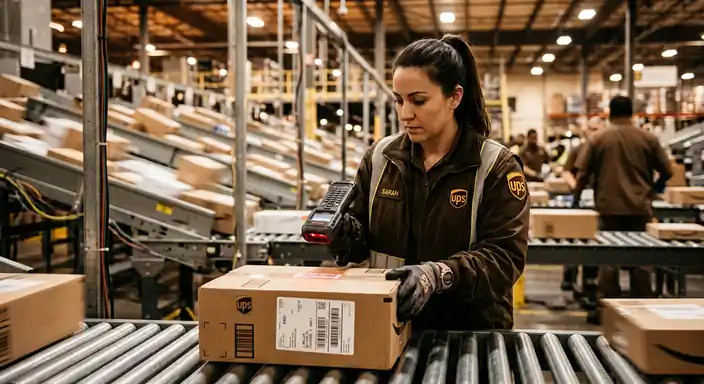
UPS delivery truck and package sorting facility

The EU Starts Requiring Product Identifiers on B2C Shipments This November

Connect CargoWise to UPS's OAuth 2.0 Developer Portal, so shipping, tracking, and landed cost data sync correctly, built around the current API platform, not the SOAP integration UPS retired back in 2024.

Book a Call

A legacy cutoff already passed, and a new EU requirement is coming

UPS's older SOAP-based API reached full end-of-life in August 2024, a harder cutoff than some carriers' softer 'maintenance-only' transitions, forcing a genuine migration to OAuth 2.0 Client Credentials authentication through the current UPS Developer Portal. Any integration still assuming SOAP access simply doesn't work anymore.

There's also a real deadline ahead worth building for now: from 1 November 2026, the EU requires Product Identifier (PID) information for certain B2C shipments entering the bloc. If your freight operations touch e-commerce shipments headed into the EU, this isn't optional documentation, it's a new required data field. Separately, if your operations include LTL freight through TForce Freight, worth knowing that UPS moved Pickup, Shipping, Rating, and Tracking for TForce entirely off the main UPS Developer Portal in May 2024, that's now its own, distinct integration at developer.tforcefreight.com.


UPS freight and logistics operations collage

UPS API products we connect into CargoWise

01

Labels, Rates, Address Validation

Shipment creation and label generation sync directly from CargoWise.

02

Real-Time Status

Package location and delivery status sync via UPS Signature Tracking for automated proof of delivery.

03

Landed Cost & Compliance

Duty, tax, and brokerage fee estimates, plus restricted trading party screening, for cross-border shipments.

04

International Shipment Docs

Document images upload and link directly to international shipments.

05

Delivery Estimates

Estimated delivery dates and service options sync into your quoting workflow.

06

November 2026 Requirement

Product Identifier data fields configured ahead of the EU's new B2C shipment requirement.

What changes once CargoWise and UPS are actually connected?

Without Integration

  • Integration still assuming legacy SOAP access
  • No PID data field for EU-bound B2C shipments
  • TForce Freight LTL data assumed to run through the main UPS API
  • Landed cost and restricted party screening handled outside your workflow
  • International customs documents uploaded manually

With CargoWise UPS Integration

  • Connected through OAuth 2.0 and the current UPS Developer Portal
  • Product Identifier data configured ahead of the November 2026 requirement
  • LTL data routed correctly through TForce's separate developer platform
  • TradeAbility data syncs directly for cross-border shipments
  • Paperless Documents Upload links directly to the shipment

Here is our complete CargoWise UPS Integration process flow

01

Discovery & Analysis

We confirm your current UPS integration status, legacy SOAP or current OAuth, and identify whether TForce Freight LTL requires a separate connection.

02

Data Mapping

We map CargoWise shipment, tracking, and landed cost fields to UPS's current REST API structure, including the new EU PID requirement.

03

Build & Configure

We register your app in the UPS Developer Portal, configure OAuth 2.0 Client Credentials with your account number, and connect Shipping, Tracking, and TradeAbility products.

04

Testing in the UPS Sandbox

We test shipment creation, tracking, and landed cost data against UPS's test environment before go-live.

05

Go-Live & Hypercare

Controlled cut-over with close monitoring through your first live cycle of UPS shipments and tracking updates.

06

Monitor, Support & Train

Ongoing monitoring of UPS API changes, including the EU PID rollout and any further TForce Freight platform updates.

What CargoWise UPS Integration delivers?

01

Fully on the Current API, Not Retired SOAP

Your integration runs on OAuth 2.0 and UPS's actively maintained platform, not infrastructure UPS ended in 2024.

02

Ready for the EU PID Requirement

Product Identifier fields configure ahead of November 2026, so EU-bound B2C shipments don't stall on a missing data point.

03

LTL Freight Routed Correctly

TForce Freight data connects through its own dedicated platform, not assumed to flow through the main UPS API.

04

Landed Cost Visibility, Before a Shipment Ships

TradeAbility data gives duty, tax, and screening estimates inside your quoting workflow, not discovered after the fact.

Contact Us

Looking for the Right CargoWise Partner to Support Your Growth?

Elicit Technology helps logistics businesses simplify CargoWise through implementation, integration, automation, configuration, BI dashboards, live setup, and ongoing support.

Full name is required
Valid email is required
Message is required
Frequently Asked Questions

Happy to Assist You with Anything

Only if it's already on OAuth 2.0. UPS's legacy SOAP API reached full end-of-life in August 2024, so any integration still built around it stopped functioning.

From 1 November 2026, the EU requires Product Identifier information for certain B2C shipments entering the EU. If your operations touch e-commerce shipments into the EU, this is a new mandatory data field, not optional documentation.

Yes. UPS moved Pickup, Shipping, Rating, and Tracking for TForce Freight entirely off the main UPS Developer Portal in May 2024, that's now handled through TForce's own dedicated API platform.

Estimated duties, taxes, and brokerage fees for cross-border shipments, plus screening against restricted trading parties, useful for landed cost visibility before a shipment ships internationally.

Through OAuth 2.0 Client Credentials, using a Client ID and Client Secret generated in the UPS Developer Portal, along with your UPS account number passed as a merchant ID header.

We handle OAuth 2.0 app registration, configure the specific products your account needs, and build in readiness for requirements like the EU's 2026 Product Identifier rule.

Latest from our blogs

View All Blogs