About Us

Discover who powers your CargoWise success.

Careers

Join our global logistics technology team.

Contact Us

Talk to CargoWise experts about your goals.

CargoWise Resources

Your Complete CargoWise Support Destination

From implementation to automation, optimize every process with expert CargoWise guidance.

Glossary

Browse key logistics and CargoWise terms.

CargoWise Resources

Your Complete CargoWise Support Destination

From implementation to automation, optimize every process with expert CargoWise guidance.

Incoterms

Understand Incoterms to make informed global shipping decisions.

CargoWise Resources

Your Complete CargoWise Support Destination

From implementation to automation, optimize every process with expert CargoWise guidance.

CargoWise NZCS Integration: New Zealand Just Changed How Low-Value Goods Get Charged. Is Your Filing Keeping Pace?

CargoWise NZCS integration files import and export declarations directly with New Zealand Customs' Trade Single Window, built to reflect current requirements, including the April 2026 shift to consignment-based levy charging.

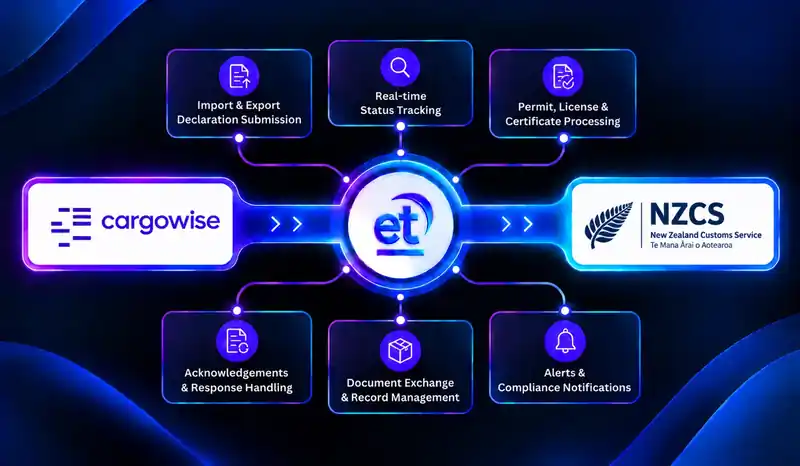
Book a Call CargoWise and NZCS integration diagram showing connected systems
NZCS and CargoWise Next integration

TSW Handles More than Just Customs

New Zealand's Trade Single Window isn't only a customs channel, it's the shared electronic gateway for Customs, the Ministry for Primary Industries, Maritime NZ, and the Ministry of Health all at once. That means a filing gap doesn't just risk a customs delay, it can hold up biosecurity or health clearance too. And TSW's rules keep moving: as of 1 April 2026, low-value goods levies shifted from a per-cargo-report basis to consignment-based charging, changing how fees get calculated on exactly the kind of high-volume, low-value shipments many forwarders handle daily.

CargoWise NZCS integration files declaration data directly through TSW, built around its current levy structure and multi-agency requirements, not a filing process that's fallen behind the April 2026 changes.


Here is Our Complete CargoWise‑NZCS Integration Process Flow

01

Discovery & Analysis

We analyse your CargoWise setup and TSW's current requirements, identify which agencies your shipments touch, Customs, MPI biosecurity, Ministry of Health, and confirm your consignment-based levy calculation reflects the current charging model.

02

Data Mapping

We map shipment, consignment, and declaration fields to TSW's expected format, with transformation and validation rules built in for Import Entry or Simplified Import Declaration requirements and low-value goods levy calculation.

03

Build & Configure

We develop the API connections, configure both CargoWise and TSW, and build in error handling and submission monitoring so filing errors surface before clearance, not after.

04

Testing for Compliance

We run thorough tests against real declaration scenarios with your operations and compliance teams, confirming submissions meet TSW's current regulatory and levy requirements before go-live.

05

Go-Live & Hypercare

Controlled cut-over with close monitoring through your first cycle of live submissions, catching filing issues before they affect clearance across any of TSW's connected agencies.

06

Monitor, Support & Train

Ongoing monitoring of submission status and rejections, exception handling, and team training to keep the integration current as TSW's requirements and charging models continue to evolve.

What CargoWise NZCS Integration Delivers?

01

Declarations Filed Once, Reaching Every Relevant Agency

Filing through TSW routes data to Customs, MPI, Maritime NZ, or Health as needed, without separate manual submissions to each.

02

Levy Calculation Matched to the Current Model

Consignment-based charging for low-value goods, effective April 2026, is reflected in filing data, not calculated against the retired per-report model.

03

Reference Numbers Carried Through Automatically

Shipment and declaration references travel with each filing, keeping the audit trail intact.

04

Fewer Multi-Agency Delays

Since a gap in one agency's data can hold up clearance across TSW's connected agencies, validated filings reduce that cross-agency risk.

05

Real-Time Status Visibility

Clearance confirmations and holds flow back into CargoWise automatically, instead of requiring a separate TSW login.

06

Built for TSW's Multi-Agency, Evolving Requirements

As New Zealand Customs and its partner agencies update levy rules or filing requirements, the mapping adjusts to match, so declarations stay compliant across every connected agency without a manual overhaul each time.

Why Choose Elicit for CargoWise NZCS Integration?

One Team, Start to Finish

/01

Whoever builds your integration is who you call when something needs adjusting.

/02

Built Around TSW's Multi-Agency Reality

Mapping accounts for Customs, biosecurity, health, and maritime requirements together, not customs data in isolation.

/03

Our Own Middleware, Fully Owned

We build and run the integration layer directly, no third-party black box.

/04

Full Environment Discipline

Development, UAT, and production each get dedicated setup and testing before touching live filings.

/05

Hypercare Built Into Go-Live

Two weeks of active monitoring follow deployment.

Contact Us

Looking for the Right CargoWise Partner to Support Your Growth?

Elicit Technology helps logistics businesses simplify CargoWise through implementation, integration, automation, configuration, BI dashboards, live setup, and ongoing support.

Full name is required
Valid email is required
Message is required
Frequently Asked Questions

Happy to Assist You with Anything

TSW is shared infrastructure across Customs, MPI, Maritime NZ, and the Ministry of Health, so where your shipments require data for any of those agencies, that's mapped as part of the integration, not treated as separate from customs filing.

Low-value goods levies moved from per-cargo-report to consignment-based charging, meaning each write-off request or Import Entry attracts its own levy. We map filings to reflect this current structure so charges calculate correctly.

The rejection or hold reason is captured and flagged for review, so your team knows exactly what needs correcting, and which agency raised the issue.

Yes, both are mapped, with the correct levy structure applied depending on which declaration type and value threshold applies to a given shipment.

Manual filing across a multi-agency platform means re-entering data multiple times and tracking levy rules that changed as recently as April 2026. This integration files once, correctly, against TSW's current requirements.

NZCS's Trade Single Window is specific to New Zealand, connecting Customs, biosecurity, maritime, and health agencies in one filing platform.

Latest from our blogs

View All Blogs