About Us

Discover who powers your CargoWise success.

Careers

Join our global logistics technology team.

Contact Us

Talk to CargoWise experts about your goals.

CargoWise Resources

Your Complete CargoWise Support Destination

From implementation to automation, optimize every process with expert CargoWise guidance.

Glossary

Browse key logistics and CargoWise terms.

CargoWise Resources

Your Complete CargoWise Support Destination

From implementation to automation, optimize every process with expert CargoWise guidance.

Incoterms

Understand Incoterms to make informed global shipping decisions.

CargoWise Resources

Your Complete CargoWise Support Destination

From implementation to automation, optimize every process with expert CargoWise guidance.

CargoWise AES Integration: Export Filing that Doesn't Wait on Someone to Remember it

CargoWise AES integration submits export declarations directly to the U.S. Automated Export System from CargoWise shipment data, validated before filing so nothing gets held at the port of export over a classification mismatch.

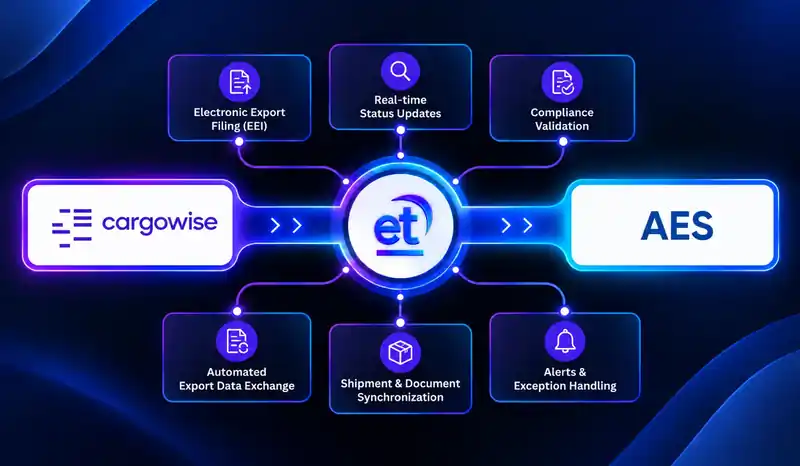
Book a Call CargoWise and AES integration diagram showing connected systems
AES and CargoWise integration

The Export Filing Problem Nobody Talks About

Import compliance gets most of the attention, but export filings through AES carry their own risk, miss the filing window or get a commodity classification wrong, and a shipment sits at the port while someone scrambles to correct it. When AES filing runs as a separate manual step from what's already documented in CargoWise, that risk isn't occasional, it's built into the process.

CargoWise AES integration closes that gap. Export data moves from CargoWise straight into AES, checked against filing requirements before submission, not after a rejection.

Here is Our Complete CargoWise‑AES Integration Process Flow

01

Discovery & Analysis

We analyse your CargoWise setup and AES's export filing requirements, identify which data points are involved, Schedule B or HTS classifications, ultimate consignee details, and confirm the specific fields required for your export volumes.

02

Data Mapping

We map shipment, consignment, and export fields to AES's expected format, with transformation and validation rules built in for commodity classifications, value thresholds, and license requirements.

03

Build & Configure

We develop the API connections, configure both CargoWise and AES, and build in error handling and submission monitoring so filing errors surface before export, not after.

04

Testing for Compliance

We run thorough tests against real export scenarios with your operations and compliance teams, confirming submissions meet AES's regulatory requirements before go-live.

05

Go-Live & Hypercare

Controlled cut-over with close monitoring through your first cycle of live AES submissions, catching filing issues before they hold up an export.

06

Monitor, Support & Train

Ongoing monitoring of submission status and rejections, exception handling, and team training to keep the integration running smoothly as AES filing requirements evolve.

What CargoWise AES Integration Delivers?

01

Export Filings That Submit Themselves

Declarations file directly from CargoWise the moment shipment data is ready, no separate manual filing step.

02

Commodity Classification Checked Before It's a Problem

Schedule B and HTS codes are validated against AES requirements before submission.

03

Reference Numbers Carried Through Automatically

Shipment and export references travel with each filing, keeping the audit trail intact.

04

Fewer Holds at the Port of Export

Validated filings reduce the risk of a shipment getting stopped over a classification or licensing mismatch.

05

Filing Status Without Leaving CargoWise

Confirmations and rejections flow back automatically, instead of requiring a separate AESDirect login.

06

Built for Evolving Export Compliance Rules

As AES updates its filing schema or licensing and classification requirements shift, the mapping adjusts to match, so export filings stay compliant without a manual overhaul each time regulations change.

Why Choose Elicit for CargoWise AES Integration?

One Team, Start to Finish

/01

Whoever builds your integration is who you call when something needs adjusting.

/02

Built Around AES's Actual Filing Logic

Field mapping reflects Schedule B classification, licensing thresholds, and AES-specific validation rules, not a generic customs template.

/03

Our Own Middleware, Fully Owned

We build and run the integration layer directly, no third-party black box.

/04

Full Environment Discipline

Development, UAT, and production each get dedicated setup and testing before touching live filings.

/05

Hypercare Built Into Go-Live

Two weeks of active monitoring follow deployment.

Contact Us

Looking for the Right CargoWise Partner to Support Your Growth?

Elicit Technology helps logistics businesses simplify CargoWise through implementation, integration, automation, configuration, BI dashboards, live setup, and ongoing support.

Full name is required
Valid email is required
Message is required
Frequently Asked Questions

Happy to Assist You with Anything

License data and value thresholds are mapped as part of configuration, so filings correctly reflect licensing status where required, though license determination itself remains your compliance team's responsibility.

The rejection is flagged immediately with the specific reason, so corrections happen fast enough to still make the filing window.

Yes, transaction type is part of the mapping, since routed and non-routed exports carry different filer-of-record responsibilities.

No. It automates the data submission step. Compliance judgment on licensing, classification, and filer responsibility still sits with your team.

AES filings often run against tighter, less-forgiving deadlines than import filings, a late or rejected export filing can hold cargo already staged for departure, so the cost of manual error is immediate.

AES (Automated Export System) is the U.S. platform for export declarations, the counterpart to ACE and AMS on the outbound side.

Latest from our blogs

View All Blogs