










CargoWise users who were preparing to migrate their integrations before January 2027 now have more flexibility.
An important update announced on 11 November 2026 confirms that the previously scheduled 1 January 2027 sunset date for eAdaptor Legacy has been removed.
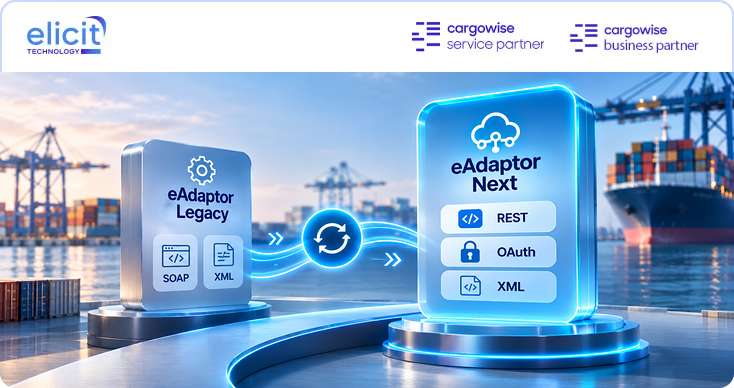
This means freight forwarders, customs brokers, and logistics businesses can continue using their existing eAdaptor Legacy integrations while planning their transition to eAdaptor Next.
Organizations no longer need to complete their migration solely to meet the earlier deadline or remain on an older CargoWise release because of that date.
However, the change does not mean that eAdaptor Legacy will remain the preferred integration solution.
eAdaptor Next continues to be the strategic replacement for eAdaptor Legacy, with improvements in authentication, messaging architecture, and integration security.
For businesses relying on CargoWise to exchange information with customers, carriers, warehouses, financial platforms, and other connected systems, the revised timeline provides an opportunity to approach migration more carefully.
The priority is no longer meeting a fixed deadline. It is ensuring that existing integrations are prepared for a more secure and modern CargoWise environment.
What has Changed with the CargoWise eAdaptor Legacy Sunset Date?
The original announcement stated that eAdaptor Legacy would be deprecated in CargoWise releases after 1 January 2027.
Future releases were expected to stop including or supporting the legacy integration functionality.
This created an important deadline for businesses using eAdaptor Legacy to exchange information between CargoWise and external applications.
Companies needed to assess their existing integrations, identify compatibility requirements, and plan their migration before the announced date.
The revised announcement changes that timeline.
The 1 January 2027 sunset date no longer applies.
eAdaptor Legacy will continue to be available and supported as a legacy protocol while customers transition to eAdaptor Next.
This provides three important benefits for CargoWise users.
First, businesses have additional time to evaluate their existing integration landscape.
Second, organizations already working on migration can continue their projects without the pressure of the previous deadline.
Third, customers are no longer required to remain on older CargoWise releases solely because their eAdaptor Legacy migration is incomplete.
However, the removal of the sunset date should not be interpreted as a cancellation of the migration initiative.
eAdaptor Next remains the recommended direction, and businesses are encouraged to continue progressing their transition.
Why should CargoWise Users Still Migrate to eAdaptor Next?
For freight forwarders, integrations are essential to maintaining connected operations.
CargoWise may exchange information with customer systems, transport providers, warehouse applications, financial platforms, and other business-critical technologies.
When these integrations work reliably, information can move between systems with less manual intervention.
However, integration technology must also evolve to meet changing security and operational requirements.
eAdaptor Legacy uses an older integration architecture and is identified as a lower-security model compared with eAdaptor Next.
Although the legacy protocol remains supported during the transition, continuing to rely on it can create security considerations that businesses should evaluate.
eAdaptor Next introduces a more modern approach to communication between CargoWise and connected applications.
Its architecture supports REST-based messaging and updated authentication requirements.
For organizations using WiseCloud-hosted CargoWise environments, inbound eAdaptor Next integrations require OAuth authentication rather than the basic authentication previously used with eAdaptor Legacy.
These changes make migration more than a technical replacement.
They represent an opportunity to review how information is exchanged, how connected applications authenticate, and whether existing integrations remain suitable for the organization’s operational requirements.
Freight forwarders should therefore treat the revised timeline as additional preparation time rather than a reason to postpone migration indefinitely.
What are the Key Differences Between eAdaptor Legacy and eAdaptor Next?
Understanding the main differences helps businesses assess the potential impact on their existing integrations.
| Integration area | eAdaptor Legacy | eAdaptor Next |
| Integration architecture | Legacy messaging architecture, including SOAP-based communication | REST-based HTTP and XML communication |
| Authentication | Existing legacy authentication arrangements | OAuth required for inbound integrations on WiseCloud-hosted systems |
| Message formats | May accept older legacy XML formats through SOAP | Requires supported Universal XML or Native XML formats |
| Asynchronous communication | Legacy SOAP-based integration patterns | REST-based messaging without SOAP envelopes |
| Security | Older, lower-security integration model | Modernized authentication and integration architecture |
| Product direction | Supported during the transition period | Strategic replacement for eAdaptor Legacy |
These differences can affect how connected applications communicate with CargoWise.
For example, an external application designed around SOAP-based messaging may require changes before it can communicate through eAdaptor Next.
Similarly, an integration using older XML structures may need additional development to support the accepted message formats.
The impact will vary depending on the organization’s current integration architecture.
A business with a small number of straightforward integrations may have different requirements from a multinational freight forwarder managing numerous customer, carrier, and financial system connections.
A proper integration assessment can help identify these differences before migration begins.
How could eAdaptor Next Migration Affect Existing CargoWise Integrations?
A CargoWise integration may appear to be a simple connection between two systems, but it often supports several operational activities.
For example, a freight forwarder may receive shipment bookings from a customer’s enterprise system, exchange milestone updates with transport providers, and transfer financial information to an accounting application.
Each connection may depend on specific authentication arrangements, message structures, and communication processes.
Moving to eAdaptor Next can affect these existing arrangements.
Inbound data communication
Inbound integrations transfer information from external applications into CargoWise.
These connections may support activities such as shipment creation, customer data exchange, or other operational updates.
Organizations need to assess whether their connected applications can communicate using the authentication and messaging requirements supported by eAdaptor Next.
Outbound data communication
Outbound integrations allow CargoWise to exchange information with connected systems.
These may include shipment status updates, financial information, and other operational messages.
Applications receiving these messages may require changes to support the REST-based communication architecture.
Message acknowledgements
Acknowledgements help connected systems understand whether a message has been processed.
With eAdaptor Next, relevant acknowledgement messages use a REST-based format rather than the legacy SOAP structure.
Businesses should ensure that their connected applications can interpret these responses appropriately.
Existing integration dependencies
Some integrations may have been developed several years ago and subsequently modified to meet changing business requirements.
Before migration, it is important to understand which applications depend on these connections and how they support daily operations.
This helps organizations avoid overlooking integrations that may be less visible but remain essential to operational continuity.
Why is XML Compatibility an Important Part of eAdaptor Next Migration?
Message compatibility is one of the most important considerations when transitioning from eAdaptor Legacy.
Some older CargoWise integrations continue to use legacy XML formats associated with the XmlInterchange namespace.
Historically, these messages could still be received through eAdaptor SOAP, even after newer XML formats became available.
eAdaptor Next introduces stricter validation requirements.
Its inbound endpoints accept supported Universal XML and Native XML message formats rather than the older legacy XML namespace.
This distinction matters because an integration that operates successfully through eAdaptor Legacy may not necessarily work through eAdaptor Next without modification.
For example, a customer system may have been developed to send shipment information using an older XML structure.
Even if the connection has operated reliably for years, the message format may require changes before it is compatible with eAdaptor Next.
Businesses should therefore evaluate both the communication method and the structure of the information being exchanged.
The broader product direction also includes the eventual removal of legacy XML format support, although the supplied announcement does not establish a specific removal date.
Identifying these dependencies early can help businesses plan the necessary integration changes without unnecessary operational pressure.
How can Freight Forwarders Plan a Smooth eAdaptor Next Migration?
The removal of the January 2027 deadline gives CargoWise users more flexibility, but migration still requires careful planning.
For logistics businesses, the objective should be to modernize integrations while protecting the continuity of existing operations.
Review the existing integration environment
Businesses should begin by understanding which external applications currently communicate through eAdaptor Legacy.
This includes identifying operationally critical connections and the business processes they support.
Assess compatibility requirements
Existing integrations should be evaluated against the authentication, communication, and message format requirements of eAdaptor Next.
This helps determine whether an integration can be transitioned with limited changes or requires more substantial development.
Prioritize business-critical connections
Not every integration carries the same operational importance.
Connections supporting shipment processing, customs activities, customer communications, or financial transactions may require additional attention.
Validate changes before production use
Testing is important because an integration may involve multiple systems and message types.
The official migration guidance strongly recommends completing migration testing in a training or test environment before implementing changes in production.
Coordinate with integration stakeholders
External application providers, internal IT teams, and CargoWise specialists may all have responsibilities during the transition.
Clear coordination can help businesses address dependencies and avoid unnecessary disruption.
Rather than treating migration as a single technical change, organizations should approach it as a structured integration modernization project.
What are the Risks of Delaying eAdaptor Next Migration?
The revised sunset approach removes the immediate deadline, but businesses should still consider the implications of continuing to rely on older integration technology.
One consideration is security.
eAdaptor Legacy remains an older, lower-security protocol. Organizations should assess the risks associated with maintaining legacy authentication and communication arrangements.
Another consideration is technical complexity.
Over time, integrations may become more difficult to maintain when they depend on outdated message formats or older application architecture.
Businesses may also face challenges when introducing new systems that are designed around modern integration standards.
For example, a freight forwarder planning to connect a new customer platform or financial application may need to evaluate whether its existing integration architecture supports the intended requirements.
Delaying migration could also result in several integration changes accumulating into a larger future project.
However, these considerations do not mean every organization must migrate immediately without preparation.
A planned transition can help businesses balance security improvements, development requirements, operational priorities, and available resources.
The important point is to maintain progress toward eAdaptor Next rather than treating the removal of the deadline as a reason to stop planning.
How can Elicit Technology Support Your CargoWise eAdaptor Next Migration?
Migrating from eAdaptor Legacy to eAdaptor Next requires a clear understanding of existing integrations, connected applications, message compatibility, and business-critical workflows.
For freight forwarders, the challenge is not simply adopting a newer integration architecture.
It is ensuring that the transition supports existing operations without unnecessary disruption.
As an official CargoWise Service and Business Partner, Elicit Technology helps logistics businesses manage CargoWise integration requirements and improve connectivity between their operational systems.
Our CargoWise specialists can support organizations evaluating their current eAdaptor Legacy environment and preparing for the transition to eAdaptor Next.
This includes reviewing existing integration dependencies, identifying compatibility considerations, assessing the impact on connected applications, and supporting suitable integration changes.
For example, a freight forwarder may need assistance evaluating integrations that exchange shipment information with customer ERP systems.
Another organization may require support assessing connections between CargoWise and financial applications, warehouse platforms, or other external systems.
Elicit Technology can help businesses understand these requirements and develop an appropriate migration approach.
Our experience in CargoWise configuration, customization, API services, and system integrations allows us to support businesses with different levels of integration complexity.
With the previous deadline removed, organizations now have an opportunity to plan the transition around their operational priorities while continuing to move toward the recommended integration architecture.
Frequently Asked Questions
Is CargoWise eAdaptor Legacy being discontinued on 1 January 2027?
No. The previously announced 1 January 2027 sunset date has been removed. eAdaptor Legacy will continue to be available and supported as a legacy protocol while customers transition to eAdaptor Next.
Is migration to eAdaptor Next still recommended?
Yes. eAdaptor Next remains the strategic replacement for eAdaptor Legacy. Businesses are encouraged to continue planning and progressing their migration, particularly because eAdaptor Legacy uses an older, lower-security model.
Can existing SOAP and legacy XML integrations work directly with eAdaptor Next?
Not necessarily. eAdaptor Next uses REST-based communication and accepts supported Universal XML and Native XML message formats. Existing SOAP-based integrations or integrations using legacy XML namespaces may require changes to achieve compatibility.
Conclusion: The eAdaptor Legacy Deadline has Changed, but Migration Still Matters
The removal of the 1 January 2027 eAdaptor Legacy sunset date is an important development for CargoWise users.
Freight forwarders and logistics businesses now have greater flexibility to assess their existing integrations, coordinate with connected system providers, and plan their transition without the pressure of the previously announced deadline.
However, eAdaptor Next remains the recommended integration solution for the future.
Its modernized authentication and messaging architecture introduces important considerations for businesses relying on older integration methods.
For organizations with multiple customer, operational, and financial system connections, a structured migration approach can help reduce compatibility issues and protect business continuity.
The revised timeline provides an opportunity to make the transition more carefully, not to postpone it indefinitely.
Planning your CargoWise eAdaptor Legacy to eAdaptor Next migration?
Elicit Technology, your official CargoWise Service and Business Partner, can help assess your existing integrations, identify migration requirements, and support a smoother transition to eAdaptor Next.
Book a Consultation with our CargoWise integration specialists to discuss your requirements.