





Managing automation fees across multiple companies can become challenging for freight forwarders operating through a shared CargoWise environment.
One branch may handle hundreds of forwarding jobs, another may process customs declarations, and a third may use additional CargoWise Value Pack services.
Although each company contributes to the overall usage, the consolidated software invoice is generally received by a designated billing company, often the head office.
This creates several accounting questions.
How can finance teams identify the automation fees generated by each company? How should shared charges be allocated? And why might the CargoWise Automation Fee Payable Clearing account still show an outstanding balance after the invoice has been processed?
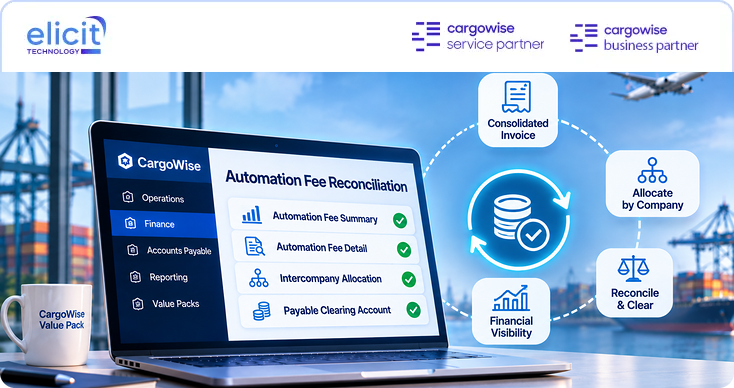
CargoWise provides dedicated reconciliation reports and intercompany recharge capabilities to support these requirements.
For multi-company freight forwarding groups, understanding these solutions can help improve cost visibility, financial accuracy, and month-end accounting.
What is the CargoWise Automation Fee Payable Clearing Account?
Under the CargoWise Value Pack billing model, eligible forwarding and customs jobs generate CargoWise Automation Fee (CWA) journals.
These journals record the applicable fees against the company, branch, and department associated with the operational activity.
The corresponding amounts are credited to the CargoWise Automation Fee Payable Clearing account.
However, the consolidated invoice is generally issued to the designated billing company rather than separately to every company generating the charges.
This creates a difference between where automation fees originate and where the invoice is processed.
The clearing account helps finance teams track these amounts until the relevant invoice, intercompany allocation, and accounting adjustments have been completed.
For businesses managing multiple legal entities, maintaining accurate clearing balances is important for understanding outstanding liabilities and ensuring that costs are allocated appropriately.
When reconciliation procedures are inconsistent, balances may remain unresolved across companies, branches, departments, or currencies.
Understanding the purpose of the clearing account is therefore essential for managing CargoWise Automation Fee transactions effectively.
Why is Monthly CargoWise Automation Fee Reconciliation Important?
Automation fees originate from operational activities, while the consolidated invoice is processed through the finance department.
These records must be reconciled to ensure that the amounts accrued against eligible jobs are appropriately accounted for.
Consider a freight forwarding group operating companies in Australia, New Zealand, and the United Kingdom.
Each company generates automation fees through its forwarding and customs activities, but the head office receives a single invoice covering the group’s usage.
The finance team needs to distinguish each company’s automation fees from other software-related charges and ensure that the correct amounts are allocated.
For example, a consolidated invoice of USD 19,300 may include USD 15,000 in disbursable automation fees, with the remaining amount relating to other Value Pack or software charges.
These charges require different accounting treatment.
Disbursable automation fees relate to amounts already recorded against eligible jobs, while other software charges are generally recognized through the appropriate expense accounts.
Without this distinction, businesses may encounter incorrect cost allocations, unexplained clearing balances, or inconsistencies in financial reporting.
A consistent monthly reconciliation process helps finance teams identify these differences and maintain more reliable accounting records.
How can CargoWise Automation Fee Reports Improve Financial Visibility?
One of the challenges in multi-company accounting is obtaining a clear picture of where automation fees originate.
Finance teams need more than a consolidated invoice. They also need visibility into the operational transactions contributing to the charges.
CargoWise provides two dedicated reports to support this requirement.
Global CargoWise Automation Fee Payable Summary Report
This report provides a consolidated view of accrued disbursable automation fees.
It helps finance teams compare company-level amounts with the corresponding billing information.
For freight forwarding groups, this creates a clearer understanding of how automation costs are distributed across participating companies.
Global CargoWise Automation Fee Payable Detail Report
The Detail Report provides a more granular view of the underlying automation fee transactions.
It can support investigations into differences across companies, branches, and departments.
For example, when a finance team identifies a discrepancy between the billed amount and the recorded accruals, detailed transaction information can help narrow the investigation.
Together, these reports support more transparent reconciliation and reduce dependence on fragmented accounting records.
However, the reports focus on disbursable automation fees. Other software-related charges must still be reviewed using the appropriate billing information.
For businesses handling large transaction volumes, effective reporting can help improve financial oversight and month-end decision-making.
How does CargoWise Intercompany Recharges Support Multi-Company Accounting?
Freight forwarding groups often share software services, operational resources, and administrative costs across multiple companies.
When one entity receives and pays a consolidated invoice, the finance team must determine how the relevant charges should be distributed.
This can become time-consuming when costs are allocated manually.
CargoWise’s Intercompany Recharges module provides a structured solution for managing shared expenses between participating companies.
The functionality supports allocating relevant costs and generating intercompany invoices based on the approved allocation.
This can be particularly useful when some charges are directly attributable to individual companies while others represent shared business expenses.
For example, automation fees associated with specific companies may require allocation based on their actual usage.
Other shared software charges may be distributed using an agreed allocation method.
The Intercompany Recharges module helps businesses manage these requirements within their CargoWise accounting environment.
It also supports maintaining relevant documentation alongside recharge transactions, improving visibility for finance teams reviewing the allocations.
For freight forwarding groups operating across several countries, this can support more consistent intercompany accounting and reduce the administrative effort involved in preparing recharge transactions.
The effectiveness of the solution depends on appropriate configuration, allocation rules, and financial controls.
Why do CargoWise Automation Fee Payable Balances Remain After Invoice Processing?
An outstanding clearing account balance does not always mean that the consolidated invoice has been processed incorrectly.
In some cases, the difference arises from how transactions are recorded across organizational units or currencies.
Two common situations deserve attention.
Branch and Department Allocation Differences
CargoWise Automation Fee journals are associated with the company, branch, and department responsible for the eligible job.
However, the related Accounts Payable invoice and intercompany transactions may be recorded against different organizational units.
As a result, the clearing account may appear settled at one reporting level while balances remain at the branch or department level.
For businesses requiring detailed financial reporting across multiple operational locations, these differences may need additional review and appropriate accounting adjustments.
Foreign Exchange Differences
Currency conversion can also affect clearing balances.
A freight forwarding group may receive a consolidated invoice in USD while individual companies maintain their accounts in AUD, NZD, GBP, or another local currency.
If the automation fee journals and corresponding invoice transactions use different exchange rates, the transaction-currency balance may be settled while a local-currency difference remains.
These differences require appropriate accounting treatment based on the organization’s financial policies.
CargoWise supports General Ledger adjustments that can help finance teams address relevant allocation and exchange differences.
Identifying the underlying cause is important before making adjustments, particularly when multiple companies and currencies are involved.
How can Freight Forwarders Improve Their Monthly CargoWise Accounting Process?
An effective month-end reconciliation process should provide finance teams with confidence that automation fees have been recorded, allocated, and cleared appropriately.
For multi-company freight forwarding businesses, several areas are particularly important.
Consistent financial data
Accurate job-related charges and accounting information provide the foundation for reliable reconciliation.
Clear separation of software charges
Disbursable automation fees and other software expenses should be distinguishable within the financial records.
Reliable intercompany allocation
Shared costs should be distributed according to the organization’s approved allocation policies.
Visibility across companies and branches
Finance teams need sufficient reporting information to understand where costs originate and investigate differences.
Appropriate currency treatment
Foreign exchange differences should be reviewed and handled consistently with the company’s accounting policies.
Timely month-end review
Outstanding balances should be investigated before the relevant accounting period is closed wherever practical.
CargoWise provides reporting, intercompany accounting, and General Ledger capabilities that can support these requirements.
However, the appropriate solution depends on the organization’s accounting structure, operational processes, and existing CargoWise configuration.
For businesses experiencing recurring reconciliation differences, reviewing the overall financial workflow can be more effective than repeatedly correcting individual balances.
How can Elicit Technology Support CargoWise Accounting and Automation Fee Reconciliation?
Managing CargoWise automation fees across multiple companies requires more than access to the right reports.
Businesses need accounting configurations, financial workflows, and reporting structures that reflect their operational requirements.
As an official CargoWise Service and Business Partner, Elicit Technology helps freight forwarders improve how they manage CargoWise accounting and financial operations.
Our CargoWise specialists can help businesses evaluate their existing automation fee reconciliation processes, identify recurring accounting challenges, and determine suitable improvements.
For example, a freight forwarding group may experience unresolved clearing balances because its intercompany allocation structure does not align with its operational reporting requirements.
Another business may need better visibility into automation fees recorded across different branches or currencies.
Elicit Technology can help assess these challenges and support the appropriate CargoWise configuration, reporting, and workflow improvements.
Our services include assistance with CargoWise accounting optimization, General Ledger configuration, intercompany accounting requirements, and financial reporting.
Rather than relying on repeated manual adjustments, businesses can work with our specialists to identify opportunities for more consistent financial processes.
The objective is to help finance teams make effective use of CargoWise’s available capabilities while maintaining accurate accounting records and reliable month-end controls.
Frequently Asked Questions
What is the purpose of the CargoWise Automation Fee Payable Clearing account?
The account records automation fee amounts associated with eligible forwarding and customs jobs until they are reconciled and cleared through the relevant accounting transactions. It helps businesses track automation fee liabilities across their CargoWise environment.
Can CargoWise help allocate automation fees between multiple companies?
Yes. CargoWise provides intercompany recharge functionality that supports allocating relevant costs between participating companies and generating corresponding intercompany invoices. The appropriate allocation approach depends on the organization’s accounting requirements.
Why does the CargoWise Automation Fee Payable Clearing account show an outstanding balance?
Outstanding balances may arise from differences in branch or department allocations, foreign exchange movements, or unreconciled transactions. Reviewing the relevant reports and accounting records can help identify the cause and determine the appropriate resolution.
Conclusion: Improve CargoWise Automation Fee Reconciliation with More Consistent Financial Workflows
Automation fee reconciliation is an important part of financial management for freight forwarding groups using CargoWise across multiple companies.
Although a consolidated invoice may simplify software billing, finance teams must still account for the fees generated by individual companies, allocate shared costs, and resolve outstanding clearing balances.
CargoWise Automation Fee Payable reports, Intercompany Recharges, and General Ledger capabilities provide useful tools for managing these requirements.
However, reliable reconciliation depends on appropriate system configuration, consistent financial data, accurate cost allocation, and effective month-end procedures.
For businesses managing complex accounting structures, improving the overall CargoWise financial workflow can help reduce recurring discrepancies and strengthen financial visibility.
Need help improving your CargoWise automation fee reconciliation and accounting processes?
Elicit Technology can help you assess your existing CargoWise environment, identify configuration or reporting gaps, and implement suitable improvements to support more efficient financial operations.
Book a Consultation with our CargoWise specialists to discuss your requirements.