









A freight forwarder in the Dominican Republic completes an import shipment and prepares an invoice covering customs clearance, inland transport, and handling charges.
The charges are recorded in CargoWise, the customer details are available, and the finance team is ready to issue the invoice. However, the transaction must also meet the electronic invoicing requirements established by the Dominican Republic’s tax authority.
A missing taxpayer registration number, incorrect electronic invoice sequence, or unsupported charge structure could prevent the invoice from being accepted.
This is where CargoWise Dominican Republic e-invoicing becomes important.
WiseTech Global’s Set up CargoWise for Dominican Republic E-Invoicing guide, published on 26 October 2026, explains how CargoWise supports electronic reporting to the Dirección General de Impuestos Internos (DGII).
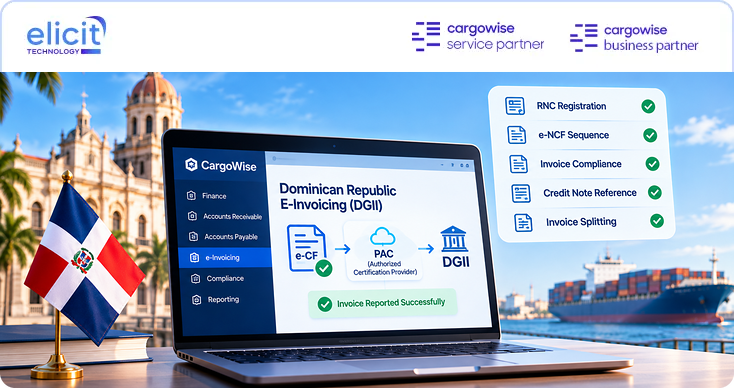
The solution enables eligible Accounts Receivable transactions to be reported electronically using the country’s Formato Comprobante Fiscal Electrónico (e-CF) standard, version 1.0, through an integrated Authorized Certification Provider (PAC).
For freight forwarders, the challenge is not simply enabling electronic invoice transmission. It is ensuring that their CargoWise financial configuration, customer information, and invoice processes meet the relevant requirements.
What is Dominican Republic E-Invoicing, and How does CargoWise Support DGII Compliance?
The Dominican Republic uses electronic fiscal documents, known as e-CF, to support tax-compliant invoicing.
These documents contain structured financial and taxpayer information that must meet the DGII’s requirements.
Unlike sending a conventional PDF invoice to a customer, electronic fiscal invoicing involves validation and authorization through the relevant electronic reporting infrastructure.
CargoWise supports this requirement through its E-Reporting and E-Invoicing solution.
According to WiseTech Global, eligible Accounts Receivable invoices and credit notes issued from a Dominican Republic CargoWise login company can be reported to the DGII through a PAC.
The PAC acts as an Authorized Certification Provider within the electronic invoicing process.
For logistics businesses, this creates a connection between their operational billing activities and electronic tax reporting.
A freight forwarder can continue managing shipment-related invoicing in CargoWise while using the supported functionality to report eligible financial transactions.
However, successful electronic reporting depends on several requirements being met before the functionality is enabled.
What are the Key CargoWise Configuration Requirements for Dominican Republic E-Invoicing?
WiseTech’s October 2026 guide identifies several configuration areas that businesses must consider.
These requirements influence whether invoices contain the correct information, whether transactions are eligible for submission, and whether errors can be identified.
| Configuration area | Why it matters |
| E-Reporting functionality | Enables eligible receivables transactions to be submitted electronically |
| Compliance document numbering | Supports mandatory electronic fiscal document numbers |
| Negative charge restrictions | Prevents unsupported negative invoice lines |
| Invoice splitting | Keeps invoices within the DGII’s documented 100-line limit |
| Credit note references | Links credit notes to their original invoices |
| Compliance sub-types | Identifies the appropriate electronic fiscal document category |
| Error notifications | Alerts designated users when electronic reporting fails |
These controls are connected to the company’s financial processes.
For example, a freight forwarder that frequently issues invoices containing many charge lines may need to review invoice splitting before electronic reporting begins.
Similarly, a business that regularly issues credit notes must ensure the original invoice information is available.
Because these settings can affect existing billing practices, configuration should be reviewed by an experienced CargoWise specialist.
Why are RNC Registration Numbers and e-NCF Sequences Important?
Two important requirements in Dominican Republic electronic invoicing are the taxpayer registration number and the electronic fiscal document number.
The Registro Nacional de Contribuyentes (RNC) identifies taxpayers registered in the Dominican Republic.
WiseTech’s documentation explains that CargoWise uses the RNC recorded against the relevant company or branch Organization Proxy when reporting invoice information to the DGII.
Customer registration information is also important because CargoWise uses organization details to prepare electronic invoice data and determine the appropriate document category.
An incorrect registration number can therefore affect electronic invoice validation.
The second requirement is the Número de Comprobante Fiscal Electrónico (e-NCF).
This is the electronic fiscal document number assigned to the transaction.
The DGII requires eligible electronic documents to contain a valid e-NCF, and CargoWise manages these numbers through Compliance Invoice Books.
Different document categories require different compliance sequences.
The WiseTech guide identifies the following electronic document types:
- TEI: Electronic Tax Credit Invoice
- TEF: Electronic Consumer Invoice
- TEG: Electronic Government Invoice
- TES: Electronic Special Regime Invoice
- TEC: Electronic Credit Note
- TED: Electronic Debit Note
Each category has its own document-type requirements.
The guide also explains that e-NCF numbers follow a 13-character structure and that the applicable sequence ranges must be obtained from the DGII.
For freight forwarders, this means invoice numbering cannot be treated as an ordinary internal reference.
The appropriate compliance sequence must be available and correctly associated with the transaction before electronic reporting.
How do Negative Charges, Credit Notes, and Invoice Limits Affect DGII E-Invoicing?
Freight forwarding invoices can contain complicated billing arrangements.
A single shipment may include ocean freight, customs clearance, terminal handling, inland delivery, and additional services.
Sometimes the finance team needs to adjust an amount or correct an earlier invoice.
However, the Dominican Republic’s electronic invoicing requirements place restrictions on how certain transactions are represented.
Negative Invoice Charges
WiseTech’s guide states that the DGII does not accept Accounts Receivable transactions containing negative charge lines.
This matters when finance teams use negative amounts to correct charges or represent adjustments.
CargoWise provides configuration controls that can prevent negative revenue charges and negative line amounts from being posted.
Businesses should review how their existing billing processes handle corrections to avoid creating transactions that cannot be successfully reported.
Credit Notes and Original Invoice References
The DGII requires electronic credit notes to contain the appropriate original invoice reference.
A credit note without that information may be rejected.
For example, if a freight forwarder needs to correct an overcharged handling fee, the credit note must maintain the required relationship with the original invoice.
CargoWise includes a control for requiring original invoice details when credit notes are created.
Maximum Invoice Charge Lines
WiseTech also documents a maximum of 100 charge lines per Accounts Receivable transaction for DGII reporting.
CargoWise supports invoice splitting to help businesses remain within this limit.
This is particularly relevant for logistics companies issuing consolidated invoices containing charges from multiple shipment activities.
These restrictions demonstrate why invoice structure and financial workflows should be reviewed before electronic reporting is introduced.
How does CargoWise Handle Electronic Invoice Processing and Error Notifications?
Once the required functionality is available, CargoWise can process eligible electronic invoices through its reporting workflow.
WiseTech identifies a dedicated Dominican Republic electronic invoice processing service task, which handles eligible Accounts Receivable invoices and credit notes.
The electronic reporting process also includes status information that helps finance teams identify whether a transaction has been processed successfully or requires attention.
For example, an invoice may fail validation because required information is missing or inconsistent.
CargoWise provides an error notification configuration that allows designated users to receive alerts when electronic invoice submissions are unsuccessful.
This helps businesses establish responsibility for investigating rejected transactions.
The WiseTech guide also describes support procedures for unresolved issues and transactions whose reporting status does not change to successful or failed within three hours.
For freight forwarders managing large invoice volumes, timely exception handling is important.
A rejected invoice can create additional administrative work and may affect the billing process until the issue is resolved.
A reliable electronic invoicing environment therefore requires more than automated submission. It also needs clear monitoring and escalation procedures.
What Electronic Invoice Details can CargoWise Display After DGII Authorization?
After a successful electronic invoice submission, CargoWise retains the relevant authorization information against the financial transaction.
WiseTech’s guide confirms that the PAC provides a PDF invoice containing the required DGII information, which is automatically attached to the transaction’s eDocs after successful authorization.
Businesses can also customize their CargoWise DocBuilder invoice templates to display additional electronic invoicing information.
These details may include the e-NCF, compliance document category, sequence expiry date, QR code, security code, and digital signature date.
The sample invoice on page 22 of WiseTech’s guide illustrates how a customer-facing document can display the electronic fiscal number, QR code, security information, and invoice amounts.
For freight forwarders, this supports the connection between the invoice maintained in CargoWise and the electronic fiscal document associated with the transaction.
It can also help finance teams respond to customer requests for invoice verification information.
However, invoice template customization should be evaluated alongside the applicable fiscal requirements and existing customer documentation needs.
Why is WiseTech’s Internal Activation Required Before Enabling E-Invoicing?
One important distinction in the Dominican Republic’s CargoWise e-invoicing process is the mandatory internal setup.
WiseTech’s guide states that completing the visible system configurations is not sufficient to begin reporting electronic invoices.
The CargoWise Product Team must also complete the required internal configuration for the relevant login company.
Businesses must submit an eRequest when they are ready to use the functionality in their test, training, or production environment.
Only after the required internal configuration has been confirmed should the final receivables electronic reporting functionality be enabled.
This requirement is particularly important for companies planning implementation timelines.
A freight forwarder should allow sufficient time for configuration review, internal activation, testing, and issue resolution before relying on electronic reporting in its production finance process.
Working with an official CargoWise Service Partner can help the business prepare its environment and coordinate the necessary support activities with WiseTech.
How can Elicit Technology Support CargoWise Dominican Republic E-Invoicing?
Dominican Republic e-invoicing involves several interconnected requirements, including registration information, compliance sequences, invoice restrictions, electronic reporting controls, and document templates.
A configuration issue in one area can affect the successful processing of financial transactions.
As an official CargoWise Service and Business Partner, Elicit Technology helps freight forwarders and logistics businesses assess their CargoWise finance environments and prepare for country-specific electronic invoicing requirements.
Our specialists can assist with reviewing existing Accounts Receivable workflows, identifying configuration gaps, evaluating compliance document requirements, and supporting testing and troubleshooting.
For businesses operating across multiple countries, Elicit can also help assess how different national e-invoicing requirements fit within their broader CargoWise accounting environment.
Our CargoWise Global E-Invoicing Integration services support organizations managing country-specific electronic invoicing requirements.
We can also assist businesses with CargoWise API services where connected systems and existing financial processes require further assessment.
Where mandatory internal activation is required, Elicit can help customers prepare their environment and coordinate the appropriate steps with WiseTech Global.
The objective is to establish a reliable electronic invoicing process without introducing unnecessary disruption to daily freight forwarding operations.
Conclusion: Is Your CargoWise Environment Ready for DGII E-Invoicing?
Dominican Republic electronic invoicing introduces requirements that affect how freight forwarders issue, validate, and manage customer invoices.
For CargoWise users, successful implementation depends on more than connecting to the tax authority.
Accurate RNC registration information, valid e-NCF sequences, appropriate invoice structures, credit note references, and reliable error monitoring all contribute to the electronic reporting process.
WiseTech Global’s October 2026 guide confirms that CargoWise supports these requirements through its integrated e-invoicing functionality and PAC connectivity.
However, businesses must complete the necessary configuration and obtain WiseTech’s internal activation before using the solution.
Need assistance preparing CargoWise for Dominican Republic e-invoicing?
Elicit Technology can help assess your current finance configuration, identify implementation requirements, and support your transition to DGII electronic reporting.
Book a consultation with our CargoWise specialists to discuss your e-invoicing requirements.