




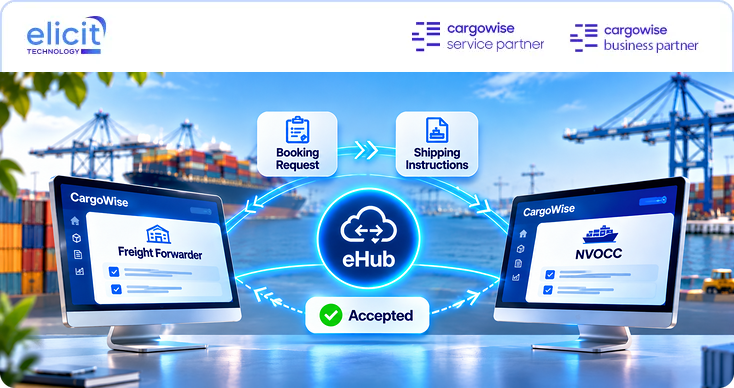




A freight forwarder sends a booking request to an NVOCC. The receiving team checks the details, verifies the shipment information, and prepares the booking in its system. Later, shipping instructions arrive, requiring another round of verification and processing.
When these activities depend on emails and manual data entry, even a straightforward booking can involve repeated communication between teams.
For Non-Vessel Operating Common Carriers (NVOCCs) using CargoWise, there is a more connected approach.
CargoWise supports the electronic receipt of Booking Requests and Shipping Instructions from other CargoWise users, allowing information to move directly between their respective systems.
The functionality helps NVOCCs establish a more structured communication process with freight forwarding customers while reducing reliance on disconnected information exchanges.
However, enabling electronic communication requires more than simply having CargoWise. Carrier identification, organization records, and system connectivity must be correctly established before electronic messages can be received and processed.
Understanding these requirements can help NVOCCs prepare their operations for more efficient electronic booking communication.
Why do NVOCCs Need Electronic Booking and Shipping Instruction Integration?
NVOCCs regularly coordinate with freight forwarders to manage ocean freight bookings and shipping documentation.
A typical shipment involves information about the booking party, shipment requirements, and instructions necessary for arranging ocean transportation.
When the sender and recipient use separate communication methods, information may need to be transferred manually between systems.
For example, a freight forwarder may prepare booking information in CargoWise but send it separately to an NVOCC through email.
The receiving team may then need to review the information and enter the relevant details into its own CargoWise environment.
This creates additional administrative work and increases the possibility of discrepancies between the sender’s original information and the recipient’s records.
Electronic booking integration addresses this challenge by supporting direct system-to-system communication.
When both parties use CargoWise and the required connectivity is established, Booking Requests and Shipping Instructions can be transmitted electronically between their systems.
This helps create a more consistent process for exchanging shipment information.
For NVOCCs managing bookings from multiple freight forwarding customers, the ability to receive information electronically can support more organized booking operations and reduce unnecessary manual handling.
How does CargoWise Electronic Booking Communication Work Between NVOCCs and Freight Forwarders?
CargoWise supports an integration process in which one CargoWise customer sends an electronic Booking Request or Shipping Instruction to another CargoWise customer operating as an NVOCC.
The communication takes place through eHub connectivity between the two CargoWise environments.
Consider a freight forwarder arranging an ocean freight shipment with an NVOCC.
The freight forwarder prepares the relevant Booking Request or Shipping Instruction within its CargoWise system.
The electronic message is then transmitted through the established connection to the recipient NVOCC’s CargoWise environment.
The receiving system processes the message, after which the NVOCC can review the request and determine whether to accept or reject it.
The integration process also supports communication back to the sender.
Depending on the outcome, the sending system can receive delivery notifications, acceptance or confirmation details, or rejection messages.
This is important because electronic communication is not limited to sending information in one direction.
Both parties need to understand whether the message reached the intended recipient and what happened after it was processed.
For example, if a booking request is rejected, the sender needs to know that the request was not accepted rather than assuming the shipment has been confirmed.
Similarly, an accepted request can be communicated back through the electronic messaging process.
The result is a more structured exchange of booking information between participating CargoWise users.
What must be Configured Before an NVOCC can Receive Electronic Bookings?
Although CargoWise supports electronic Booking Requests and Shipping Instructions, the receiving NVOCC must meet specific system requirements.
The configuration depends on accurate carrier identification, appropriate organization records, and established connectivity.
Carrier identification
The NVOCC must be represented by a Carrier Reference File in CargoWise.
This record identifies the organization as an NVOCC and includes the relevant carrier identification information.
The official guidance specifies that the record must be system-defined and contain a CargoWise code or Standard Carrier Alpha Code (SCAC).
These identifiers help CargoWise recognize the intended recipient of an electronic message.
If the carrier information is missing or incomplete, the organization may need assistance obtaining or correcting the required reference details.
Organization record alignment
The NVOCC’s Carrier Reference File must also be associated with the appropriate Organization Proxy record.
This connection helps establish the relationship between the carrier identity and the organization represented within CargoWise.
Accurate organization records are important because electronic messaging depends on identifying the correct parties.
eHub connectivity
Electronic communication between the sender’s and recipient’s CargoWise systems requires eHub connectivity.
The official process includes registration through a CR9 eRequest, with the CargoWise provider assisting in establishing connectivity between the participating systems.
Appropriate system access
Configuration activities require users with suitable administrative or management permissions.
Businesses should ensure that the personnel responsible for the integration have the necessary access and understand the existing ocean carrier messaging environment.
These requirements demonstrate why electronic booking implementation should be treated as a coordinated configuration project rather than a simple feature activation.
Why are Booking Party Organization Records Important in CargoWise?
Carrier identification establishes who receives an electronic message, but the receiving NVOCC must also identify who sent it.
This is where Booking Party Organization records become important.
For every customer expected to send electronic Booking Requests or Shipping Instructions, the NVOCC must maintain a corresponding Organization record in CargoWise.
The record is used to identify the message sender within the relevant forwarding booking or shipment.
The sender’s organization information must also be accurate.
In particular, the company name and address should correspond to the sender’s branch-level Organization Proxy record.
Consider an NVOCC receiving bookings from several freight forwarding companies.
Each customer may operate through different branches or organizational structures.
If the information in the receiving CargoWise system does not align with the sender’s corresponding records, it can create identification or message-processing difficulties.
Maintaining accurate Organization records helps establish a reliable foundation for electronic communication.
This also highlights the importance of master data management.
Even when the technical connection between two systems is available, inconsistent company details can affect the effectiveness of the integration.
NVOCCs should therefore consider customer organization data as an essential part of electronic booking readiness.
How does Electronic Messaging Help Manage Booking Acceptance and Rejection?
Receiving an electronic booking request is only one part of the process.
An NVOCC must also review the request and communicate the outcome to the sending freight forwarder.
CargoWise’s NVOCC integration message flow supports several communication outcomes.
When a sender transmits a Booking Request or Shipping Instruction, eHub identifies the intended recipient and attempts to deliver the message.
The process includes delivery notifications that indicate whether the message was successfully sent or whether a technical issue prevented delivery.
Once the message reaches the receiving CargoWise environment, the NVOCC can process the request.
If the request is accepted, the sender can receive the relevant acceptance and confirmation details.
If the request is rejected, the sender can receive a rejection message.
This distinction between technical delivery and operational acceptance is particularly important.
A successfully delivered message does not automatically mean the NVOCC has accepted the booking.
For example, a freight forwarder may submit a request that reaches the NVOCC’s system successfully, but the receiving team may still need to review shipment requirements before accepting it.
Electronic acknowledgements and responses help communicate these different stages.
For freight forwarders and NVOCCs, this can provide a clearer understanding of message status and reduce the need for separate follow-up communication.
What should NVOCCs Consider Before Implementing Electronic Booking Integration?
For an NVOCC handling numerous bookings, electronic communication can become an important part of daily operations.
However, implementation should reflect the organization’s existing processes and customer relationships.
One consideration is the current ocean carrier messaging setup.
The NVOCC should already be familiar with and appropriately configured for CargoWise ocean carrier messaging functionality.
Another consideration is the number of customers expected to exchange electronic messages.
An organization working with several CargoWise-based freight forwarders may need to review multiple Booking Party records and ensure that customer information is consistent.
Businesses should also consider how their operational teams will handle incoming requests.
Electronic receipt does not eliminate the need to review booking information or make acceptance decisions.
Instead, it changes how requests enter the workflow and how responses are communicated.
Staff should understand the distinction between a message being delivered, a request being accepted, and a request being rejected.
Finally, organizations should verify that the necessary carrier and organization information is available before proceeding with connectivity arrangements.
Addressing these considerations early can help create a more reliable electronic communication environment.
How can Elicit Technology Help NVOCCs Enable CargoWise Electronic Booking Integration?
For NVOCCs, the value of electronic booking integration depends on how effectively it connects with existing CargoWise operations.
A correctly established connection can support the exchange of Booking Requests and Shipping Instructions, but the underlying configuration must also reflect the organization’s carrier identity, customer relationships, and operational requirements.
As an official CargoWise Service and Business Partner, Elicit Technology helps freight forwarding and logistics businesses implement, configure, and optimize CargoWise solutions.
Our specialists can assist NVOCCs in assessing their readiness to receive electronic Booking Requests and Shipping Instructions from other CargoWise users.
This includes reviewing relevant carrier and organization records, identifying configuration requirements, and helping businesses prepare their CargoWise environment for electronic messaging.
For organizations managing several customer relationships, Elicit Technology can also support the review of Booking Party information and related system configuration.
Where connectivity registration or provider-side assistance is required, our team can help businesses understand the prerequisites and coordinate their preparation for the official process.
Through our CargoWise implementation, configuration, and integration services, we help logistics businesses align system capabilities with their operational workflows.
The objective is not simply to enable electronic communication, but to help NVOCCs establish a reliable process for receiving and managing booking information from connected CargoWise customers.
Conclusion: Build More Connected NVOCC Booking Operations with CargoWise
For NVOCCs working with CargoWise-based freight forwarders, electronic Booking Requests and Shipping Instructions offer an opportunity to improve how shipment information moves between organizations.
Instead of relying entirely on separate communication channels, participating businesses can exchange booking information through connected CargoWise environments.
However, successful implementation depends on accurate carrier identification, customer Organization records, and properly established eHub connectivity.
The process also requires a clear understanding of how electronic requests are received, reviewed, accepted, or rejected.
With the right configuration and operational preparation, NVOCCs can establish a more consistent approach to managing booking communication with their freight forwarding customers.
Looking to enable electronic Booking Requests and Shipping Instructions in CargoWise?
Elicit Technology can help you review your existing CargoWise setup, identify integration requirements, and prepare your system for electronic booking communication.
Book a Consultation with our CargoWise specialists to discuss your NVOCC integration requirements.