










CargoWise e-invoicing guidance highlights different electronic invoice reporting requirements across four countries, helping freight forwarders understand the configurations needed for compliant financial operations.
Electronic invoicing is changing how freight forwarders manage their financial transactions across international markets. As governments introduce structured digital invoice requirements, businesses must ensure their accounting systems can generate, validate, and process invoices according to local regulations.
For CargoWise users, these changes involve more than replacing PDF invoices with electronic documents. Each country has different reporting platforms, tax identifiers, invoice formats, and submission procedures.
WiseTech Global has published how to set-up CargoWise e-invoicing guidance covering Poland, Belgium, Germany, and the Dominican Republic, outlining how freight forwarders can prepare their systems for country-specific electronic invoicing.
Poland: CargoWise Integration with the KSeF E-Invoicing Platform
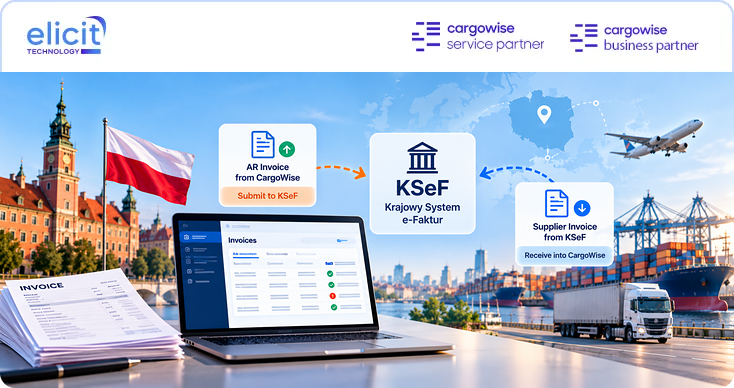
Poland’s electronic invoicing framework operates through Krajowy System e-Faktur (KSeF), the country’s national electronic invoicing platform.
WiseTech Global’s guidance, published on 21 October 2026, explains how CargoWise integrates with KSeF to support electronic invoice submission and receipt.
Eligible Accounts Receivable (AR) invoices posted by Polish login companies can be automatically transmitted to KSeF through the integration.
Once submitted, KSeF validates the invoice and returns its processing result. Successfully accepted invoices receive a KSeF invoice number and an Official Receipt Certificate (UPO).
CargoWise also supports importing supplier invoices received through KSeF into Accounts Payable (AP) workflows.
What should freight forwarders configure?
Businesses need to maintain valid KSeF authentication certificates, Polish VAT registration details, tax mappings, and electronic reporting settings.
For supplier invoice processing, CargoWise can route incoming invoices through Transactions Pending Allocation or the Payables Invoice Processing Portal.
The supplier invoice import functionality must be enabled separately because it is disabled by default.
These capabilities can help logistics businesses reduce manual invoice handling while maintaining the information required for Polish electronic tax reporting.
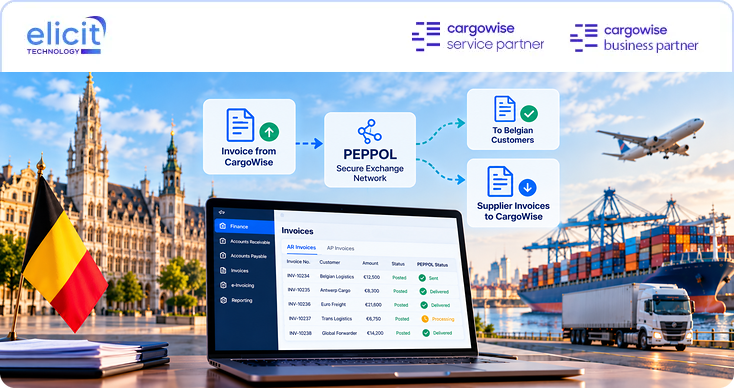
Belgium: CargoWise Supports PEPPOL-Based B2B E-Invoicing
Belgium introduced mandatory structured electronic invoicing for domestic transactions between VAT-registered businesses from 1 January 2026.
WiseTech Global’s CargoWise configuration guidance, published on 22 October 2026, explains how the platform supports electronic invoice exchange through the PEPPOL network.
CargoWise converts eligible AR transactions into structured UBL XML invoices that comply with EN 16931 and PEPPOL BIS Billing 3.0 requirements.
These invoices can then be transmitted through WiseTech Global’s PEPPOL Access Point to the recipient’s registered endpoint.
CargoWise also supports receiving supplier invoices through PEPPOL and processing them within its AP workflows.
What should freight forwarders configure?
Belgian companies must maintain accurate BTW registration numbers for their issuing entities and customers.
They should also review Tax ID Posting Groups, VAT exemption messages, PEPPOL endpoint details, and electronic reporting service tasks.
For incoming supplier invoices, businesses must complete the required PEPPOL registration and configure the appropriate processing workflow.
Correct registration information is particularly important because CargoWise uses it to identify the recipient’s PEPPOL endpoint.
Germany: CargoWise Generates XRechnung for Government Invoicing
Germany’s XRechnung format supports structured electronic invoicing in accordance with European standard EN 16931.
WiseTech Global’s German configuration guide, updated on 2 January 2025, explains how CargoWise generates XRechnung invoices for eligible transactions addressed to the German Federal Government.
When an AR invoice is posted, CargoWise maps the transaction information into the required electronic format.
After validation, the XRechnung XML file is attached to the invoice’s eDocs record.
Users can then submit the file through the applicable ZRE or OZG-RE government invoice submission channel.
Unlike Poland’s KSeF integration and Belgium’s PEPPOL exchange, the process described in this guide involves generating the structured invoice for subsequent government submission.
What should freight forwarders configure?
Businesses must maintain the issuing organisation’s German VAT identifier, official invoicing contact details, and bank IBAN information.
Government customers must also have their Leitweg-ID, a unique routing identifier, correctly recorded.
CargoWise requires the relevant E-Reporting service task to be active, while error notifications help teams identify invoices that fail validation.
Accurate master data is essential because missing mandatory information can prevent the XRechnung file from being generated.
Dominican Republic: CargoWise Supports DGII Electronic Tax Reporting
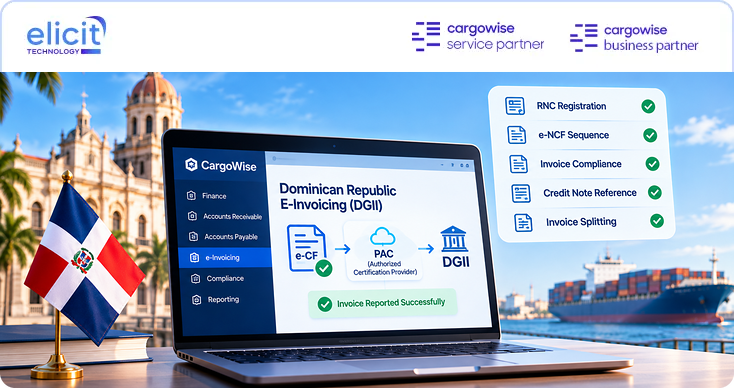
On 26 October 2026, WiseTech Global published guidance for configuring CargoWise electronic invoicing in the Dominican Republic.
The solution supports automatic reporting of eligible AR invoices and credit notes to the Dirección General de Impuestos Internos (DGII), the country’s tax authority.
CargoWise uses an integrated connection with an authorised certification provider (PAC) to support the country’s e-CF electronic tax document format.
Once an eligible transaction is successfully authorised, the relevant information is recorded in CargoWise.
An authorised PDF invoice provided by the PAC is also attached to the transaction’s eDocs record.
What should freight forwarders configure?
Businesses must maintain their Dominican Republic RNC taxpayer registration numbers and configure electronic tax document numbering through Compliance Sequence Books.
Each eligible transaction requires an e-NCF, the electronic tax document number assigned using DGII-approved number sequences.
The guidance also recommends preventing negative invoice charge lines, limiting invoices to 100 charge lines, and requiring original invoice references for credit notes.
Before enabling electronic reporting, businesses must request mandatory internal configuration from the CargoWise Product Team.
These settings help ensure that invoice data meets the DGII’s validation requirements.
How Elicit Technology Supports CargoWise E-Invoicing?
Electronic invoicing compliance depends on how accurately financial data, tax configurations, customer records, and automated workflows are maintained.
As a CargoWise Platinum Service Partner, Elicit Technology supports freight forwarders with CargoWise accounting configurations, system integrations, workflow optimisation, and automation.
Our team helps businesses review their existing CargoWise environments, identify configuration gaps, and prepare country-specific invoicing workflows.
Whether your operations involve KSeF, PEPPOL, XRechnung, or DGII electronic reporting, the right configuration can help improve invoice accuracy, reduce manual processing, and support regulatory compliance.