






A freight forwarder in Germany receives an invoice from a transport subcontractor. The document arrives as a PDF, contains the correct charges, and looks ready for processing.
But does it meet Germany’s electronic invoicing requirements?
Since 1 January 2025, Germany has been transitioning to mandatory structured electronic invoicing for domestic business-to-business (B2B) transactions. This means finance teams must look beyond whether an invoice can be opened, read, or emailed. They need to understand whether it contains the structured data required under German rules.
For logistics businesses using CargoWise, the practical questions are more specific. Can CargoWise generate XRechnung invoices? Can it receive ZUGFeRD invoices from suppliers? How should electronic invoice files be exchanged, validated, and processed?
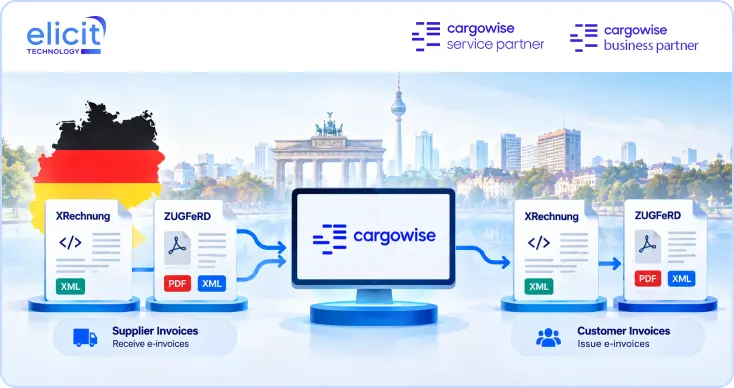
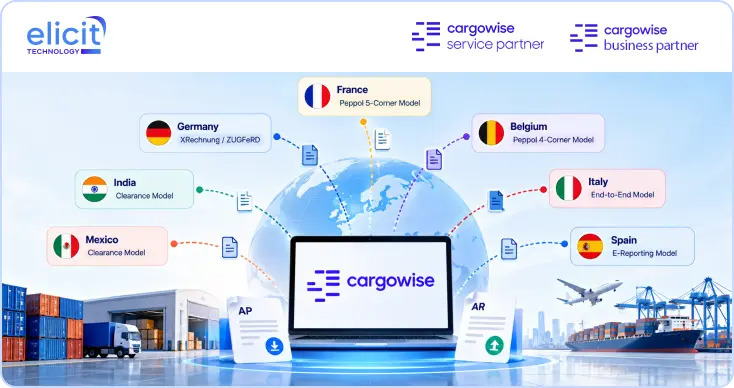
WiseTech Global’s 2 October 2026 E-Invoicing Support Matrix confirms that CargoWise supports both receivables and payables electronic invoicing for Germany, using XRechnung and ZUGFeRD formats within its documented optional e-invoicing model.
However, supported functionality does not mean every German invoicing requirement is automatically fulfilled.
This guide explains Germany’s e-invoicing requirements, the differences between XRechnung and ZUGFeRD, how the documented CargoWise processes work, and how Elicit Technology can help freight forwarders prepare their invoicing operations.
Why is Germany’s E-Invoicing Requirement Important for Freight Forwarders?
Freight forwarding involves more than sending a single invoice to a customer.
A shipment may involve carrier charges, terminal handling, inland transportation, customs-related services, warehousing, and other costs. The freight forwarder must manage supplier invoices, allocate costs appropriately, and issue customer invoices.
When these activities involve German domestic B2B transactions, the relevant electronic invoicing requirements may apply.
Germany’s transition is particularly important because a conventional PDF invoice is not automatically considered a structured electronic invoice under the new rules.
For finance teams, this changes how invoices should be prepared and received.
Instead of relying only on a document that employees can read, businesses must consider whether invoice information is available in the required structured format and whether their accounting processes can handle it.
For freight forwarders operating multiple branches or legal entities, the challenge becomes more complex. A German entity may need to follow different invoicing requirements from branches operating in France, Belgium, or other countries.
That is why Germany’s e-invoicing transition should be treated as a finance-process requirement, not simply a document-format change.
What are Germany’s E-Invoicing Deadlines for 2025–2028?
Germany introduced its domestic B2B electronic invoicing transition on 1 January 2025, with different obligations for receiving and issuing invoices.
The implementation is phased rather than requiring every business to issue structured electronic invoices immediately.
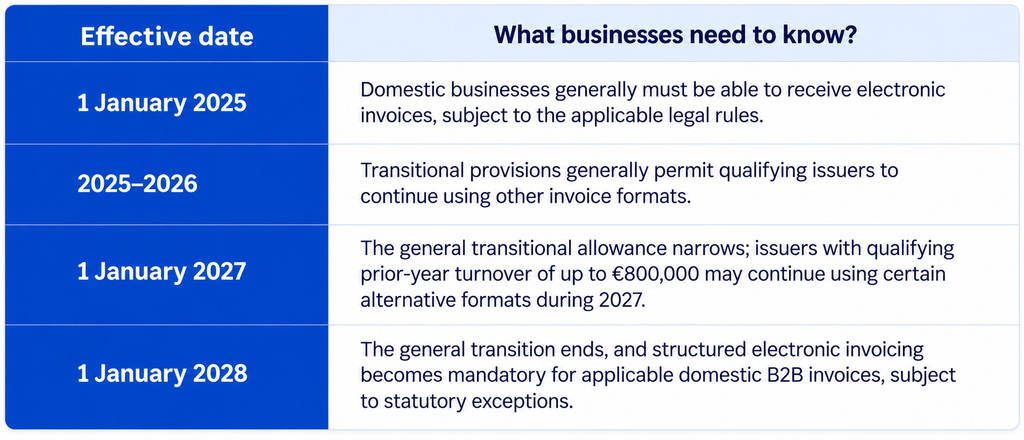
These dates affect how businesses should plan their CargoWise e-invoicing processes.
A company that currently receives structured invoices but continues issuing conventional PDFs may need to change its outgoing invoice workflow before the applicable transition ends.
The deadlines also make it important to distinguish between receiving an electronic invoice and issuing one. The legal requirements and transition periods are not identical.
Germany also provides exceptions for certain invoice categories, including qualifying small-value invoices and specific transport tickets. Businesses should confirm which transactions fall within the legal scope rather than assuming that every invoice follows the same rule.
What is the Difference Between XRechnung and ZUGFeRD?
Both formats can meet Germany’s electronic invoicing requirements, but they present invoice information differently.
XRechnung — structured XML
XRechnung is a structured electronic invoice format designed for machine-readable processing. Unlike a conventional PDF, the invoice is represented as structured data that compatible software can validate and process.
ZUGFeRD — PDF with embedded XML
ZUGFeRD combines a human-readable PDF/A-3 document with structured XML invoice data. This allows employees to view the invoice while compatible systems process its embedded data.
Germany’s Federal Ministry of Finance recognizes compliant XRechnung and ZUGFeRD formats, including qualifying ZUGFeRD versions from 2.0.1 onward. However, not every ZUGFeRD profile qualifies: the MINIMUM and BASIC-WL profiles are excluded from the recognized formats described in the ministry’s guidance.
For a freight forwarder, the distinction affects how invoices are received, reviewed, and processed.
A carrier may send an XRechnung XML file that requires a compatible viewer for employees to read. Another supplier may send a ZUGFeRD document that looks like a normal PDF but also contains structured invoice data.
The receiving process should recognize the relevant format and preserve the information needed for accounting and compliance.
One particularly important point is that the structured XML data takes precedence over the visual PDF component when the two disagree in a hybrid invoice. Finance teams should therefore validate the structured information rather than relying exclusively on what appears on screen.
Does CargoWise Support XRechnung and ZUGFeRD in Germany?
Yes. WiseTech Global’s official E-Invoicing: List of Supported Countries, published on 2 October 2026, confirms support for both issuing receivables invoices and receiving payables invoices in Germany.
The document identifies an optional e-invoicing model without a government connection or third-party provider.
Its supported processes are:
Accounts Receivable — outgoing invoices
CargoWise maps the receivables invoice into UBL XML in XRechnung format and uploads the resulting XML invoice to eDocs. The user can then send the file using the chosen delivery method.
Accounts Payable — incoming invoices
Users can send supplier invoices in XRechnung or PDF/A-3 ZUGFeRD format to a dedicated mailbox for import into CargoWise as AP invoices.
This distinction is important: the WiseTech document confirms XRechnung output for AR and XRechnung/ZUGFeRD input for AP. It does not establish that CargoWise natively generates outgoing ZUGFeRD invoices under the same documented model.
For freight forwarders, the capability creates an opportunity to manage structured invoice information within the CargoWise finance environment without automatically introducing a separate government-connected clearance process.
It also means the implementation must define how outgoing invoices are delivered, how incoming files are processed, and how exceptions are handled.
How can Freight Forwarders Set Up Germany E-Invoicing in CargoWise?
A successful setup starts with the invoicing process, not simply the document format.
Consider a German freight forwarder that invoices customers for ocean freight, terminal handling, customs clearance services, and inland transportation. The same company receives invoices from carriers, subcontractors, and warehouse providers.
The implementation should account for both directions.
First, review the CargoWise financial environment. Confirm which legal entity issues the invoice, how customer and supplier records are maintained, how charges and taxes are represented, and whether the required invoice information is available.
Next, prepare outgoing XRechnung processing. CargoWise’s documented model converts receivables invoice information into structured XRechnung XML. The business needs to ensure the source data is accurate, the generated output is valid, and the agreed delivery method meets the recipient’s requirements.
Then, establish incoming invoice processing. Supplier XRechnung and ZUGFeRD files can be routed to the dedicated mailbox used for CargoWise AP import. Finance teams should confirm how imported information is reviewed, matched to the appropriate supplier and transaction, and handled when information is incomplete or incorrect.
Finally, test the complete process. This should include realistic customer invoices, carrier invoices, invoices with multiple charge lines, tax variations, corrections, and rejected or invalid files.
The goal is not simply to prove that CargoWise can create or import an XML document. It is to confirm that the electronic invoice can move through the intended finance process with accurate information and appropriate controls.
What Common E-Invoicing Issues should German Finance Teams Check?
Even when a system supports the required format, the underlying invoice data and business process can still create problems.
For freight forwarders, some of the most important checks include:
Missing or incorrect invoice information. Customer tax identifiers, supplier details, invoice references, tax treatment, and other mandatory information should be reviewed before electronic invoices are issued.
Incorrect format or profile. A PDF alone is not a structured e-invoice. Likewise, the presence of XML inside a document does not guarantee that the file meets the applicable German requirements.
Differences between visual and structured data. For ZUGFeRD invoices, finance teams should confirm that the XML reflects the intended invoice information, since the structured component is authoritative under the German rules.
Supplier invoice matching. An imported electronic invoice still needs to be associated with the correct supplier, costs, and accounting records. Electronic import does not eliminate the need for appropriate validation and approval.
Archiving and retention. German tax rules generally require invoices to be retained for eight years. For electronic invoices, at least the structured component must be preserved intact in its original form. Businesses should verify that their retention arrangements meet applicable requirements rather than assuming that an ordinary PDF archive is sufficient.
These checks are particularly relevant for logistics businesses processing large volumes of invoices from multiple carriers, agents, and subcontractors.
How can Elicit Technology Help with CargoWise Germany E-Invoicing Integration?
As an official CargoWise Service and Business Partner, Elicit Technology helps logistics businesses prepare their CargoWise environment for Germany’s structured electronic invoicing requirements.
Our approach begins with understanding the customer’s invoicing process, CargoWise financial configuration, German legal entities, supplier invoice flow, and applicable XRechnung and ZUGFeRD requirements.
From there, Elicit supports the relevant configuration, invoice data mapping, receiving and issuing workflows, testing, and exception handling. We also help teams validate real transaction scenarios before go-live and provide ongoing support as invoicing requirements and business processes evolve.
This is especially valuable for freight forwarders that want to manage German electronic invoicing alongside their existing CargoWise shipment, billing, and accounting processes.
Explore Elicit’s dedicated CargoWise Germany E-Invoicing Integration service to understand the implementation approach and available support.
Prepare Your CargoWise Finance Operations for Germany’s E-Invoicing Requirements
Germany’s electronic invoicing transition changes how domestic B2B invoices must be issued and received. For freight forwarders, the impact extends beyond document formatting to invoice data quality, supplier processing, accounting controls, and electronic record retention.
CargoWise’s documented support for XRechnung receivables output and XRechnung/ZUGFeRD payables import provides a useful foundation. However, successful implementation depends on configuring those capabilities around the company’s actual invoicing requirements.
With the 2027 and 2028 issuing milestones approaching, businesses should review their existing processes, identify gaps, and test structured invoice handling before the relevant deadline.
Elicit Technology can help you assess and prepare your CargoWise environment for Germany’s e-invoicing requirements. Book a consultation to discuss your current configuration and implementation needs.