About Us

Discover who powers your CargoWise success.

Careers

Join our global logistics technology team.

Contact Us

Talk to CargoWise experts about your goals.

CargoWise Resources

Your Complete CargoWise Support Destination

From implementation to automation, optimize every process with expert CargoWise guidance.

Glossary

Browse key logistics and CargoWise terms.

CargoWise Resources

Your Complete CargoWise Support Destination

From implementation to automation, optimize every process with expert CargoWise guidance.

Incoterms

Understand Incoterms to make informed global shipping decisions.

CargoWise Resources

Your Complete CargoWise Support Destination

From implementation to automation, optimize every process with expert CargoWise guidance.

CargoWise ASYCUDA Integration: One Filing System, Dozens of Countries, Still One Integration

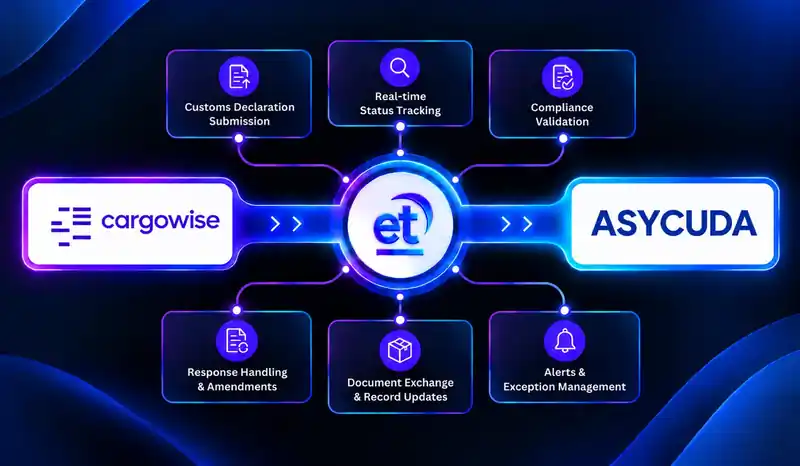
CargoWise ASYCUDA integration files customs declarations directly with the ASYCUDA platform used across most African customs authorities, mapped to handle country-specific variations without a separate build for each one.

Book a Call CargoWise and ASYCUDA integration diagram showing connected systems
ASYCUDA and CargoWise Next customs integration

The Same Platform, Different Rules in Every Country

ASYCUDA's biggest advantage for a forwarder operating across Africa is also its biggest trap, it's the same underlying system in dozens of countries, but each customs authority configures its own tariff structures, document requirements, and validation rules on top of it. A filing process built for one ASYCUDA-running country doesn't automatically work for the next one, and manually adjusting for that country by country is exactly where declarations start getting rejected.

CargoWise ASYCUDA integration is built to handle that variation directly, filing correctly whether you're clearing goods in Kenya, Nigeria, Zambia, or another ASYCUDA-based customs authority.

Here is Our Complete CargoWise‑ASYCUDA Integration Process Flow

01

Discovery & Analysis

We analyse your CargoWise setup and the specific ASYCUDA configuration used by each customs authority you operate in, identify country-level variations in tariff structure and required fields, and confirm what each authority's implementation expects.

02

Data Mapping

We map shipment, consignment, and declaration fields to ASYCUDA's expected format, with transformation and validation rules built in per country configuration, not a single generic mapping applied everywhere.

03

Build & Configure

We develop the API or EDI connections appropriate to each country's ASYCUDA implementation, configure both CargoWise and the customs authority's system, and build in error handling and submission monitoring.

04

Testing for Compliance

We run thorough tests against real declaration scenarios per country with your operations and compliance teams, confirming submissions meet each authority's specific regulatory requirements before go-live.

05

Go-Live & Hypercare

Controlled cut-over with close monitoring through your first cycle of live submissions in each jurisdiction, catching country-specific issues before they affect clearance.

06

Monitor, Support & Train

Ongoing monitoring of submission status and rejections, exception handling, and team training to keep the integration running smoothly as individual countries update their ASYCUDA configurations independently.

What CargoWise ASYCUDA Integration Delivers?

01

One Integration Framework, Multiple Countries

A single underlying integration handles country-specific tariff and field variations, instead of requiring a separate build for each customs authority.

02

Country-Specific Validation, Not a Generic Template

Tariff classifications and duty data are validated against each authority's actual configuration before submission.

03

Reference Numbers Carried Through Automatically

Shipment and declaration references travel with each filing, regardless of which country's ASYCUDA instance it's routed through.

04

Fewer Rejections From Cross-Country Assumptions

Filings built for the correct country configuration reduce the errors that come from applying one country's rules to another.

05

Real-Time Status Visibility, Country by Country

Clearance confirmations and rejections flow back into CargoWise automatically, regardless of jurisdiction.

06

Built to Scale as You Expand Into New Countries

Adding a new ASYCUDA-running country means configuring that jurisdiction's specific rules, not rebuilding the integration from scratch, so growth into new markets doesn't multiply the setup effort.

Why Choose Elicit for CargoWise ASYCUDA Integration?

One Team, Start to Finish

/01

Whoever builds your integration is who you call when something needs adjusting, across every country you operate in.

/02

Built to Handle Multi-Country Variation, Not Just One Instance

Mapping accounts for the fact that ASYCUDA isn't configured identically everywhere.

/03

Our Own Middleware, Fully Owned

We build and run the integration layer directly, no third-party black box.

/04

Full Environment Discipline

Development, UAT, and production each get dedicated setup and testing before touching live filings, per country where needed.

/05

Hypercare Built Into Go-Live

Two weeks of active monitoring follow deployment.

Contact Us

Looking for the Right CargoWise Partner to Support Your Growth?

Elicit Technology helps logistics businesses simplify CargoWise through implementation, integration, automation, configuration, BI dashboards, live setup, and ongoing support.

Full name is required
Valid email is required
Message is required
Frequently Asked Questions

Happy to Assist You with Anything

Not without configuration for each. The underlying integration framework is reusable, but each country's tariff structure and required fields are mapped individually during setup, since ASYCUDA implementations aren't standardized country to country.

Significantly less than starting from scratch, the framework and much of the mapping logic carry over. What's added is the country-specific tariff and field configuration for the new jurisdiction.

We track each country's configuration independently, so an update in one jurisdiction doesn't require touching the integration for countries that haven't changed.

Both are assessed during discovery, since some countries still run earlier ASYCUDA versions alongside others on ASYCUDA World, and the integration approach depends on which version a given authority uses.

Managing each country as a completely separate project means duplicating discovery, testing, and support overhead every time you expand. A unified framework means expanding into a new ASYCUDA country is a configuration exercise, not a new integration built from zero.

ASYCUDA is used across more than 90 countries and territories, most heavily concentrated in Africa, but also active in parts of Asia, Latin America, and the Caribbean, with each country running its own configuration on the shared platform.

Latest from our blogs

View All Blogs