







Captured once, with the place
Incoterm and named place made mandatory at booking or shipment entry, including bookings that come in through CargoWise Neo, so every later step reads the same value.
Quote faster with automated freight pricing.
Capture purchase orders straight into CargoWise.
Turn sales orders into shipment records.
Create bookings automatically from incoming requests.
Build shipments from documents without retyping.
Process vendor invoices faster with accuracy.
Collect payments faster with automated follow-ups.
Launch transport jobs with zero manual steps.
Push shipments into warehouse workflows instantly.
Launch CargoWise with the right foundation.
Onboard new entities faster with confidence.
Control access without slowing teams down.
Share and approve documents without delays.
Remove bottlenecks with smarter workflows today.
Keep master data clean and compliant.
Migrate to Neo with lower operational risk.
Connect systems securely with eAdaptor Next.
Deploy CargoWise patches safely every time.
Sync orders between systems in real time.
Push bookings into CargoWise automatically.
Keep shipment data synced across platforms.
Group shipments into consols automatically.
Update house bills as documents finalize.
Keep party details synced across systems.
Publish milestone updates to customers instantly.
Update customs fields from connected systems.
Attach job documents automatically from anywhere.
Manage CargoWise jobs through secure APIs.
Expose live tracking data to your portals.
Sync CargoWise billing with Xero seamlessly.
Automate QuickBooks entries from shipment data.
Connect Dynamics finance with CargoWise billing.
Bridge Sage ledgers with logistics accounting.
Link Oracle ERP with shipment workflows.
Sync retail orders with freight operations.
Unify MYOB EXO with CargoWise finance.
Connect retail sales with shipment execution.
Automate credit workflows alongside receivables.
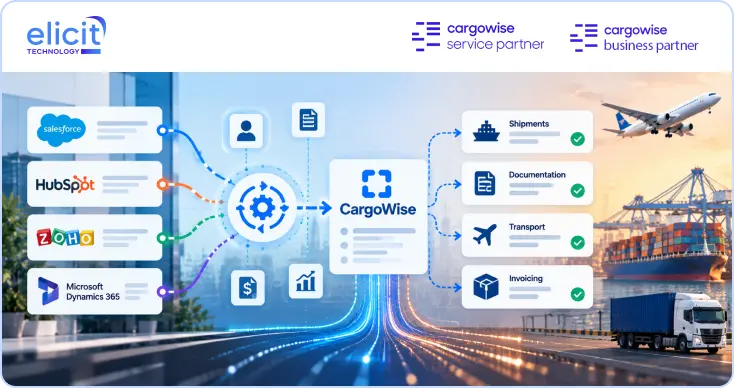 How to Integrate CargoWise with Salesforce, HubSpot, Zoho or Microsoft Dynamics CRM?
Oct 6, 2026
How to Integrate CargoWise with Salesforce, HubSpot, Zoho or Microsoft Dynamics CRM?
Oct 6, 2026
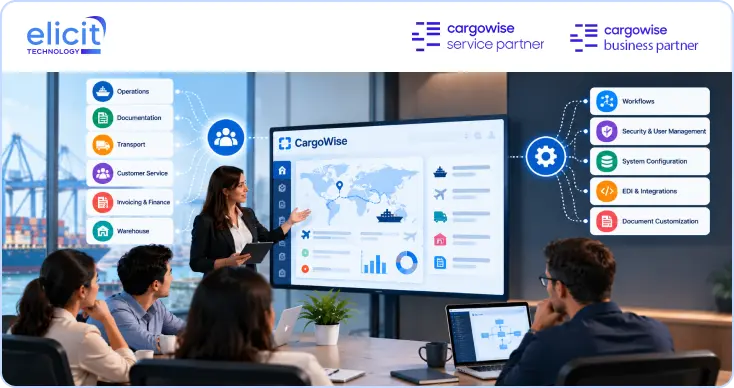 Training New CargoWise Users: Functional vs Technical Training Explained
Oct 6, 2026
Training New CargoWise Users: Functional vs Technical Training Explained
Oct 6, 2026
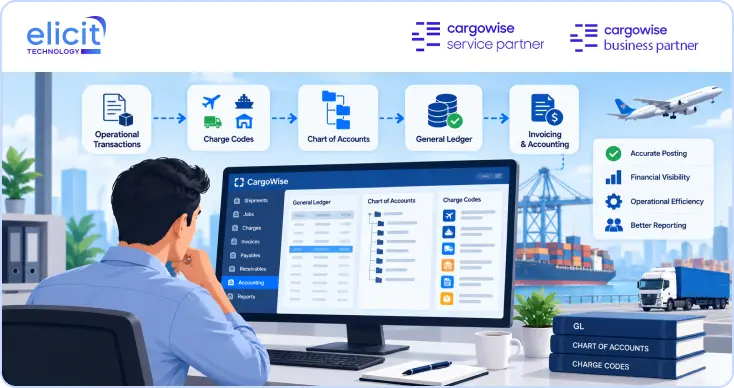 Financial Automation in CargoWise: Getting GL, COA and Charge Codes Right
Sep 30, 2026
Financial Automation in CargoWise: Getting GL, COA and Charge Codes Right
Sep 30, 2026
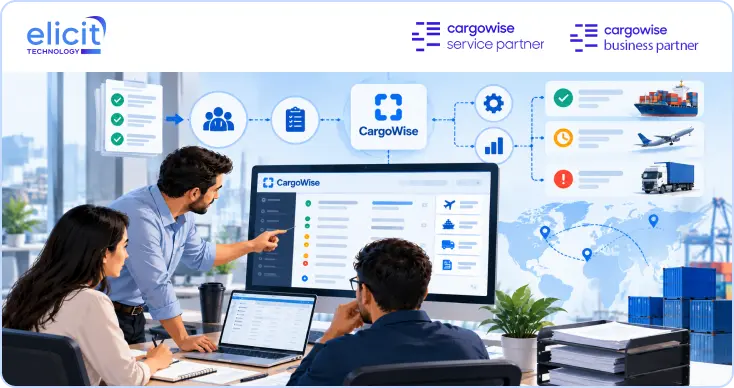 10 Mistakes to Avoid During a CargoWise Implementation
Sep 30, 2026
10 Mistakes to Avoid During a CargoWise Implementation
Sep 30, 2026
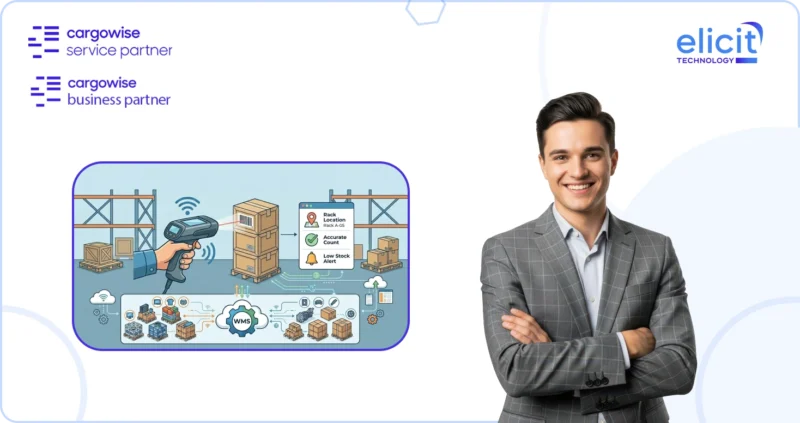 How a U.S.-Based Warehouse Customer Reduced Manual Errors with RF Gun Scanner Optimization?
Jun 12, 2026
How a U.S.-Based Warehouse Customer Reduced Manual Errors with RF Gun Scanner Optimization?
Jun 12, 2026
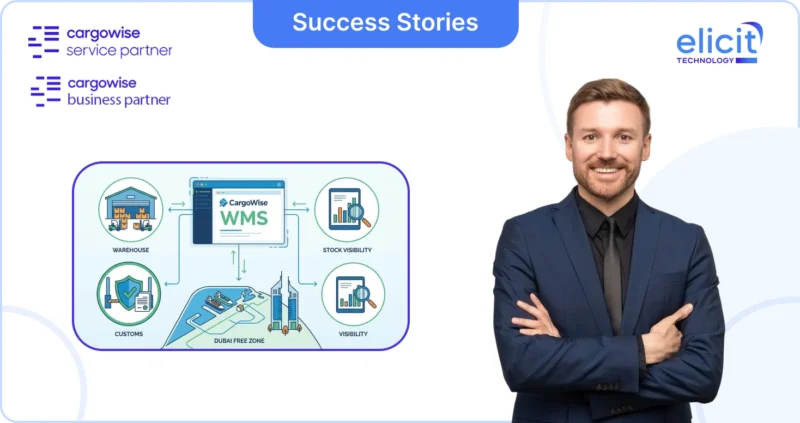 How a Dubai Free Zone 3PL Improved Warehouse, Customs, and Stock Visibility with CargoWise WMS Implementation?
May 21, 2026
How a Dubai Free Zone 3PL Improved Warehouse, Customs, and Stock Visibility with CargoWise WMS Implementation?
May 21, 2026
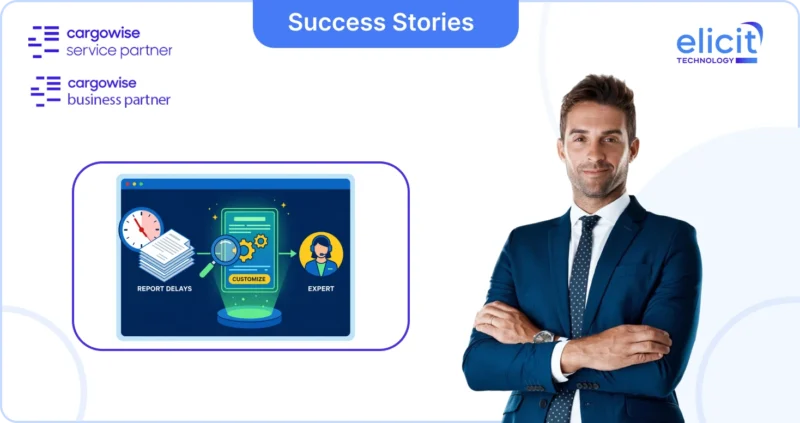 How a Freight Forwarder Reduced CargoWise Report Delays with Expert Report Customization?
May 21, 2026
How a Freight Forwarder Reduced CargoWise Report Delays with Expert Report Customization?
May 21, 2026
 How Elicit Technology Streamlined Transglobal Cargo’s CargoWise System with Tailored Workflows and Smart Configuration
Apr 24, 2025
How Elicit Technology Streamlined Transglobal Cargo’s CargoWise System with Tailored Workflows and Smart Configuration
Apr 24, 2025
 Elicit Technology Among the First Three CargoWise Service Partners Worldwide to Achieve PAVE Certification
Oct 12, 2026
Elicit Technology Among the First Three CargoWise Service Partners Worldwide to Achieve PAVE Certification
Oct 12, 2026
 Elicit Technology Achieves CargoWise Gold Customs Competency: A New Milestone in Compliance Expertise
Oct 12, 2026
Elicit Technology Achieves CargoWise Gold Customs Competency: A New Milestone in Compliance Expertise
Oct 12, 2026
 CargoWise and PortConnect Integration Brings Near Real-Time Container Events into Landside Planning
Oct 5, 2026
CargoWise and PortConnect Integration Brings Near Real-Time Container Events into Landside Planning
Oct 5, 2026
 A Milestone Built on Expertise, Trust, and Delivery: Elicit Technology’s CargoWise Recognition
Sep 28, 2026
A Milestone Built on Expertise, Trust, and Delivery: Elicit Technology’s CargoWise Recognition
Sep 28, 2026
Connect with a certified CargoWise partner for implementation, integration, and long-term support.
Streamline transport operations with integrated Transtream workflows and connected logistics data.
Expand your reach with cloud-based transportation solutions built for scalable freight operations.
Three letters on a contract decide where risk changes hands, who books the freight, who clears customs and who gets the invoice. This guide puts all eleven rules on one handover line, then shows how the term on each job should drive billing in CargoWise.
Same cargo, same lane. Change the three letters and every line on the job changes with it.
The International Chamber of Commerce (ICC) publishes eleven rules. A rule only works when it travels with a named place and the edition. Tap each part to see what it does.
Pick a term. The top band shows who carries the risk at each point of the journey. The second shows who pays. Where the seller is still paying but the buyer already carries the risk, the gap is marked. That gap is where most C-term arguments come from.
Swipe the line sideways →
Who pays each part of the move under all eleven rules. Filter by mode or group. Click any row to see it on the handover line. Download it or print it as a one-page sheet for your sales and operations desks.
| Rule | Export clearance | Origin handling & loading | Main carriage | Insurance | Destination terminal | Unloading at place | Import clearance & duty | Risk passes at |
|---|
Two or three questions about how the cargo moves and how far the seller’s job should go. You get a best fit, an alternative, and the one thing to watch.
In many CargoWise setups the Incoterm is typed in and then ignored. Charges are added by hand, the freight is marked prepaid or collect from memory, and nobody checks the term on the commercial invoice. Pick a term to see what a well-configured job does with it.
Each readout is a starting point we use when mapping a forwarder’s billing rules.
Assumes you are the forwarder arranging the main carriage for the party that pays for it. Real setups vary by client, lane and agent agreement, which is why we map before we configure.
Incoterm and named place made mandatory at booking or shipment entry, including bookings that come in through CargoWise Neo, so every later step reads the same value.
Charge codes, prepaid or collect, and bill-to parties set by Incoterm, so destination charges on a CFR job go to the right party and aren’t billed twice.
Workflow templates and milestones that add the right tasks: an import entry for DDP, an insurance certificate in eDocs for CIF and CIP, a review flag for FOB containers.
AI document automation reads the Incoterm on commercial invoices and bills of lading and flags any mismatch with the job before release, not after the dispute.
Talk to a certified CargoWise consultant about Incoterm-driven charges, workflow tasks and document checks. Start with a one-hour session. No minimum hours.
These come up again and again when we review forwarders’ jobs and billing. Tap a card to see the fix.
Import duty and tax follow the Incoterm, not the news. Under ten of the eleven rules the buyer clears import and pays. Only under DDP does the seller carry them.
What the rules don’t cover is a tariff that changes after the contract is signed. Incoterms allocate the duty, not the price. If a DDP seller quotes a landed price and duty rises before the goods arrive, the loss stays with the seller unless the contract says otherwise.
General information, not legal advice. Incoterms® is a registered trademark of the International Chamber of Commerce. This page is an independent summary and not a substitute for the ICC’s official Incoterms® 2020 publication. CargoWise is a trademark of WiseTech Global. Check your contracts with qualified counsel where needed.
Elicit Technology helps logistics businesses simplify CargoWise through implementation, integration, automation, configuration, BI dashboards, live setup, and ongoing support.
Under FOB, risk passes when the goods are on board the vessel. Under FCA, it passes when they are handed to the buyer’s carrier at a named place, such as the container terminal or the seller’s premises. FCA fits containers, which reach the terminal days before loading. FOB fits bulk or loose cargo loaded straight onto the ship.
No. Incoterms 2020 is still the current edition. The ICC has historically revised the rules about every ten years, so the next edition is widely expected around 2030, but no date has been confirmed. Contracts should cite Incoterms 2020.
The buyer, under ten of the eleven rules. Only under DDP does the seller pay import duty and taxes. Incoterms don’t say who absorbs a tariff change after signing, so that needs its own clause.
Only CIF and CIP. Under CIF the seller buys minimum cover, Institute Cargo Clauses (C). Under CIP the seller buys broader cover, Institute Cargo Clauses (A). Both require at least 110% of the contract price. Under the other nine rules, neither party has to insure.
The buyer, unless the seller’s contract of carriage already includes them. If the seller’s freight rate covers them, the seller can’t charge them to the buyer again unless agreed. This is one of the most common sources of double billing.
Capture the Incoterm and named place once, on the booking or shipment, and let it drive charge defaults, bill-to parties, prepaid or collect freight, customs and insurance tasks, and document checks. How that’s done depends on your registry, charge codes and workflow templates, so we start by mapping how your teams use the terms today.