



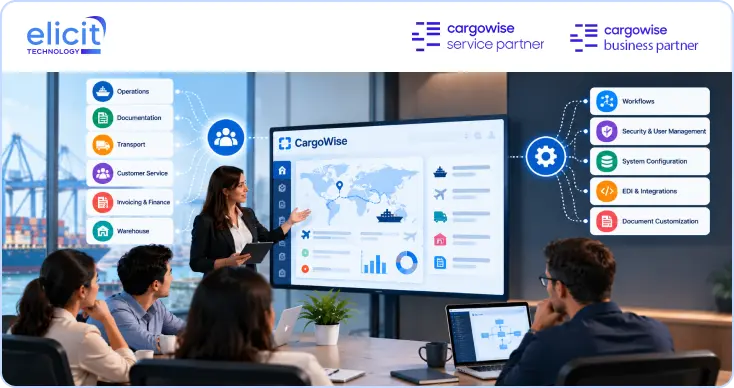
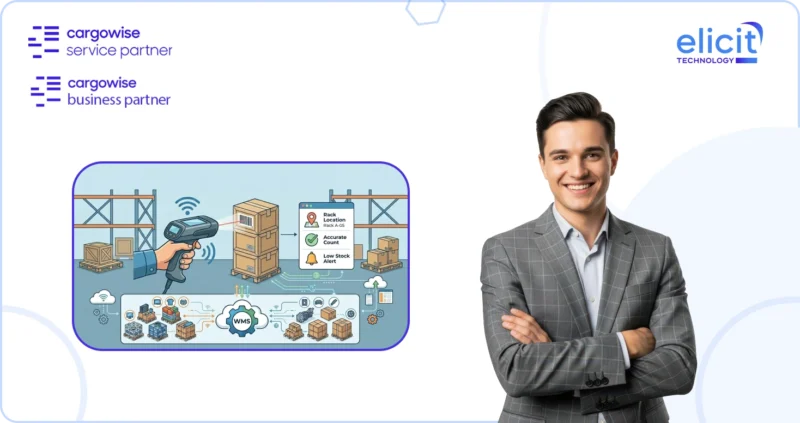
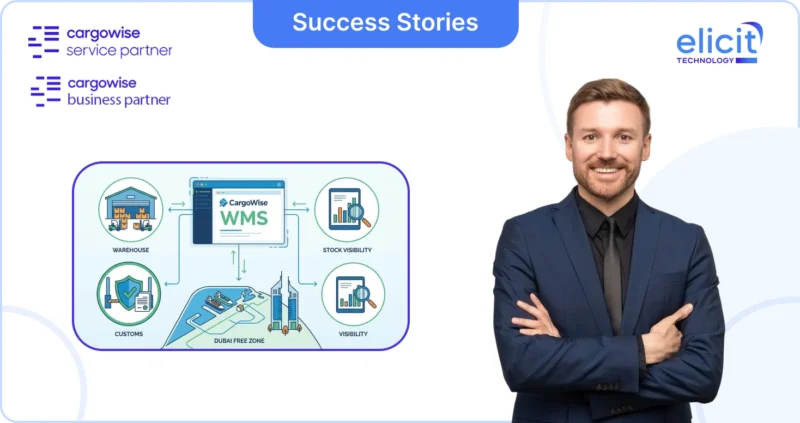





System Scanning & Health Check

Find risks before they hit operations.

Operations Audit & Optimization

Improve performance with measurable operational gains.

User Training

Train teams to work smarter every day.

This and other consulting & optimization services in CargoWise

We are always ready with the solution you need.

Share your goals with us — we'll optimize CargoWise to deliver measurable results.

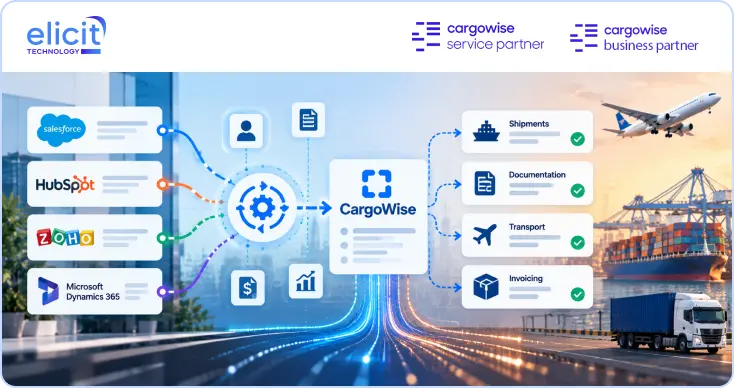
Salesforce

Sync Salesforce data with live shipments.

HubSpot

Align sales activity with operational shipment data.

Zoho CRM

Connect Zoho deals with CargoWise operations.

Microsoft Dynamics CRM

Unify CRM and logistics on one workflow.

This and other CRM integrations in CargoWise

We are always ready with the solution you need.

Share your requirements with us — we'll integrate CRM into CargoWise to fit the way you work.

ICEGATE Integration

Accelerate ICEGATE integration delivery for efficiency, connecting CargoWise to India's national customs gateway for automated declaration filing.

ACE Integration

Accelerate ACE integration delivery for efficiency, connecting CargoWise to the US CBP's Automated Commercial Environment for import filings.

AMS Integration

Optimize AMS integration delivery at scale, automating advance cargo manifest submissions into the US Automated Manifest System.

AES Integration

Accelerate AES integration delivery for efficiency, automating US export declaration filing through the Automated Export System.

CDS Integration

Accelerate CDS integration delivery for efficiency, connecting CargoWise to the UK's Customs Declaration Service.

DMS Integration

Streamline Netherlands customs declaration delivery, connecting CargoWise to Dutch Customs' current DMS platform, which fully replaced AGS in 2024.

MPCI Integration

Automate UAE pre-loading manifest filing, connecting CargoWise to MPCI for mandatory cargo information submission before loading.

ICS2 Integration

Accelerate ICS2 integration delivery for efficiency, meeting the EU's mandatory Entry Summary Declaration requirements across all transport modes.

ASM Sequoia Integration

Accelerate ASM Sequoia integration for efficiency, connecting CargoWise to Sequoia's customs filing platform.

TradeNet Integration

Streamline Singapore customs filing, connecting CargoWise to TradeNet's single window for permits, duties, and Certificate of Origin declarations.

ASYCUDA Integration

Accelerate ASYCUDA integration delivery for efficiency, linking CargoWise to the customs automation system used widely across Africa.

SARS Integration

Accelerate SARS integration delivery for efficiency, connecting CargoWise to South Africa's national customs system.

SISCOMEX Integration

Accelerate SISCOMEX integration delivery for efficiency, connecting CargoWise to Brazil's Integrated Foreign Trade System.

VUCEM Integration

Optimize VUCEM integration delivery at scale, connecting CargoWise to Mexico's single window for foreign trade.

NZCS Integration

Accelerate NZCS integration delivery for efficiency, connecting CargoWise to New Zealand Customs Service's filing platform.

About Us

Discover who powers your CargoWise success.

Careers

Join our global logistics technology team.

Contact Us

Talk to CargoWise experts about your goals.

CargoWise Resources

Your Complete CargoWise Support Destination

From implementation to automation, optimize every process with expert CargoWise guidance.

CargoWise Shortcuts

Work faster with practical keyboard shortcuts.

Free Tools

Use free tools for everyday logistics tasks.

CargoWise Healthcheck

Uncover ways to improve CargoWise performance.

CargoWise Resources

Your Complete CargoWise Support Destination

From implementation to automation, optimize every process with expert CargoWise guidance.

Glossary

Browse key logistics and CargoWise terms.

CargoWise Resources

Your Complete CargoWise Support Destination

From implementation to automation, optimize every process with expert CargoWise guidance.

Incoterms

Understand trade terms for global shipping.

CargoWise Resources

Your Complete CargoWise Support Destination

From implementation to automation, optimize every process with expert CargoWise guidance.

Malaysian flag on an office desk
CargoWise Malaysia e‑Invoicing Integration

Comply with Malaysia's MyInvois Mandate, Without Adding a Separate Platform

Get real-time invoice validation, UIN and QR code handling, and MyInvois sync built directly into your CargoWise environment, so e‑Invoice compliance runs from the system you already use for shipments and billing.

Book a Call
Cargo ship sailing on turquoise blue water

The rollout is staged by revenue. Your obligation start date depends on which tier you fall into.

Malaysia's e‑Invoice mandate under LHDN (the Inland Revenue Board) went live in phases by annual turnover, starting with businesses above RM100 million in August 2024, RM25 million to RM100 million from January 2025, and progressively lower thresholds rolling in through 2025 and into 2026 until virtually every business is in scope.

Every invoice, credit note, and debit note has to be validated in real time through MyInvois before it's legally recognised, returning a Unique Identifier Number and a QR code that must appear on the document. CargoWise Malaysia e‑Invoicing Integration handles that validation loop automatically, so your team keeps invoicing from CargoWise instead of a separate LHDN portal.

The Real Problems

Challenges freight businesses actually run into with e‑invoicing

Parameters
Challenge
Our Fix
Invoice Details Submitted to MyInvois One at a Time

Manually validating each invoice through the MyInvois portal doesn't scale once shipment and billing volume grows.

CargoWise invoices submit to MyInvois automatically for real-time validation, with the response matched back to the originating job.

UIN and QR Code Printing on Every Invoice

The Unique Identifier Number and QR code MyInvois returns are mandatory on the document, a second step if invoicing and compliance run on separate systems.

The Unique Identifier Number and QR code get applied directly onto the CargoWise-generated invoice, no manual download-and-merge step.

Data Errors Reaching the LHDN Portal

Incorrect TIN, classification codes, or line-item details submitted to MyInvois get rejected, or worse, accepted incorrectly.

Invoice data is validated against CargoWise records before submission, catching mismatches before they ever reach MyInvois.

Invoice Formats Not Matching Between Systems

The invoice format CargoWise generates and the structured XML or JSON MyInvois expects are not automatically the same.

Field mapping keeps your CargoWise invoice and the structured version pushed to MyInvois in sync, with a clear audit trail between the two.

Real-Time Validation Adds a Dependency

If validation isn't handled reliably, a delayed or failed response can hold up invoice issuance entirely.

Validation status is stored inside your CargoWise environment permanently, so retrieval never depends on the MyInvois portal.

Here is our complete CargoWise Malaysia e‑Invoicing Integration process flow

01

Discovery & Analysis

We confirm which mandate tier your annual turnover falls into, and identify which transaction types, B2B, B2C, and export, apply to your business.

02

Data Mapping

We map CargoWise invoice fields, TIN, classification codes, line items, to the structured XML or JSON format MyInvois requires.

03

Build & Configure

We connect CargoWise to MyInvois via the LHDN API, configuring the flow that submits invoice data and retrieves the UIN and QR code automatically.

04

Testing for Compliance

We test invoice submission against real transaction scenarios, including consolidated e‑Invoices where applicable, confirming validation succeeds before go-live.

05

Go-Live & Hypercare

Controlled cut-over with close monitoring through your first live invoicing cycle, catching validation issues before they hold up billing.

06

Monitor, Support & Train

Ongoing monitoring of MyInvois validation status, plus mapping updates as LHDN advances the phased rollout to lower turnover tiers.

What It Delivers

What CargoWise Malaysia e‑Invoicing Integration delivers?

01

Every Invoice Gets Validated Automatically

Invoices submit to MyInvois and return with a Unique Identifier Number and QR code without manual portal entry.

02

Built for Your Mandate Tier

Submissions align to the specific rollout phase your turnover falls into, so you stay compliant as the mandate expands.

03

Consolidated e‑Invoices Handled Correctly

Eligible low-value transactions are consolidated and submitted the way LHDN expects, not itemised unnecessarily.

04

No Invoice Ships Without Validation

An invoice that hasn't cleared MyInvois validation isn't legally recognised, this integration is built specifically to prevent that gap.

Why choose Elicit for CargoWise Malaysia e‑Invoicing Integration?

Built Around LHDN Requirements Specifically

/01

Mapping reflects Malaysia-specific fields, TIN, classification codes, UIN, QR codes, not a one-size-fits-all template.

Our Own Middleware, Fully Owned

/02

We build and run the connection to MyInvois directly, so validation and retrieval are managed end-to-end.

Full Environment Discipline

/03

Development, UAT, and production each get dedicated setup and testing before anything touches live invoicing.

One Team, Start to Finish

/04

The team that connects your CargoWise environment to MyInvois is the same one that adjusts it as LHDN advances the phased rollout.

Global e-Invoicing Coverage Timeline

A regional view of where mandates currently stand, and where they're headed, mapped to the model each country actually uses.

CountryStatusModel
India Mandatory Reporting via IRP
Singapore Phasing In PEPPOL + Tax Authority (InvoiceNow)
Malaysia Phasing In Tax Authority Portal (MyInvois)
Thailand Voluntary Tax Authority (e-Tax Invoice)
Vietnam Mandatory Tax Authority Portal
Japan Voluntary PEPPOL (JP PINT)
CountryStatusModel
Egypt Mandatory Tax Authority (ETA)
Kenya Mandatory Tax Authority (eTIMS)
Zambia Mandatory Tax Authority (Smart Invoice)
Nigeria Phasing In Tax Authority (FIRS)
CountryStatusModel
Belgium Mandatory (Jan 2026) PEPPOL BIS 3.0
Poland Phasing In (Feb–Apr 2026) Clearance (KSeF)
France Phasing In (Sep 2026+) Reporting
Germany Phasing In (2025–2028) PEPPOL / XRechnung, ZUGFeRD
Croatia Mandatory (Jan 2026) Tax Authority (Fiskalizacija 2.0)
Spain Phasing In (2026–2027) Tax Authority (VeriFactu)
CountryStatusModel
Saudi Arabia Mandatory, by wave Clearance (ZATCA/Fatoora)
UAE Voluntary 2026, mandatory 2027 PEPPOL + Tax Authority (via ASPs)
Oman Upcoming PEPPOL (planned)
Bahrain Upcoming Tax Authority (planned)
Qatar Upcoming Tax Authority (planned)
Jordan Mandatory Tax Authority (JoFotara)
CountryStatusModel
Australia Voluntary PEPPOL
New Zealand Voluntary PEPPOL
CountryStatusModel
Brazil Mandatory, long-established Tax Authority (NF-e)
Mexico Mandatory, long-established Tax Authority (CFDI)
Chile Mandatory, long-established Tax Authority (SII)
Colombia Mandatory, long-established Tax Authority (DIAN)
United States No federal mandate Emerging PEPPOL pilots
Canada No federal mandate Voluntary

Status reflects publicly announced timelines as of 2026 and can shift; we confirm your specific obligation during discovery rather than relying on a static table alone.

Contact Us

Looking for the Right CargoWise Partner to Support Your Growth?

Elicit Technology helps logistics businesses simplify CargoWise through implementation, integration, automation, configuration, BI dashboards, live setup, and ongoing support.

Full name is required
Valid email is required
Message is required
Frequently Asked Questions

Happy to Assist You with Anything

It depends on your annual turnover tier. Businesses above RM100 million were first in scope from August 2024, with RM25 million to RM100 million following from January 2025, and lower tiers phasing in through 2025 and into 2026.

It isn't legally recognised until it passes validation and receives a Unique Identifier Number, so the transaction can't be relied on for tax purposes until that happens.

Yes. Consolidated e‑Invoices for eligible B2C and low-value transactions are handled the way LHDN expects, alongside standard B2B invoices.

Yes. Export transactions are mapped and submitted under the same MyInvois framework as domestic invoices, with the relevant classification applied.

We monitor the phased rollout and adjust your configuration as new thresholds and requirements come into effect, so you stay compliant without tracking the timeline yourself.

We track your phase and relaxation status directly against LHDN's requirements, so consolidated-versus-individual invoicing switches correctly without your team monitoring every threshold revision.

Latest from our blogs

View All Blogs