







Your sales team closes an opportunity in the CRM. Then someone emails operations the details.
Operations creates or updates the customer information in CargoWise. Sales later wants to know whether the shipment has departed, so they ask operations for an update. Operations checks CargoWise and sends the information back.
Both systems may be working exactly as intended. The problem is the gap between them.
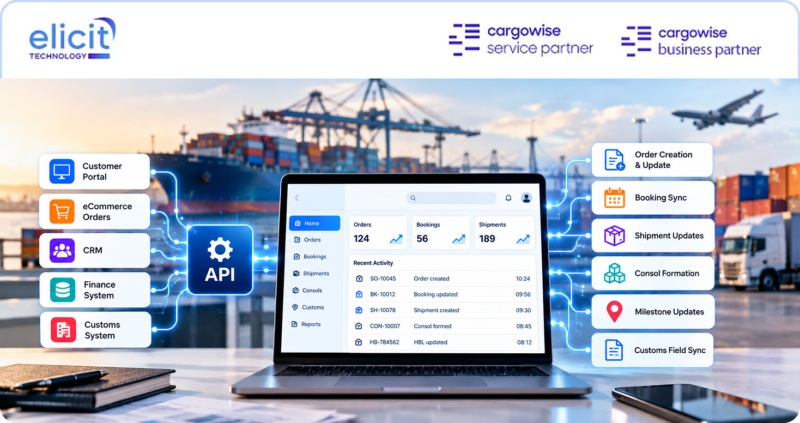
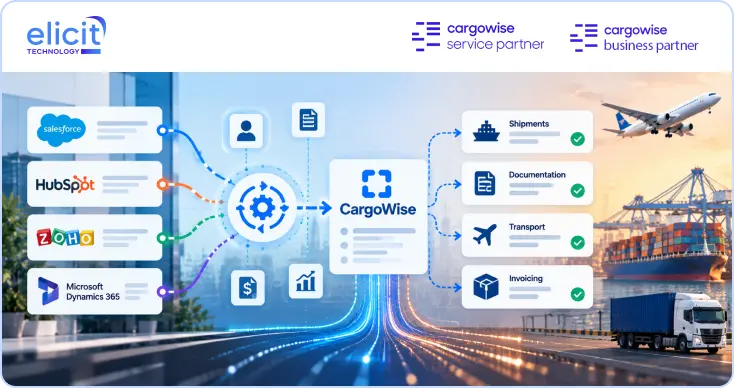
For logistics businesses that use Salesforce, HubSpot, Zoho CRM, Microsoft Dynamics, or another CRM alongside CargoWise, CargoWise CRM integration can connect selected customer, commercial, and operational information so sales and operations do not have to keep transferring the same information manually.
CargoWise officially provides integration capabilities for connecting its platform with external systems and applications. Its current connectivity portfolio includes eAdaptor Next, which supports inbound and outbound communication with improved traceability and multi-system support, as well as CargoWise Connector for connectivity between CargoWise and external systems, applications, authorities, and business partners.
But a useful CRM integration starts long before an API connection is built.
It starts by deciding what each system should own, what information should move between them, and what should happen when the same record changes in both places.
Why Integrate an External CRM When CargoWise Already has CRM Capabilities?
This is an important question.
CargoWise already provides Customer Relationship Management capabilities designed for logistics service providers. Its CRM functionality covers areas such as opportunities, enquiries, communications, campaigns, sales information, and the progression from prospect through sale. CargoWise also connects sales information with wider operational activity.
However, many logistics companies already have an established CRM strategy outside CargoWise.
Salesforce may be used across a global organization. HubSpot may support marketing and sales pipelines. Zoho CRM may manage customer acquisition and follow-up. Microsoft Dynamics may already be connected with the wider corporate technology environment.
Replacing that CRM may not be the business objective.
The requirement instead becomes:
How do we keep our existing CRM while connecting the information sales needs with the operational data managed in CargoWise?
That is where CargoWise CRM systems integration becomes relevant.
The goal should not be to duplicate everything from CargoWise inside the CRM. It should be to connect the specific information that improves the handoff between sales and logistics operations.
Where does the Sales-to-Operations Gap Usually Begin?
The gap often begins before the first shipment moves.
Sales may create a prospect and gradually build information around the company, contacts, opportunity, expected volume, trade lanes, services, and commercial requirements.
Once the business is won, operations need some of that information.
If there is no integration, the handover may depend on emails, spreadsheets, messages, or somebody manually creating information again in CargoWise.
Then the direction reverses.
Once CargoWise becomes the operational system for the shipment, sales may want selected information back in the CRM.
Has the customer’s first shipment been created? What is its current milestone? Has a significant operational event occurred? Is the account actually generating shipment activity?
Without an integration, the salesperson may have to ask operations.
The problem is therefore not simply duplicate data entry.
It is a break in the information flow between the commercial customer lifecycle and logistics execution.
What Data should You Actually Integrate Between CargoWise and a CRM?
This is where CRM integration projects should become selective.
Not every CargoWise field belongs in Salesforce, HubSpot, Zoho, or Dynamics. And not every CRM field should automatically create or change something in CargoWise.
Start with business use cases.
Customer and account information is an obvious candidate. When a prospect becomes an approved customer, relevant organization and contact information may need to flow into the operational environment, subject to the company’s validation and onboarding rules.
Opportunity and quote information may also be relevant where the business wants a smoother transition between commercial activity and execution.
In the opposite direction, selected shipment information can provide sales teams with operational context without requiring them to work directly inside operational records.
The right scope may therefore include selected customer and account data, contacts, opportunities, quotations, shipment references, and agreed shipment milestones or status information.
But the exact objects and fields should be determined during discovery.
A good integration is not the one that moves the most data.
It is the one that moves the right data to the people who need it.
Which System should be the Source of Truth?
This is one of the most important decisions in the entire CargoWise CRM integration.
Suppose the customer address exists in both CargoWise and Salesforce.
A salesperson changes it in Salesforce.
Later, operations changes it in CargoWise.
Which version should win?
Without an agreed answer, a two-way integration can create more confusion than the manual process it replaced.
Elicit’s CargoWise CRM Systems Integration process therefore begins by identifying the integration points and agreeing on the source of truth for each data object.
For example, the CRM might own a lead while it remains a prospect. After the customer passes the required onboarding process, CargoWise may become authoritative for certain operational organization information.
Shipment execution information would normally originate from the system managing that execution rather than being manually recreated by sales.
The precise ownership model depends on the business.
The important point is that it must be designed deliberately.
Do not begin by saying, “Sync everything both ways.”
Begin by asking, “Which system should be allowed to create or change this information?”
How do We Integrate CargoWise with Your CRM?
At Elicit Technology, the integration process begins with the business flow rather than immediately building an interface.
The first stage is Discovery & Analysis.
We review how your CargoWise environment and CRM are currently being used. We identify the objects that need to communicate, the direction in which information should move, the relevant business events, and which system owns each piece of information.
This is also where we establish whether a synchronization needs to be immediate, event-driven, scheduled, one-way, or two-way.
That distinction matters.
A shipment milestone may need to reach the CRM quickly because a sales or customer-service team relies on it. Another type of information may only require scheduled synchronization. Some records should never be updated automatically from both directions.
There should be a business reason behind each integration rule.
Why is Data Mapping More than Matching Two Field Names?
Once the integration scope is understood, the next stage is Data Mapping.
At first glance, this sounds straightforward.
CRM Account = CargoWise Organization.
CRM Contact = CargoWise Contact.
But real integration mapping is rarely that simple.
The two systems may structure the same information differently. A CRM may contain sales-specific fields that have no equivalent operational purpose in CargoWise. CargoWise may contain logistics information that would create unnecessary complexity if every field were copied into the CRM.
Values may also need transformation.
Customer types, country formats, currencies, status values, service categories, identifiers, and other data may be represented differently in each environment.
The integration therefore needs mapping and transformation rules that define how information should be interpreted as it crosses the system boundary.
CargoWise’s current integration capabilities are designed to support connectivity with external systems. WiseTech also positions its integration tools around multi-system communication and external application connectivity.
The technical connection is important, but the quality of the mapping determines whether the information remains useful after it arrives.
What Happens When the Same Customer Exists in Both Systems?
This is where deduplication becomes critical.
Imagine Salesforce contains:
ABC Global Logistics LLC
CargoWise already contains:
ABC Global Logistics
Creating another organization automatically because the names are not identical could produce duplicate customer records.
The integration therefore needs rules for determining whether a CRM record corresponds with an existing CargoWise organization.
Depending on the available data and business rules, matching may involve stable identifiers and other validated attributes rather than relying solely on a company name.
The same principle applies to contacts.
Integration should not mean:
CRM creates record → CargoWise blindly creates another record.
The logic should determine whether the record needs to be created, matched, updated, rejected, or sent for review.
That is why Elicit includes deduplication and data-cleansing rules within the CRM integration layer.
How can Salesforce Integrate with CargoWise?
For a company using Salesforce, the integration can be designed around the point where a commercial opportunity becomes relevant to logistics operations.
Sales may continue managing leads, opportunities, account relationships, and commercial activity within Salesforce.
Once agreed business conditions are met, selected customer or commercial information can move toward CargoWise according to the integration rules.
Operational information can then travel in the opposite direction where there is a valid sales use case.
The objective is not to recreate CargoWise inside Salesforce.
It is to give Salesforce users enough operational context to manage the customer relationship while keeping logistics execution in the appropriate operational environment.
Elicit provides dedicated CargoWise Salesforce integration services for businesses following this model.
How does HubSpot Integration Differ?
HubSpot is often closely connected with marketing and sales activity.
That can make the transition from marketing-qualified activity through sales and eventually into logistics operations particularly important.
The integration should define the point at which information becomes operationally relevant.
A new marketing contact, for example, should not automatically become an operational customer in CargoWise simply because it exists in HubSpot.
Instead, the business can establish qualification rules around when selected information should progress.
Once the customer begins shipping, agreed CargoWise information can be returned to HubSpot where it supports the commercial team’s requirements.
CargoWise HubSpot Integration creates a cleaner separation between marketing activity, sales qualification, and logistics execution while still allowing the systems to exchange the information that connects those stages.
What About Zoho CRM and Microsoft Dynamics?
The same integration principle applies to Zoho CRM and Microsoft Dynamics.
The CRM continues performing the customer and sales functions the business has chosen it for. CargoWise continues managing the relevant logistics processes.
The CargoWise Zoho CRM integration layer handles the agreed exchange between them.
What changes are the technical object model, field structure, authentication, APIs, business rules, and configuration required by each CRM platform.
This is why a Salesforce connector cannot simply be renamed a Zoho integration.
The business objective may be similar, but the technical implementation needs to respect the architecture of the CRM being connected.
Elicit’s approach uses the same overall integration framework while adapting the mapping and configuration to Salesforce, HubSpot, Zoho CRM, Microsoft Dynamics, or another CRM platform.
How does Elicit Integrate CRM Systems as an Official CargoWise Service Partner?
As an official CargoWise Service and Business Partner, Elicit Technology approaches CRM integration around both the CargoWise environment and the external CRM rather than treating it as a standalone API connection. We first understand how customer, quote, sales, and shipment information should move between the two systems before defining the appropriate integration architecture.
Our team handles the integration from data mapping and synchronization rules through eAdaptor Next/API connectivity, deduplication, error handling, testing, go-live, and ongoing monitoring. The objective is to keep Salesforce, HubSpot, Zoho CRM, Microsoft Dynamics, or another CRM connected with CargoWise while maintaining clear data ownership and reliable information flow between sales and operations. This aligns well with the integration process already described in your article. Pasted text
Where do eAdaptor Next and APIs Fit?
Once the business rules and mapping have been defined, the technical integration can be built using the appropriate CargoWise connectivity capability and the interfaces available from the CRM.
CargoWise currently positions eAdaptor Next as its modern inbound and outbound communication capability, with improved traceability, multi-system support, and advanced messaging. WiseTech also provides CargoWise Connector as a platform for connecting CargoWise with external systems and applications.
The CRM side will have its own available integration interfaces.
The resulting architecture therefore depends on both environments.
This is another reason not to begin a project with the assumption:
“We just need an API.”
An API provides a method of communication.
It does not decide which system owns the customer, how duplicate records are handled, which shipment events sales needs, what happens when a message fails, or whether a user should be allowed to overwrite a particular field.
Those decisions belong to the integration design.
What Happens When a Sync Fails?
Successful integrations are designed for failure as well as success.
What happens if CargoWise is available but the CRM endpoint is temporarily unavailable?
What happens if a required value is missing?
What if the CRM rejects the message?
What if a customer record cannot be matched confidently?
What happens if the same message is received twice?
These scenarios need error handling and monitoring.
Simply sending information is not enough. The integration should make it possible to identify exceptions, understand what failed, and determine what needs to happen next.
This is why Elicit’s build and configuration stage includes error handling and monitoring, followed by testing against realistic customer and shipment records before go-live.
The objective is not merely to prove that System A can communicate with System B.
It is to prove that the business process still works when something unexpected happens between them.
What should Change After CargoWise CRM Integration Goes Live?
The biggest improvement should not be that “two systems are connected.”
It should be that people stop acting as the connection.
Sales should not have to repeatedly ask operations for information that has already been approved for synchronization.
Operations should not have to manually recreate sales information that can safely enter CargoWise through the agreed process.
Customer updates should not require unnecessary changes in multiple systems.
Shipment information that sales legitimately needs should become available through the CRM according to the defined integration design.
And when synchronization fails, the business should have a clear way to identify and resolve the exception.
That is what turns an interface into an operational integration.
Connect Your CRM to CargoWise Without Creating Another Data Problem
CargoWise CRM integration is not simply about connecting Salesforce, HubSpot, Zoho CRM, Microsoft Dynamics, or another CRM to an API.
The real work is deciding what should connect and how it should behave.
Which system owns the customer?
When should a lead become operationally relevant?
Which quotation information needs to cross systems?
Which shipment milestones does sales genuinely need?
How should duplicate organizations be handled?
Should a field synchronize one way or both ways?
What happens when synchronization fails?
Elicit Technology’s CargoWise CRM Systems Integration service covers this complete process, from discovery and source-of-truth design through data mapping, integration development, deduplication, testing, go-live, monitoring, support, and team training.
Book a call with us to copy every piece of CargoWise data into your CRM.
It is to create a controlled connection where sales can keep working in the CRM they know, operations can keep executing in CargoWise, and the right information moves between them without people becoming the middleware.