






Your CargoWise integrations may be working perfectly today.
Customer portals are receiving shipment data. Bookings are moving between systems. ERP connections are exchanging information. Warehouse applications are communicating with CargoWise. Accounting data is flowing where it needs to go.
So why change anything?
Because an integration that works today is not automatically an integration strategy that is ready for tomorrow.
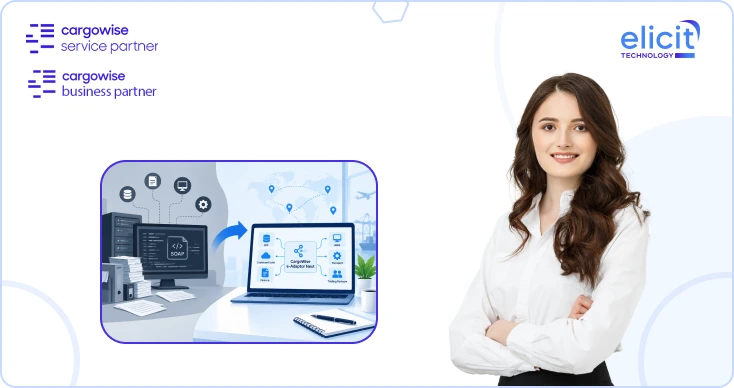
CargoWise is positioning eAdaptor Next as its modern integration capability, with improved traceability, multi-system support, and advanced messaging. CargoWise states that eAdaptor Next fully replaces SOAP for inbound and outbound communication.
If your business still depends heavily on Legacy eAdaptor integrations, the question is becoming less about whether those integrations work today and more about how prepared you are to move them when change becomes necessary.
And waiting until an important integration is under pressure is rarely the ideal time to start figuring that out.
What is Changing with CargoWise eAdaptor?
CargoWise has long used eAdaptor to connect its platform with external applications and trading partners.
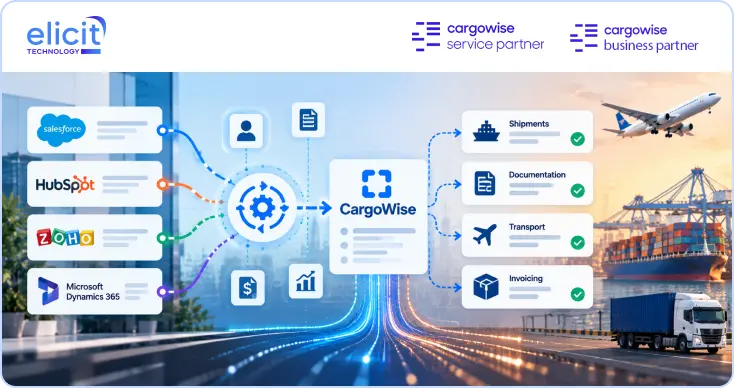
For freight forwarders, these integrations can sit behind some of the most important processes in the business: customer systems, ERPs, WMS platforms, transport providers, finance applications, portals, agents, and other third-party systems.
CargoWise’s current product portfolio includes both eAdaptor Classic and eAdaptor Next, while the company describes eAdaptor Next as a new feature designed around stronger traceability, multi-system support, and advanced messaging capabilities.
The direction is therefore important for businesses with existing integration estates.
This is not simply a cosmetic version change.
Moving to CargoWise eAdaptor Next can mean reviewing how your integrations authenticate, communicate, exchange messages, handle responses, and manage connections to different external systems.
Why can Waiting Make an eAdaptor Migration More Difficult?
A Legacy eAdaptor integration rarely exists in isolation.
Over time, one integration may become five, ten, or considerably more.
One could connect CargoWise with a customer’s booking portal. Another might exchange information with an ERP. Others could support warehouse orders, transport bookings, shipment milestones, invoices, or internal applications.
Some may have been developed years ago.
Documentation may be incomplete. The original developer may no longer be involved. Business rules may have changed. Custom logic may have been added around the original interface.
That means the real migration question is not:
“How do we switch on eAdaptor Next?”
It is:
“What currently depends on Legacy eAdaptor, and what has to change before those integrations can operate correctly through the newer architecture?”
The longer that discovery is postponed, the more difficult it can become to perform it under a tight business deadline.
What could Your Business Face by Delaying the Migration?
The most obvious risk is not that every Legacy eAdaptor integration suddenly stops working overnight.
The bigger concern is migration readiness.
Imagine that a business-critical customer integration needs a major change. Or a connected application changes its authentication requirements. Or your integration architecture needs to support a new system.
If your organization has already mapped and prepared its migration path, the change can be approached as a controlled project.
If nothing has been assessed, the team first has to discover what is connected, how it works, what credentials it uses, which messages are exchanged, what custom logic exists, and what must be rebuilt or reconfigured.
That is when a technical migration can turn into an operational problem.
Security requirements can move faster than legacy integrations
Modern integration environments increasingly require stronger authentication and more controlled access.
An integration architecture designed years ago may not align neatly with the security requirements of today’s hosted applications, APIs, and external platforms.
Migrating provides an opportunity to review authentication, credentials, certificates, access, and integration ownership rather than continuing to extend older configurations.
Compatibility requirements can change
Legacy integrations may rely on older communication patterns and established message structures.
CargoWise explicitly says eAdaptor Next fully replaces SOAP for inbound and outbound communication, which makes communication architecture an important part of migration planning.
Existing integrations therefore need to be assessed individually rather than assuming that every connection can simply be transferred unchanged.
Migration pressure can increase later
A migration planned over several months allows time for inventory, mapping, development, testing, exception handling, user acceptance testing, and controlled deployment.
A migration triggered by an urgent integration requirement does not offer the same flexibility.
The technical work may ultimately be similar.
The difference is the amount of time available to do it safely.
What does eAdaptor Next Change for CargoWise Integrations?
The value of eAdaptor Next is not limited to replacing an older integration mechanism.
CargoWise highlights three particularly important improvements: traceability, support for multiple systems, and advanced messaging capabilities.
These capabilities can change how integration teams design and manage connectivity around CargoWise.
Better separation between external systems
A freight forwarder may have CargoWise connected to multiple customers and applications, each with different technical requirements.
Modern integration design benefits from treating those connections separately rather than forcing unrelated external systems through the same integration assumptions.
That gives administrators and developers more control when credentials, endpoints, or requirements change for one connected party.
More modern messaging capabilities
CargoWise integrations increasingly need to interact with API-driven applications and modern cloud platforms.
Moving away from SOAP-only communication provides greater flexibility when designing integrations around newer system architectures.
This becomes particularly important as freight forwarders connect CargoWise with customer portals, ERPs, finance platforms, transport systems, visibility solutions, and other digital services.
Improved traceability
One of the hardest integration problems is not necessarily sending a message.
It is discovering what happened when the message did not produce the expected result.
CargoWise specifically identifies improved traceability as an eAdaptor Next capability.
Better visibility into integration activity can make it easier for technical teams to investigate message flows and troubleshoot problems without treating every failure as a black box.
Is eAdaptor Next Migration Just an IT Project?
No.
That is one of the easiest mistakes to make.
An integration may be technically owned by IT, but the processes depending on it belong to the business.
A booking integration affects operations.
A shipment-status interface affects customer service.
An invoice integration affects finance.
A warehouse-order interface affects fulfillment.
A transport connection affects execution.
If an integration is changed without understanding those downstream processes, a technically successful migration can still create operational problems.
That is why the migration should start with an integration inventory, not development.
For each existing Legacy eAdaptor connection, businesses should understand what external system is connected, which messages move in each direction, how authentication works, what business process depends on it, what transformations or custom logic exist, how errors are handled, and how the integration will be tested after migration.
Only then should the technical migration plan be finalized.
Which Legacy eAdaptor Integrations should You Migrate First?
Not every interface needs to move at exactly the same time.
A practical approach is to prioritize based on business dependency and technical complexity.
Start by identifying integrations that support revenue-critical customers, high transaction volumes, financial processing, warehouse operations, bookings, customs or compliance processes, and other time-sensitive operational activities.
Then identify dependencies.
For example, an interface may appear simple but feed another internal system that subsequently supplies information to several customers.
That integration may carry much more operational risk than its message volume suggests.
This assessment gives the migration program an order rather than treating dozens of interfaces as one large technical exercise.
Why is Testing Critical Before Moving an Integration?
Seeing a successful connection does not mean the migration is complete.
The business output must also be correct.
Testing should therefore consider both the technical exchange and the operational result.
If a booking is submitted, was the correct CargoWise transaction created?
If CargoWise sends shipment information, did the external system receive the right fields?
If a request fails, can the team identify why?
If the same message is processed again, what happens?
What happens when required information is missing?
And what happens when the external system is temporarily unavailable?
Testing these scenarios before go-live is considerably easier than discovering them after a production integration starts processing live customer transactions.
The Best Time to Understand Your Migration is Before it becomes Urgent
This is where the eAdaptor Next should really sit.
Not around fear that every Legacy eAdaptor connection will suddenly disappear tomorrow.
It is about losing the advantage of time.
Every month spent waiting can be another month in which undocumented integrations remain undocumented, dependencies continue to grow, new interfaces are added to older architecture, and the eventual migration becomes larger.
Starting now does not necessarily mean migrating everything tomorrow.
It means knowing what you have.
Which Legacy eAdaptor integrations are still active?
Which are business-critical?
Which could be retired?
Which need redevelopment?
Which can move with limited change?
Which require extensive testing?
Once those questions have answers, migration becomes a manageable program rather than an emergency response.
How can Elicit Technology Help You Move to eAdaptor Next?
Moving from Legacy eAdaptor to eAdaptor Next requires more than changing an integration endpoint.
It requires understanding your existing CargoWise environment, external systems, message flows, authentication, data mappings, custom logic, operational dependencies, and testing requirements.
At Elicit Technology, we, as a CargoWise service partner, help CargoWise customers assess existing Legacy eAdaptor integrations and build a structured migration path to eAdaptor Next.
Our CargoWise integration specialists can support the migration from initial assessment and integration mapping through configuration, development, authentication changes, message transformation, REST integration, testing, troubleshooting, deployment, and go-live support.
The objective is simple: move before migration pressure starts making the decisions for you.
Conclusion: Don’t Let Your Most Important Integration Decide Your Migration Date
If Legacy eAdaptor is still sitting behind your customer portal, ERP, WMS, finance platform, transport system, or another business-critical application, now is the right time to understand what migrating it actually involves.
CargoWise continues to expand its newer integration capabilities, and eAdaptor Next is part of that direction.
You do not need to wait for an integration problem to begin planning.
Assess the environment. Map the dependencies. Prioritize the critical interfaces. Test the migration properly. Then move on a timeline your business controls.
Because the worst time to discover how complicated your Legacy eAdaptor environment has become is when one of those integrations urgently needs to change.
Still using Legacy eAdaptor? Book a call with Elicit Technology’s CargoWise integration experts and assess your eAdaptor Next migration before it becomes an urgent project.