







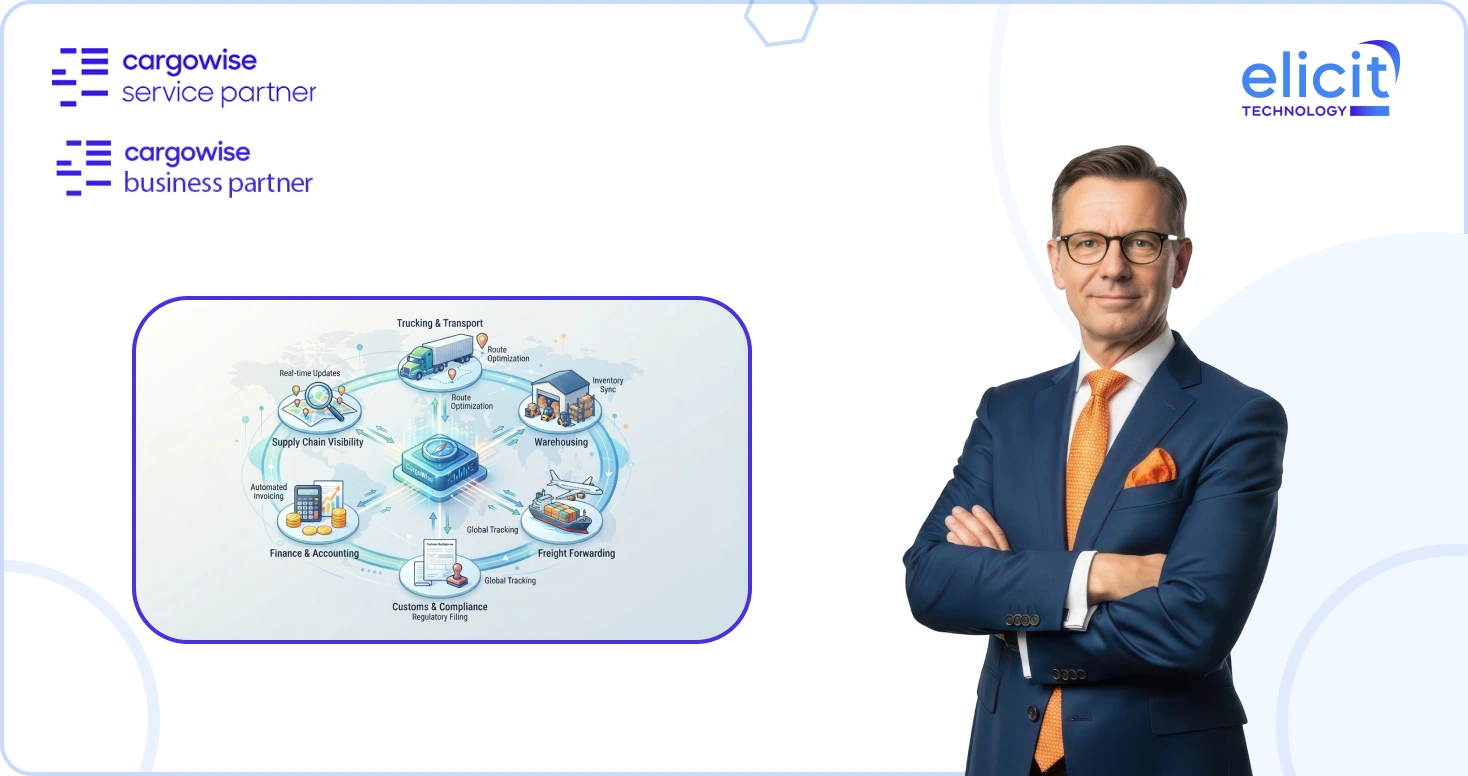
A shipment may be managed in CargoWise, the sales team may work in Salesforce, accounts may be maintained in Xero, customs data may move through a government platform, and container updates may arrive from carriers or tracking providers.
Each system can work well on its own. The trouble starts when they do not work together.
Employees begin copying customer information between platforms. Finance teams export and re-enter invoices. Operations waits for payment updates. Customer service checks several portals for shipment status. Customs teams repeat information already captured elsewhere. Management receives reports built from different versions of the same data.
CargoWise integration services connect these systems so information can move automatically, accurately, and securely across the business. Instead of maintaining isolated platforms, logistics organizations can create one connected digital environment around CargoWise.
For freight forwarders, NVOCCs, customs brokers, transport providers, warehouses, and global logistics companies, this means fewer manual handoffs, stronger data quality, faster processing, and better visibility from customer inquiry through financial settlement.
What are CargoWise Integration Services?
CargoWise integration services connect CargoWise with external business systems, logistics partners, carriers, customs authorities, finance platforms, customer applications, and internal software.
These connections allow selected data to move into or out of CargoWise automatically. Depending on the business requirement, information may flow in one direction or move bidirectionally so both systems remain synchronized.
CargoWise integration services can support:
- ERP and SAP environments
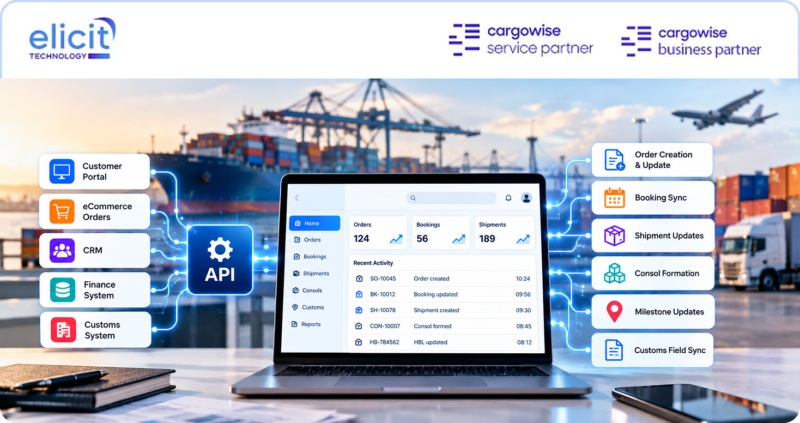
- CRM platforms
- Accounting and financial systems
- Customs and compliance platforms
- Global e-invoicing networks
- EDI connections
- Carrier and transport systems
- Vessel and container tracking platforms
- Warehouse and order-management systems
- Customer portals and in-house applications
The objective is not simply to connect software. It is to remove unnecessary data entry and build a reliable flow of information across operations, finance, sales, compliance, transport, and customer service.
Why do Logistics Companies Need CargoWise Integration Services?
Logistics transactions involve many systems and parties. One shipment can generate customer records, quotations, bookings, milestones, customs declarations, supplier invoices, receivable invoices, transport instructions, warehouse records, and tracking events.
Without integration, every handoff becomes a manual task.
That creates common operational problems:
- Duplicate data entry
- Delayed invoice and payment updates
- Inconsistent customer or supplier records
- Missing shipment milestones
- Customs data discrepancies
- Slow financial reconciliation
- Limited customer visibility
- Heavy spreadsheet dependency
- Higher risk of user error
- Poor reporting across departments
CargoWise integration services reduce these gaps by enabling data to enter once and flow to the people and systems that need it.
How do CargoWise Integrations Work?
The right integration method depends on the connected system, transaction volume, security requirements, data format, and how quickly information needs to move.
Some businesses need immediate, event-driven synchronization. Others need scheduled batch transfers at the end of the day. Certain legacy systems may depend on structured files, while modern cloud platforms may support direct APIs.
A professional integration begins by deciding which system owns each data object. For example, CargoWise may be the source of truth for shipments and job costing, while Salesforce owns sales opportunities and the accounting platform owns bank reconciliation.
Once ownership is clear, fields, rules, validations, and error-handling processes can be mapped correctly.
CargoWise Integration Methods
eAdaptor Next Messaging
CargoWise eAdaptor Next can provide secure, structured messaging between CargoWise and connected systems. It can support inbound and outbound information exchange while providing a controlled foundation for integrations involving operational, customer, and financial data.
Businesses using older connectivity should review their current integration architecture and plan secure, maintainable connections around the latest supported approach.
REST and SOAP APIs
APIs allow CargoWise to communicate directly with modern cloud applications. They are useful for real-time or near-real-time workflows involving CRM platforms, accounting systems, customer portals, order systems, and internal applications.
EDI Connections
EDI remains essential for standardized exchanges with carriers, customers, suppliers, customs environments, and trading partners. It can automate bookings, shipment instructions, status events, invoices, and other structured transactions.
Custom Middleware
Middleware sits between CargoWise and another platform to transform data, apply rules, route messages, and manage exceptions. It is useful when systems use different formats or when several platforms must connect through one managed integration layer.
File and CSV Integration
Where APIs are unavailable, structured CSV, XML, or flat-file exchanges can automate data transfer. Files can be generated, validated, transmitted, and imported on an agreed schedule.
Scheduled and Event-Driven Sync
Scheduled synchronization works well for high-volume or end-of-day processes that do not need to happen instantly. Event-driven integrations trigger when a specific action occurs, such as posting an invoice, creating a booking, receiving a payment, or updating a shipment milestone.
SAP Integration with CargoWise
CargoWise SAP integration connects logistics execution with enterprise resource planning and financial management.
Shipment costs, revenue, customer invoices, supplier transactions, cost centers, tax data, and General Ledger information can flow between CargoWise and SAP based on agreed ownership rules.
This helps larger logistics organizations reduce finance reconciliation and maintain better alignment between job-level performance in CargoWise and enterprise financial reporting in SAP.
A strong SAP integration should address company structures, currencies, tax treatment, cost centers, customer and vendor identifiers, posting periods, error management, and audit requirements.
CargoWise CRM Integration Services
CRM integration connects CargoWise operations with sales and customer relationship management.
Elicit supports integrations with platforms such as:
- Salesforce
- HubSpot
- Zoho CRM
- Microsoft Dynamics CRM
A CRM integration can move customer records, contacts, opportunities, quotations, shipment references, account activity, and service information between systems.
Sales teams gain visibility into customer activity without asking operations for updates. Operations receives cleaner customer and booking information. Management can connect commercial performance with actual logistics execution.
CargoWise Financial Systems Integration
Financial integration connects CargoWise with accounting and ERP platforms so operations and finance work from synchronized information.
Elicit supports CargoWise integrations with:
- Xero
- QuickBooks
- Microsoft Dynamics
- Sage
- Oracle and NetSuite
- Brightpearl
- MYOB EXO
- Retail Express
- on-account
- In-house accounting systems
CargoWise can send Accounts Receivable invoices, credit notes, Accounts Payable transactions, job costs, revenue, tax codes, customer records, vendor records, currencies, and cost centers.
The finance system can return payment confirmations, invoice status, reconciliation details, account holds, credit limits, updated master records, and General Ledger mappings.
This bidirectional exchange removes double entry and improves job profitability, cash-flow visibility, month-end reporting, and audit readiness.
CargoWise Customs and Compliance Integration
Customs integration connects CargoWise with customs authorities, brokerage platforms, government systems, and compliance workflows.
It can support the exchange of declaration information, shipment data, commodity details, registration numbers, response messages, statuses, approvals, and release information.
Because customs requirements differ by country, integrations must account for local data standards, mandatory fields, message rules, security requirements, and government responses.
A properly managed customs integration reduces re-entry and helps teams work from consistent shipment and declaration data.
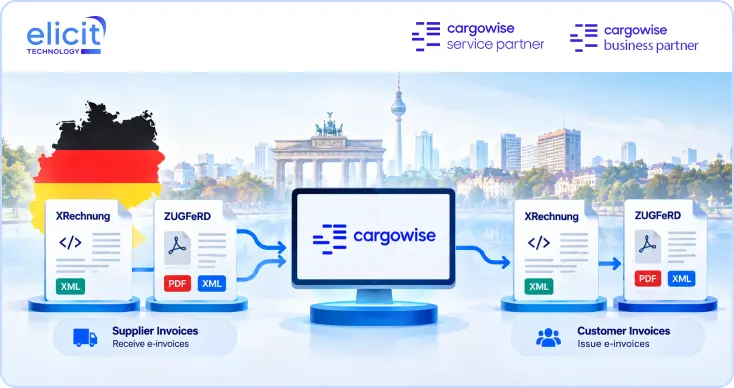
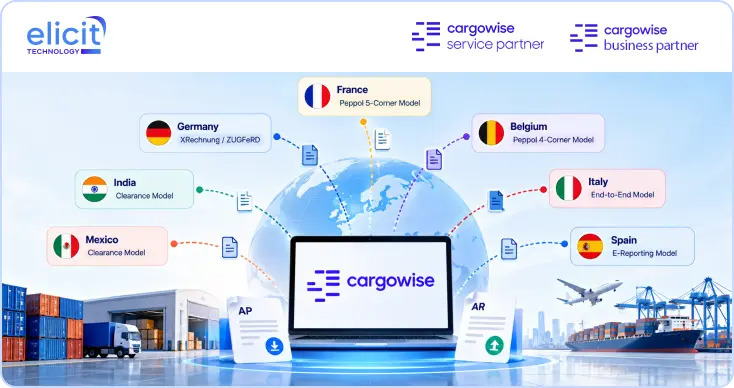
Global E-Invoicing Integration
E-invoicing regulations continue to expand across global markets. Requirements may involve structured invoice formats, government reporting, accredited providers, tax validation, electronic acknowledgments, and regulated retention.
Elicit support for CargoWise e-invoicing integration requirements across:
- Asia Pacific
- Africa
- Europe
- Middle East
- Oceania
The exact integration depends on the country’s mandate and architecture. It may involve government portals, accredited service providers, Peppol networks, tax platforms, or local middleware.
The objective is to take invoice data generated from CargoWise, convert or map it to the required format, submit it through the approved channel, and return status or validation details to the operational and finance teams.
CargoWise EDI Integration
CargoWise EDI integration automates structured data exchange with logistics partners and customers.
Common EDI workflows include:
- Booking requests and confirmations
- Shipping instructions
- Shipment status events
- Transport orders
- Warehouse orders
- Invoices and credit notes
- Customs messages
- Customer shipment updates
EDI reduces email-driven processing and manual entry while creating a more standardized flow of transactions.
A successful EDI integration requires accurate partner mapping, agreed message formats, validation, acknowledgments, monitoring, and clear exception handling.
CargoWise Carrier and Transport Integration
Carrier integration connects CargoWise with airlines, ocean carriers, road transport providers, rail operators, and other logistics partners.
It can support schedules, rates, bookings, confirmations, transport instructions, milestones, capacity information, and shipment updates.
This helps operations teams manage carrier activity from within their core CargoWise workflow rather than moving repeatedly between portals.
Transport integration can also connect CargoWise with local transport providers, dispatch systems, proof-of-delivery applications, and fleet platforms.
Vessel Tracking and Container Tracking Integration
CargoWise vessel and container tracking integrations help teams receive movement events, estimated dates, actual dates, delays, port calls, and inland updates.
When tracking data flows directly into CargoWise, it can support:
- Automated shipment milestones
- ETA change alerts
- Exception workflows
- Customer notifications
- Transport planning
- Warehouse preparation
- Route visibility
- Performance reporting
This is more useful than a standalone tracking screen because the data becomes part of the operational job and can trigger action.
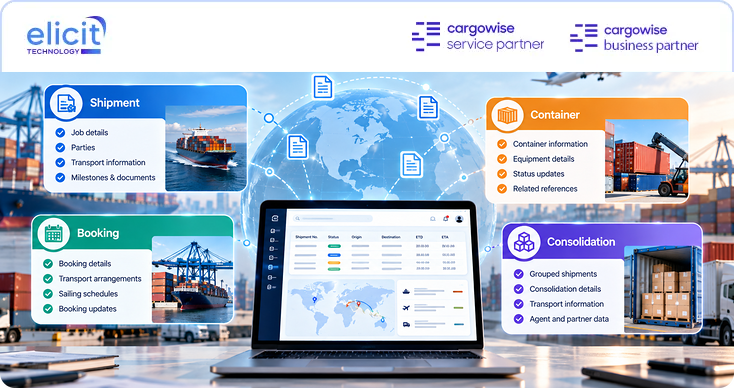
What Data can Move Through CargoWise Integrations?
The specific data depends on the systems involved, but CargoWise integration services can commonly exchange:
- Customers, suppliers, and contacts
- Orders, quotations, and bookings
- Shipments and consolidations
- Routing and transport information
- Warehouse receipts and orders
- Customs and compliance data
- Documents and references
- Milestones and tracking events
- AR and AP invoices
- Payments and receipts
- Charges, costs, revenue, and accruals
- Tax codes and currencies
- General Ledger and cost-center data
- Vessel and container movement information
Each data object should have a clearly defined owner, validation rule, destination, and exception process.
The CargoWise Integration Process Elicit Follows
1. Discovery and Business Analysis
We review your CargoWise environment, connected platforms, business workflows, volumes, pain points, and required outcomes. We also identify the source of truth for each data type.
2. Data and Process Mapping
Fields, messages, codes, statuses, and business rules are mapped between CargoWise and the external system. This stage also defines transformations, validations, and error scenarios.
3. Solution Design and Development
We select the right combination of eAdaptor Next messaging, APIs, EDI, middleware, structured files, batch processing, or event triggers. Connectors and monitoring controls are then built and configured.
4. Testing and UAT
Realistic transactions are tested across normal workflows, exceptions, reversals, duplicate scenarios, currencies, taxes, and failure conditions. Operations, finance, and other stakeholders confirm the results before go-live.
5. Go-Live and Hypercare
The integration is released through a controlled cutover. Message flows and business outcomes are monitored closely during the first operating period.
6. Monitoring and Ongoing Support
Elicit supports integration health monitoring, exception management, troubleshooting, documentation, user training, and future enhancements.
Why CargoWise Integration Projects Fail?
Integration failures are rarely caused by connectivity alone. They usually come from unclear ownership, weak data mapping, poor master data, incomplete testing, and missing exception processes.
Common mistakes include:
- Integrating before cleaning master data
- Sending every field without a business need
- Assuming customer and vendor codes match across systems
- Ignoring multi-company, currency, and tax requirements
- Building one-way data flow when bidirectional updates are required
- Failing to define duplicate prevention
- Going live without monitoring or retry controls
- Treating integrations as one-time projects with no ongoing ownership
A successful integration must be designed around both technology and the real operational process.
How Elicit Delivers CargoWise Integration Services?
Elicit Technology provides end-to-end CargoWise integration services for logistics businesses that need reliable connections across operations, finance, sales, customs, compliance, carriers, and customer systems.
Our services cover:
- SAP integration
- Salesforce, HubSpot, Zoho, and Microsoft Dynamics CRM integration
- Xero, QuickBooks, Sage, Oracle, MYOB EXO, and other finance integrations
- Customs and compliance connectivity
- Global e-invoicing integration
- EDI implementation
- Carrier and transport connections
- Vessel and container tracking
- API development
- eAdaptor Next messaging
- Custom middleware
- File and batch integration
- Monitoring and integration support
As a CargoWise Service and Business Partner, Elicit combines system expertise with practical logistics knowledge. We do not connect applications in isolation. We design data flows around how bookings, shipments, customs, warehouse activities, invoices, payments, and customer updates actually move through your business.
Conclusion
CargoWise integration services help logistics companies replace disconnected systems and repetitive data entry with one connected flow of operational and financial information.
Whether you need to connect CargoWise with SAP, Salesforce, HubSpot, Zoho CRM, Xero, QuickBooks, Oracle, customs authorities, e-invoicing networks, carriers, EDI partners, vessel tracking, or container tracking systems, the integration must be secure, well mapped, tested, and supported.
Elicit provides complete CargoWise integration services, from discovery and architecture through development, UAT, go-live, monitoring, and ongoing enhancement.
Looking for CargoWise integration services built around your logistics operation? Book a consultation with Elicit Technology and connect your systems with confidence.