






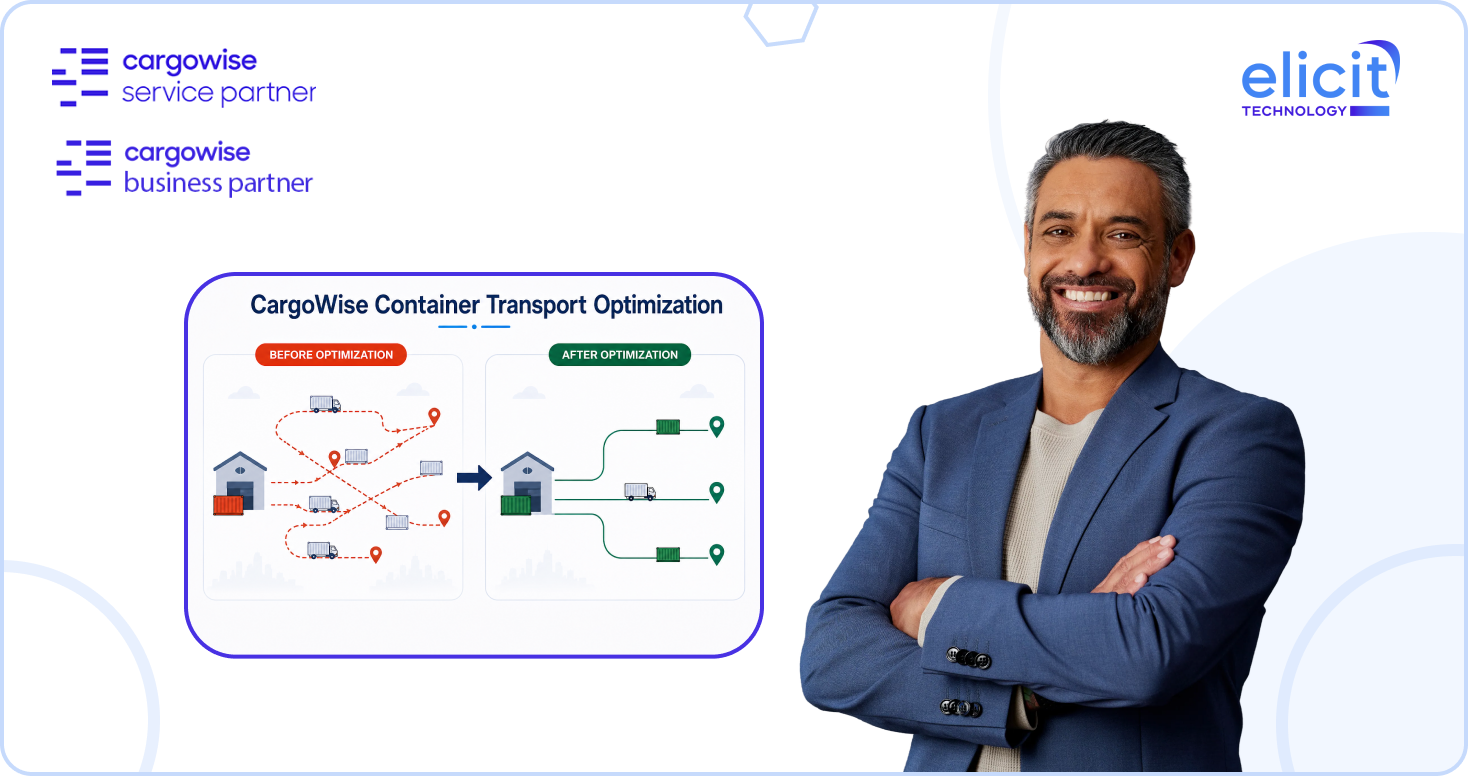
A container delivers an import load, gets emptied, travels back to a depot, sits there, and later another truck collects another empty container for an exporter only a few miles away.
Every individual move may look perfectly normal. Look at the network as a whole, though, and the inefficiency becomes obvious.
Empty container movements remain one of the biggest hidden drains on landside logistics. The reference material notes that approximately 41% of global container movements are empty, while up to 40% of inland container movements can involve empties. Beyond transport cost, these movements consume truck capacity, add congestion, increase handling, reduce equipment availability, and create unnecessary emissions.
CargoWise Container Transport Optimization approaches this differently. Instead of treating every empty return and export pickup as an isolated transport job, it uses container reuse, triangulation, network visibility, and optimization-driven planning to identify more efficient ways of connecting container supply with export demand.
Why are so Many Empty Container Movements Happening?
The obvious explanation is trade imbalance. Some regions import considerably more containerized cargo than they export, while others experience the opposite.
But imbalance isn’t the whole problem.
Once containers move inland, freight forwarders, importers, exporters, shipping lines, depots, terminals, and transport providers are often making decisions through different systems and according to their own operational priorities.
An importer may finish unloading a container and arrange its return to the nominated depot. Meanwhile, an exporter nearby may need exactly that container type and arrange for another empty unit to be collected from a depot.
Both decisions make sense individually.
Together, they can create two unnecessary empty movements.
The CargoWise material therefore reframes empty container movement as an optimization problem, not simply an unavoidable consequence of global trade. Better visibility and coordination can reveal opportunities that fragmented planning doesn’t see.
Where does Inefficiency Enter the Container Lifecycle?
The problem can begin before an export container is even packed.
An empty container must first be sourced and transported to the exporter. Limited visibility into nearby equipment can result in longer collection trips. Misalignment between exporter readiness and truck schedules can add waiting or staging.
Once packed, the container travels to the terminal, where appointment delays, congestion, and additional stops can increase dead mileage and detention or demurrage exposure.
At destination, similar issues happen in reverse. After discharge, the full container travels inland for unloading. Once emptied, it may be returned to a depot even though another exporter within the same area needs compatible equipment.
The reference identifies friction throughout this lifecycle, from empty sourcing and inland transportation to terminal handling, importer unloading, depot return, storage, and eventual allocation to another export.
The result can include repeated handling, additional depot visits, empty truck runs, yard congestion, longer inland movements, and greater fuel consumption.
The problem isn’t necessarily one bad decision.
It’s thousands of individually reasonable decisions being made without enough network-level coordination.
What is Container Reuse?
One of the simplest ways to rethink the process is container reuse.
Under a conventional movement, an importer unloads the cargo and returns the empty container to a depot. Later, an empty container is collected for another export movement.
With reuse, the same party can use the import container for an eligible export shipment instead of automatically returning it to the empty depot.
That can remove an unnecessary depot cycle from the container journey.
The potential benefits include fewer empty miles, fewer staging movements, shorter turnaround cycles, and better utilization of available equipment.
However, reuse alone has an obvious limitation: the same organization needs a compatible import and export requirement.
That’s where triangulation becomes particularly interesting.
What is Container Triangulation?
Container triangulation, or container exchange, expands the concept beyond a single importer or exporter.
Imagine Company A has just unpacked an import container.
Company B, operating nearby, needs a compatible empty container for an upcoming export.
Instead of Company A returning the container to a depot and Company B separately collecting another empty, an optimization platform can identify whether that container is eligible to move between the two requirements.
CargoWise describes its enhanced triangulation capability as matching container availability using attributes including owner, size, type, grade, delivery window, eligibility, and drop type. It can then coordinate container exchanges among the parties involved.
That distinction matters.
Triangulation isn’t simply about finding the closest empty box. The proposed movement still has to satisfy operational and carrier requirements.
Why is Container Triangulation Difficult to do Manually?
In a small operation, an experienced allocator might know that one customer has an empty container available while another needs one.
Scale that across hundreds or thousands of jobs, however, and the number of possible combinations grows rapidly.
The planner would need to consider container location, owner, size and type, condition or grade, timing, carrier policies, delivery windows, export demand, transport capacity, and other operational restrictions.
Meanwhile, those variables are constantly changing.
The reference explains that a human allocator can evaluate only a limited number of possibilities at any given moment. Optimization technology can continuously analyze container availability, shipment demand, transport bookings, and operational constraints to identify reuse or triangulation opportunities that would otherwise be difficult to find.
That’s the real difference between digitizing container transport and optimizing it.
Digitization records the moves.
Optimization questions whether all those moves need to happen in the first place.
How does CargoWise Container Transport Optimization Work?
CargoWise Container Transport Optimization brings optimization into existing export transport booking workflows. CargoWise describes the process as presenting an optimized rate and path after export container details are provided; once accepted, the container is sourced with inefficient movements removed, transport jobs are assigned, and milestones are provided as the movement progresses.
The broader workflow described in the supplied material follows four connected stages.
First comes booking intake, where eligible export transport bookings can be considered for optimization.
Next is container matching. Available import containers are evaluated against export demand while considering container eligibility, operational restrictions, and carrier policies.
Then comes transport optimization, where movements across multiple jobs can be evaluated for more efficient routing, sequencing, and allocation.
Finally, there is execution and visibility. Transport providers receive assignments while milestones are captured and shared as movements progress.
This last step is important because identifying an efficient movement isn’t enough.
It has to be executable.
Why does Network Density Matter for Container Optimization?
Container optimization becomes more powerful as the available network becomes richer.
If an optimization engine can see only ten container movements, it has relatively few potential matches.
If it can evaluate thousands of eligible container movements, bookings, transport providers, and demand points, the number of potential optimization opportunities becomes much larger.
This creates a network effect.
CargoWise’s landside ecosystem includes technologies for road, rail, container exchange, asset management, and forwarding. Its landside operations also incorporate MatchBox Exchange capabilities, which enable import containers to be reused for export activity or exchanged with other companies instead of automatically moving through empty container parks.
The reference identifies several capabilities behind this network advantage: algorithm-driven optimization, network density, cross-party orchestration, ecosystem connectivity, and richer operational data.
In other words, the algorithm matters, but so does the ecosystem the algorithm can see.
What does Optimization Change for Freight Forwarders and Exporters?
For freight forwarders, container optimization can reduce some of the manual coordination involved in arranging landside export movements while improving visibility into container availability and transport execution.
For exporters, more direct container sourcing can mean fewer unnecessary movements, reduced exposure to staging costs, and potentially more predictable inland transportation.
CargoWise states that its Container Transport Optimization solution is designed to remove inefficient container legs and stops, reduce travel distances and storage requirements, automate landside container jobs with transport providers, and provide milestone and status reporting.
That shifts the conversation from:
“Where should we collect an empty container?”
to:
“Is there already an eligible container within the network that can satisfy this export demand more efficiently?”
That’s a much more valuable question.
Transport Providers and Shipping Lines Benefit Too
The advantages aren’t limited to freight forwarders.
Transport providers can benefit when fewer dead legs and unnecessary depot trips mean trucks spend more time performing productive movements. Better planning can also reduce queueing, idle time, and avoidable fuel consumption.
Shipping lines have a different priority: equipment utilization.
A container sitting in the wrong location or repeatedly being repositioned isn’t generating productive value. Faster reuse can shorten turnaround cycles and reduce unnecessary empty repositioning.
Ports and depots can also benefit indirectly. Fewer unnecessary container movements and storage requirements can reduce pressure on yards and infrastructure.
The supplied research therefore presents container optimization as an ecosystem-level opportunity rather than a benefit for one participant alone.
Can Container Optimization Reduce Emissions?
There is also a straightforward sustainability benefit.
An unnecessary empty truck movement still consumes fuel.
An unnecessary depot visit still creates road traffic.
Additional container handling still consumes resources.
Reducing empty miles and unnecessary repositioning therefore has the potential to lower fuel consumption and associated emissions while also reducing road congestion around ports and logistics hubs. The CargoWise material explicitly identifies fewer empty miles, lower fuel burn, reduced congestion-related emissions, and improved inland ESG performance among the potential network benefits.
The useful point here is that sustainability and operational efficiency aren’t competing objectives.
In this case, eliminating waste can support both.
Why is this Bigger than Container Tracking?
Container visibility tells you what is happening.
Container optimization helps determine what should happen next.
CargoWise already provides container tracking capabilities that combine inland and onboard movements, milestone information, delays, ETA changes, automated exception management, and workflow triggers.
Container Transport Optimization takes the landside conversation further by applying available operational information to the planning and execution of container movements.
That represents an important shift for logistics technology.
The goal is no longer simply to digitize an inefficient process so everyone can see it more clearly. The opportunity is to use data and optimization to redesign the process so some of those inefficient movements never need to occur.
How Elicit Helps CargoWise Users Get More from Transport Optimization?
Access to CargoWise functionality doesn’t automatically mean every business is getting the maximum operational value from it.
Your forwarding setup, transport workflows, booking processes, integrations, milestones, data quality, and operational rules all influence how effectively new capabilities can fit into day-to-day operations.
As an official CargoWise Service and Business Partner, Elicit Technology helps freight forwarders review and optimize their CargoWise environment around real operational requirements. From forwarding configuration and workflow optimization to automation, integrations, reporting, and ongoing CargoWise support, we help teams understand where technology can remove manual work and where configuration needs to evolve alongside new CargoWise capabilities.
For organizations exploring landside optimization, the first step is understanding the current container workflow: where empty movements occur, how bookings are created, how transport is allocated, what information is available, and where manual coordination continues to create friction.
Conclusion
Empty container movements have traditionally been treated as an unavoidable cost of containerized trade. Some repositioning will always be necessary because global import and export demand isn’t perfectly balanced.
But not every empty movement is inevitable.
Container reuse can remove unnecessary depot returns. Triangulation can connect available import containers with export demand across different parties. Algorithm-driven planning can evaluate opportunities at a scale human allocators simply can’t match. And digitally coordinated execution can help turn those opportunities into actual container movements.
That’s the significance of CargoWise Container Transport Optimization: it reframes landside container transport from a series of isolated bookings into a network that can be continuously evaluated for better ways to move equipment.
For freight forwarders looking to understand how these capabilities fit into their existing CargoWise operation, schedule a call with an experienced CargoWise Service Partner who can help turn access to new functionality into practical operational value.