











A freight forwarder in Brazil completes a shipment and prepares an invoice for transportation, customs clearance, or other logistics services. The operational work may be finished, but issuing the invoice involves more than recording the charges and sending a document to the customer.
For taxable services, the business may also need to report the transaction to the relevant municipal tax authority and obtain authorization for its electronic service invoice.
This is where CargoWise Brazil e-invoicing and e-reporting become important.
Brazil has specific electronic invoicing requirements for services, including municipal tax registrations, electronic document numbering, tax calculations, and communication with city tax authorities.
For freight forwarders operating across multiple Brazilian cities, managing these requirements can become particularly complex.
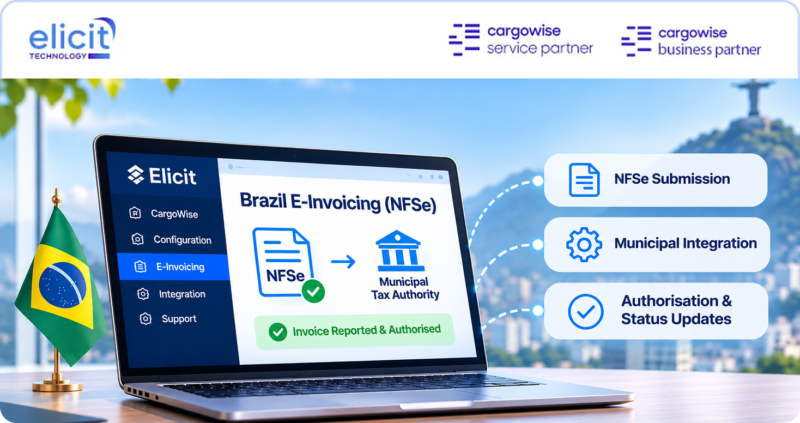
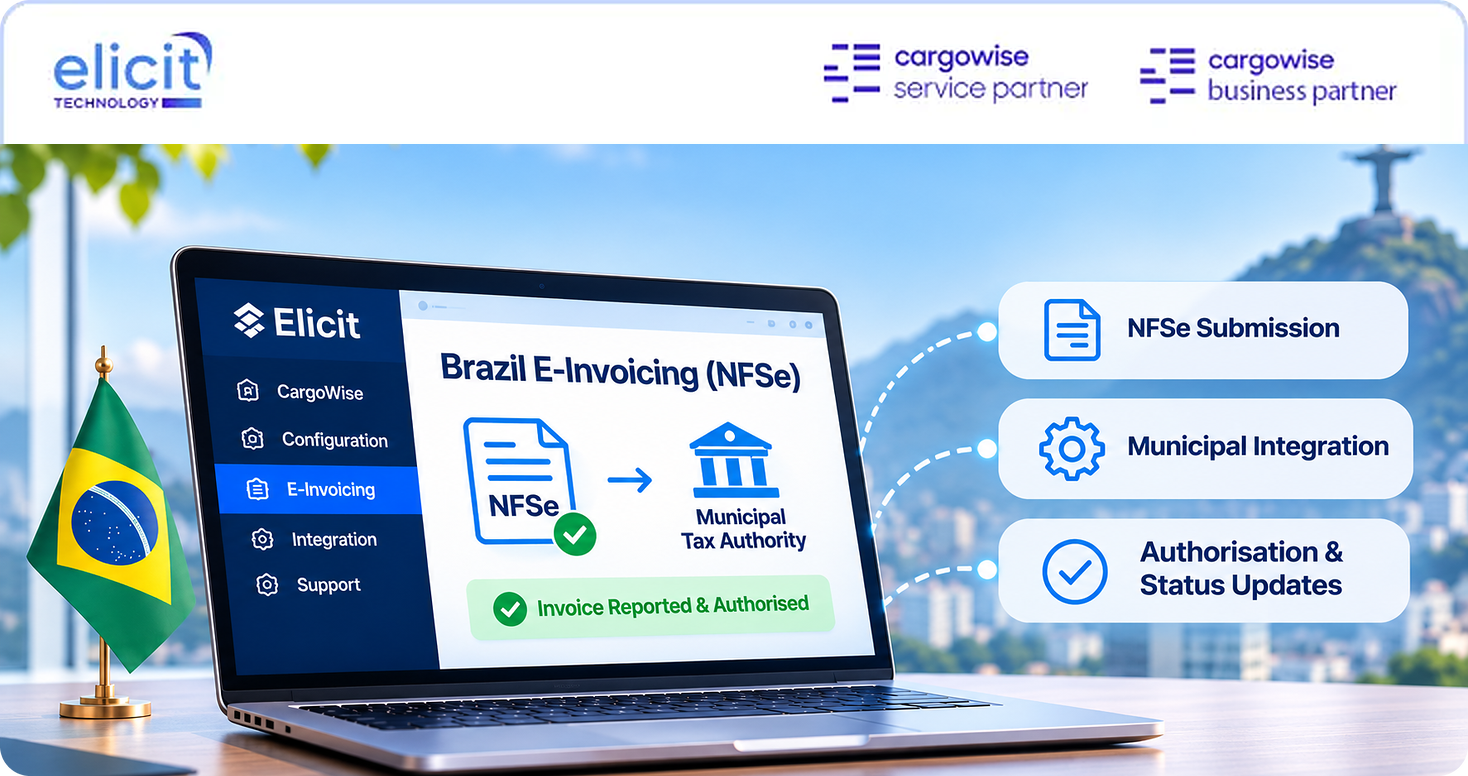
CargoWise provides an electronic reporting solution that allows eligible Accounts Receivable transactions to be transmitted to supported Brazilian municipal tax authorities through the Nota Fiscal de Serviços Eletrônica (NFSe) system.
According to WiseTech Global’s Brazil e-Reporting/e-Invoicing configuration guide, the solution supports electronic invoice submission, municipal authorization responses, fiscal document numbering, and transaction status monitoring.
Understanding how these capabilities work can help CargoWise users establish more consistent invoicing and tax reporting processes.
What is Brazil NFSe E-Invoicing, and Why Does It Matter for Freight Forwarders?
Brazil’s Nota Fiscal de Serviços Eletrônica (NFSe) is an electronic fiscal document used to report taxable services to the relevant municipal tax authority, commonly known as the Prefeitura.
Businesses providing taxable services may be required to maintain federal and municipal tax registrations and report eligible transactions to the appropriate city authority.
For logistics companies, the relevant service transactions may include activities such as freight forwarding, customs-related services, or other invoiced services, depending on their tax treatment.
Under the process described in WiseTech’s guide, a valid fiscal invoice for taxable services is issued only after the relevant municipal authority assigns an NFSe number and verification code.
These two references serve different purposes:
- NFSe Number: The government transaction number assigned by the municipal tax authority.
- Verification Code: The government authorization reference returned by the authority.
CargoWise records these references against the relevant Accounts Receivable transaction after receiving the authorization response.
This allows finance teams to distinguish an invoice that has been posted internally from one that has been successfully reported and authorized by the municipal authority.
How does CargoWise Integrate With Brazil’s Municipal Tax Authorities?
Unlike a single centralized reporting workflow, the Brazil integration described in WiseTech’s guide involves communication with individual municipal tax authorities.
Different cities can have their own web service communication protocols and electronic message formats.
CargoWise addresses these differences through its electronic reporting infrastructure.
When an eligible Accounts Receivable invoice containing an ISS tax transaction is posted, CargoWise prepares the relevant information for electronic reporting.
The information is processed through WiseTech’s Global Electronic Invoicing solution, which identifies the appropriate municipal tax authority and applies the corresponding message mapping.
The eHub messaging platform digitally signs and transmits the message to the relevant authority.
Once the municipality processes the submission, its response is returned to CargoWise.
The system then updates the transaction with the authorization details or an error message.
WiseTech’s April 2025 guide documents integrations with municipal tax authorities, including São Paulo, Rio de Janeiro, Campinas, Curitiba, Santos, Belo Horizonte, Porto Alegre, Recife, and other supported cities.
However, businesses should confirm the currently supported municipalities and message formats before implementation, as the uploaded guide is not a live compatibility list.
What are the Main Configuration Requirements for CargoWise Brazil E-Invoicing?
Successful electronic reporting depends on several connected areas of CargoWise configuration.
A business may have the appropriate tax registrations but still encounter reporting errors if the branch credentials, customer details, tax configuration, or compliance numbering are incomplete.
The following areas are particularly important.
| Configuration area | Why it matters |
| Branch e-invoicing credentials | Authenticates electronic submissions to the relevant municipal authority |
| Branch registration numbers | Identifies the company and municipal tax registration used for reporting |
| Receivables organization details | Supplies the customer’s relevant tax registration information |
| E-reporting registries | Controls electronic reporting and notification behavior |
| Compliance invoice books | Allocates fiscal document numbers by branch and document type |
| Tax configurations | Determines applicable ISS and other relevant tax transactions |
| EBR service task | Supports processing of Brazil electronic reporting messages |
These configurations must work together to support the intended electronic invoicing process.
Branch credentials and digital certificates
WiseTech’s guide explains that each Brazilian municipality may use different communication protocols.
CargoWise therefore requires an appropriate digital certificate authorized for the relevant municipal web service.
The certificate is maintained against the corresponding branch and is used to authenticate transactions sent to that city’s tax authority.
If a certificate is authorized for multiple municipalities, it may need to be configured against each relevant branch.
Company and customer registration numbers
Brazil e-invoicing also depends on accurate tax registration information.
The guide identifies three important registration types:
CNPJ (Cadastro Nacional da Pessoa Jurídica): The business taxpayer registration number.
Inscrição Municipal (IM): The municipal taxpayer registration.
Inscrição Estadual (IE): The state taxpayer registration.
These details are maintained against the relevant branch and receivables organization records.
The CNPJ and municipal registration information are included in electronic reporting messages where applicable.
Missing or incorrect registrations can therefore affect whether an electronic invoice is accepted.
How does CargoWise Manage ISS and Other Brazilian Tax Configurations?
Brazilian electronic service invoicing is closely connected to the applicable tax treatment of each transaction.
One of the key taxes involved is ISS (Imposto Sobre Serviços), a municipal tax associated with taxable services.
WiseTech’s guide explains that CargoWise uses tax configurations and tax defaulting rules to determine when relevant tax transactions should be recorded.
For eligible invoices containing ISS, the corresponding electronic reporting process can be triggered.
The guide also discusses federal taxes and withholdings, including PIS, COFINS, CSLL, and IRRF, where relevant to the company’s configuration.
To support the required calculations, businesses need to review the tax configurations enabled at company and branch levels.
They must also ensure that appropriate tax configuration templates and defaulting rules are applied to receivables organizations.
For example, a freight forwarder may invoice different customers for different service categories.
The tax treatment may vary depending on the nature of the service, the applicable tax rules, and the customer’s tax profile.
CargoWise configuration must reflect those distinctions rather than applying a single tax treatment to every invoice.
Accurate tax setup is particularly important because the ISS tax transaction helps determine which invoices are reported to the municipal authority.
Why are Compliance Invoice Books and RPS Numbers Important?
Brazil’s electronic service invoicing process involves fiscal document numbering as well as government authorization.
The Recibo Provisório de Serviços (RPS) is a provisional service receipt used in the electronic reporting process.
WiseTech’s guide explains that CargoWise uses Compliance Invoice Books to maintain document number sequences for relevant Brazilian transactions.
These include RPS, debit notes, credit notes, and NFSe cancellation documents.
Each Brazilian branch must have the appropriate compliance books configured.
When a relevant Accounts Receivable transaction is posted, CargoWise can assign a compliance subtype and allocate the corresponding number from the appropriate sequence.
For example, an invoice containing a qualifying ISS tax transaction can receive the NFS compliance subtype and an RPS number.
That number is then included in the electronic message sent to the municipal authority.
WiseTech recommends configuring compliance number allocation at transaction posting for the documented Brazil workflow.
This is important because an eligible Accounts Receivable invoice is automatically queued for reporting only after its compliance number has been allocated.
If numbering is deferred, the invoice may remain unreported until the required number is assigned.
For finance teams processing large invoice volumes, consistent numbering procedures can help prevent avoidable reporting interruptions.
How does CargoWise Process and Monitor Brazil Electronic Invoices?
Once the necessary configuration is in place, CargoWise can process eligible electronic invoices through its reporting infrastructure.
The workflow described in WiseTech’s guide involves several connected activities.
First, an Accounts Receivable invoice is posted.
CargoWise evaluates the applicable tax defaulting rules and records the relevant tax transactions.
Where an invoice contains a qualifying ISS tax transaction, the system prepares the electronic reporting information.
The message is then converted into the appropriate municipal format and transmitted through the eHub platform.
The municipal authority validates the submission and returns a response.
CargoWise records the response against the original transaction.
The E-Reporting Status field allows users to monitor the outcome.
Two particularly important statuses are:
SUC – Successful: The municipal tax authority has successfully processed the electronic invoice. CargoWise records the assigned NFSe number and verification code.
FAL – Failed: The submission has failed, and the system records the relevant error information returned by the authority.
The guide also describes situations where transactions may remain in other processing statuses because of communication interruptions or unresolved errors.
Authorized users can requeue eligible transactions after the underlying problem has been corrected.
This provides finance teams with a way to investigate and address reporting failures without recreating the entire invoice unnecessarily.
What Happens When a Brazil NFSe Invoice is Rejected or Needs Cancellation?
Electronic reporting does not always succeed on the first submission.
An invoice may be rejected because of incorrect taxpayer information, missing registration details, or other validation issues.
WiseTech’s guide includes an example of a municipal response indicating that a CNPJ could not be found in the relevant database.
In such cases, the business needs to investigate the error and correct the underlying information before resubmitting the transaction where permitted.
CargoWise can also notify a designated group when electronic reporting transactions fail.
The E-Reporting Error Notification Group registry allows businesses to identify users who should receive these notifications.
This is useful for finance teams responsible for monitoring electronic invoice processing across several branches.
Cancellation is another important requirement.
If an invoice has already been successfully authorized by a municipal authority but needs to be canceled, the guide describes a process involving reversal of the original Accounts Receivable invoice.
The reversal creates a credit note that triggers the corresponding NFSe cancellation message.
The municipal authority processes the cancellation request, and CargoWise records the response against the credit note.
A successful cancellation response confirms that the related NFSe has been canceled.
Businesses should follow the applicable municipal requirements and their own accounting procedures when correcting or canceling fiscal documents.
Can CargoWise Generate Brazil NFSe and RPS Fiscal Documents?
Electronic reporting is only one part of the invoicing process.
Businesses may also need to produce a suitable representation of the fiscal document for their records or customer communication.
CargoWise supports printing RPS documents and representations of NFSe documents for relevant transactions.
WiseTech’s guide describes a DocBuilder BR RPS_NFS-e Fiscal Note template that can be customized and attached to the appropriate compliance invoice book.
The template is designed to produce a Brazil local-currency fiscal document for invoices containing the relevant ISS expense tax transaction.
CargoWise users can print the compliance document from the job billing area or through the Print Invoice module.
Depending on the configured printing options, users can produce the standard CargoWise invoice, the compliance document, or both.
The guide also emphasizes that users should not change the compliance number of an already reported transaction, because this could create a mismatch between the RPS number in CargoWise and the municipal authority’s records.
For businesses requiring changes to fiscal document layouts, appropriate CargoWise Document Customization can help align document presentation with operational requirements, while preserving the necessary fiscal information.
What should CargoWise Users Check Before Enabling Brazil E-Invoicing?
Before implementing the Brazil electronic reporting workflow, businesses should review their operational and technical readiness.
This includes confirming that the relevant municipal authority is supported by the integration and that the appropriate digital certificates are available.
Branch and customer registration numbers should be accurate and maintained consistently.
Tax configurations must reflect the applicable services and customer tax profiles.
Compliance invoice books should also be configured for each participating Brazilian branch.
The EBR – Brazil E-Invoice Processing Service Task must be active to support the electronic reporting process.
WiseTech’s guide states that Brazil e-reporting is enabled by default in Brazilian test databases, while production activation requires a CR9 service request.
Businesses should therefore complete appropriate testing and follow WiseTech’s activation procedures before using the functionality in production.
The guide also recommends raising a support incident if an expected electronic reporting response does not reach either successful or failed status within three hours.
These checks help identify potential problems before they affect routine invoice processing.
How can Elicit Technology Support CargoWise Brazil E-Invoicing Implementation?
Brazil e-invoicing requires coordination between accounting configuration, tax data, compliance document numbering, electronic messaging, and municipal authorization requirements.
For CargoWise users, the challenge is ensuring these elements operate together within the existing financial workflow.
As an official CargoWise Service and Business Partner, Elicit Technology helps freight forwarders and logistics businesses configure, integrate, and optimize CargoWise for their operational requirements.
Our CargoWise Global E-Invoicing Services support businesses evaluating country-specific electronic invoicing requirements and their implementation within CargoWise.
For organizations operating in Brazil, our specialists can assist with reviewing the relevant CargoWise configuration requirements, including branch registration information, compliance numbering, tax-related settings, and electronic reporting workflows.
We can also help evaluate how existing Accounts Receivable processes align with the documented Brazil e-reporting functionality.
Where document presentation or connected system requirements need attention, our CargoWise customization and integration capabilities can support the appropriate technical changes.
The objective is to help businesses use CargoWise’s available functionality effectively while maintaining reliable electronic invoicing procedures.
Municipal tax obligations, registration requirements, and legal interpretations should be confirmed with qualified local tax professionals and the relevant authorities.
Conclusion: Build a More Reliable Brazil E-Invoicing Process With CargoWise
Brazil’s electronic service invoicing requirements involve several interconnected activities, from municipal tax registration and invoice numbering to tax calculations and electronic authorization.
For freight forwarders, these requirements must be managed alongside daily shipment operations and customer invoicing.
CargoWise’s Brazil e-reporting functionality provides a structured way to transmit eligible service invoices to supported municipal authorities, receive authorization responses, and monitor reporting outcomes.
However, successful implementation depends on accurate master data, appropriate tax configurations, compliance numbering, valid digital certificates, and correctly configured electronic reporting services.
Businesses should also verify the latest municipal requirements and currently supported CargoWise integrations before deployment.
Planning to implement or improve Brazil e-invoicing in CargoWise?
Elicit Technology can help you review your CargoWise environment, assess the documented configuration requirements, and identify suitable improvements to your electronic invoicing workflows.
Book a Consultation with our CargoWise specialists to discuss your requirements.