





A shipment booking arrives with incomplete product information. The customs team needs to verify the commodity classification, operations is following up on missing documents, and finance is reviewing supplier invoices that do not match the expected job costs.
Each activity requires attention, but much of the work involves collecting information, checking records, and coordinating between departments.
For freight forwarders managing hundreds or thousands of shipments, these repetitive activities can consume a significant portion of the working day.
CargoWise AI agents are designed to change how logistics teams manage these responsibilities by bringing intelligent assistance, information processing, and task execution into existing CargoWise workflows.
Instead of relying entirely on manual follow-ups, document reviews, and information searches, businesses can explore AI-powered capabilities that support employees throughout the shipment lifecycle.
The opportunity goes beyond completing individual tasks faster. It is about creating more connected operations where teams can focus on shipment exceptions, customer requirements, and decisions that need human expertise.
Why are AI Agents Becoming Important for Freight Forwarding Operations?
Freight forwarding involves multiple interconnected processes, from shipment bookings and customs documentation to compliance checks, invoicing, and delivery coordination.
Although logistics businesses have adopted digital platforms, many operational activities still require considerable manual involvement.
Employees may need to search for product information, compare documents, request missing details, or investigate discrepancies between invoices and shipment records.
These activities are necessary, but they can slow down operations when shipment volumes increase.
Traditional automation helps execute predefined tasks. AI agents extend these capabilities by interpreting information, considering operational context, and supporting decisions or actions within defined workflows.
For CargoWise users, the advantage is that these capabilities are designed to operate within the platform already managing shipment, customs, and financial information.
This can reduce the need to move between disconnected applications and help employees work with more relevant information.
Which CargoWise AI Solutions can Improve Daily Logistics Operations?
CargoWise’s expanding AI portfolio addresses several common challenges experienced by freight forwarders, customs brokers, and logistics finance teams.
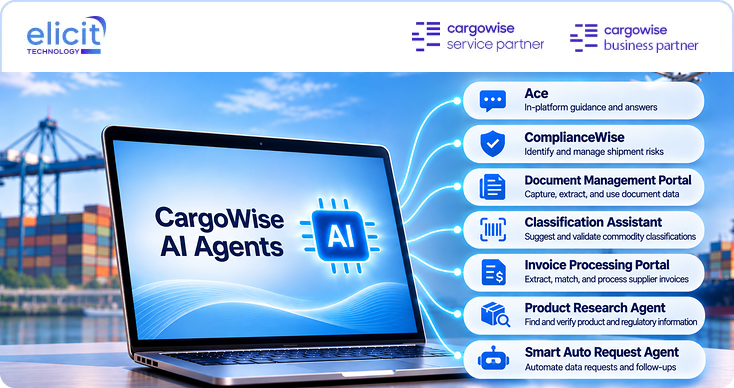
1. Ace: Get CargoWise Guidance When Your Team Needs It
Employees frequently encounter questions while working in CargoWise.
A new team member may be unfamiliar with a particular function, while an experienced operator may need clarification about an uncommon process.
Searching through documentation or waiting for assistance can interrupt the workflow.
Ace chatbot provides AI-assisted guidance grounded in verified CargoWise knowledge.
It is designed to help users find relevant answers while working within the platform.
For freight forwarding businesses, this can support employee onboarding, reduce routine support enquiries, and help teams resolve operational questions more efficiently.
Instead of repeatedly interrupting senior employees for guidance, teams can access assistance closer to the point of work.
2. ComplianceWise: Identify Shipment Compliance Risks Earlier
International trade compliance involves more than checking a commodity description.
The nature of the goods, parties involved, intended end use, and applicable restrictions may all influence whether a shipment requires additional review.
ComplianceWise is designed to assess shipment risk using relevant transaction context.
It helps identify potentially high-risk commodities and provides supporting information for compliance assessments.
For example, a shipment containing specialized industrial equipment may require closer examination because of its possible applications or the parties involved.
Earlier identification of such concerns can help compliance teams prioritize investigations and maintain more consistent assessment records.
The objective is to support informed compliance decisions while retaining appropriate human oversight.
3. Document Management Portal: Reduce Repetitive Document Handling
Commercial invoices, packing lists, transport documents, and other shipment paperwork contain information needed throughout the logistics process.
When employees manually extract and re-enter that information, the work becomes repetitive and can introduce inconsistencies.
The Document Management Portal is designed to transform document information into structured data that can support downstream activities.
It also helps identify discrepancies earlier in the process.
For example, inconsistent quantities between a commercial invoice and packing list may require investigation before customs documentation is finalized.
By supporting document interpretation and validation, this solution can help operators spend more time resolving exceptions and less time handling routine information.
4. Classification Assistant: Support More Consistent HS Code Decisions
Correct commodity classification is essential for customs declarations, duty calculations, and regulatory compliance.
However, determining the appropriate Harmonized System (HS) code can require detailed product knowledge and interpretation.
The Classification Assistant is designed to guide users through classification assessments using relevant questions and supporting justification.
Rather than relying only on manual searches, customs teams can work through a more structured decision process.
This can help reduce research effort, improve consistency, and maintain clearer records supporting classification decisions.
Human review remains important, particularly for complex goods or classifications involving significant regulatory consequences.
5. Invoice Processing Portal: Connect Finance With Shipment Operations
Supplier invoice processing is a common source of administrative work for freight forwarders.
Finance teams must verify charges, match invoices to the correct jobs, review accruals, and investigate discrepancies.
When this information is spread across departments, approvals may require additional communication.
The Invoice Processing Portal is designed to connect invoice processing with the relevant CargoWise job and accrual information.
It supports coordinated reviews, approvals, comments, and audit trails.
For example, when a carrier invoice differs from the expected shipment cost, finance and operations can work with the associated job context to investigate the discrepancy.
This can support more consistent invoice processing and reduce unnecessary administrative coordination.
6. Product Research Agent: Make Commodity Research More Efficient
Customs teams frequently receive incomplete or unclear product descriptions.
A commercial invoice may identify an item using a general term that does not provide enough information for classification.
Employees then spend time researching product characteristics, technical specifications, and intended uses.
The Product Research Agent is designed to identify products from goods descriptions and gather relevant, source-supported information.
This helps customs specialists begin their assessments with more useful product details.
It complements the Classification Assistant by supporting the research stage rather than replacing the classification decision itself.
For businesses handling varied or technically complex commodities, this can help reduce repetitive research activities.
7. Smart Auto Request Agent: Reduce Missing-Information Follow-Ups
Incomplete shipment information can affect booking processing, customs preparation, and operational coordination.
A missing product description, customer reference, or required document may lead to several follow-up emails.
Employees must then monitor responses and determine whether the information is complete.
The Smart Auto Request Agent is designed to request missing information from the appropriate parties through a more coordinated process.
By initiating requests earlier, it can help teams obtain necessary details before they become obstacles to subsequent activities.
For freight forwarders, this supports a shift from repeatedly chasing information to concentrating on requests that genuinely need intervention.
How can CargoWise AI Support the Entire Shipment Lifecycle?
The value of CargoWise AI becomes clearer when considering how these capabilities relate to different stages of a shipment.
During booking, intelligent document processing and information requests can help improve the completeness of shipment records.
During customs preparation, product research, classification assistance, and compliance assessment can support more informed decisions.
Throughout operations, employees can use contextual guidance to understand unfamiliar processes.
During financial processing, invoice automation can help connect supplier charges with shipment records and expected costs.
These capabilities address related operational challenges rather than functioning as entirely separate productivity tools.
The longer-term opportunity is to create more connected workflows where information collected during one activity can support subsequent processes.
However, individual AI solution availability and the extent of integration between agents should be confirmed before planning implementation.
Can CargoWise AI Help Freight Forwarders Reduce Operational Costs?
AI can create opportunities to reduce the manual effort associated with repetitive logistics activities.
Potential benefits include less time spent searching for information, fewer routine document-handling tasks, more efficient invoice reviews, and reduced administrative follow-ups.
CargoWise’s AI development strategy includes a target of up to approximately 50% labor cost savings.
This is an aspirational target rather than a guaranteed result.
Actual benefits depend on the organization’s shipment volumes, existing workflows, data quality, employee adoption, and the specific AI capabilities deployed.
For example, a freight forwarder processing high volumes of similar supplier invoices may have different opportunities from a business handling specialized project cargo.
Rather than focusing only on a percentage target, businesses should evaluate practical performance measures such as processing time, manual corrections, outstanding information requests, and invoice exception resolution.
This provides a clearer understanding of where AI can deliver operational value.
What should CargoWise Users Consider Before Introducing AI into Their Operations?
AI adoption works best when the underlying business processes are clearly understood.
A freight forwarder may want to automate document processing, but inconsistent customer information or incomplete shipment records can limit the value of that initiative.
Similarly, AI-assisted invoice processing may be less effective when job costing and accrual practices are inconsistent.
Before adopting new capabilities, businesses should evaluate their existing CargoWise environment.
Important considerations include data accuracy, standardized operational workflows, system configuration, integration requirements, user permissions, and appropriate oversight.
Organizations should also identify which repetitive activities create the greatest operational burden.
This helps prioritize solutions based on genuine business requirements rather than adopting technology without a clear purpose.
How can Elicit Technology Help You Prepare for CargoWise AI Solutions?
Introducing AI into freight forwarding operations requires more than identifying the right technology.
Businesses also need to understand how new capabilities will fit into their existing CargoWise processes, data structures, and operational responsibilities.
As an official CargoWise Service and Business Partner, Elicit Technology helps freight forwarders assess their current CargoWise environment and prepare for more intelligent, connected workflows.
Our specialists support CargoWise implementation, configuration, workflow optimization, customization, and integration requirements.
For example, a business interested in AI-assisted invoice processing may need to review its existing supplier invoice and job costing processes.
Another organization planning to improve document handling may need to assess how shipment information is captured, maintained, and shared between departments.
Elicit Technology can help identify these requirements and recommend suitable improvements that support the effective adoption of available CargoWise capabilities.
Through our CargoWise AI Automation Services, we help logistics businesses evaluate automation opportunities and strengthen the operational foundations needed for AI-enabled workflows.
Our focus is on helping customers make practical improvements while maintaining consistency across their CargoWise operations.
The native AI agents are CargoWise product capabilities, with availability and activation subject to the product provider’s requirements.
Conclusion: Prepare Your CargoWise Operations for More Intelligent Logistics Execution
Freight forwarding involves numerous activities that require employees to collect information, verify details, coordinate with other departments, and resolve operational issues.
CargoWise AI introduces opportunities to reduce the manual effort involved in these activities by bringing intelligent assistance into existing logistics workflows.
From document processing and customs classification to compliance assessments and invoice management, these solutions can help businesses rethink how routine work is handled.
The greatest opportunity is not simply automating more tasks. It is enabling employees to concentrate on the decisions, exceptions, and customer requirements where their expertise adds the most value.
For CargoWise users, successful AI adoption begins with reliable data, well-defined workflows, and a clear understanding of operational priorities.
Looking to make your CargoWise operations more intelligent and efficient?
Elicit Technology, your official CargoWise Service and Business Partner, can help you assess your existing environment and identify suitable configuration, integration, and automation opportunities.
Book a Consultation to discuss how your business can prepare for AI-enabled CargoWise operations.