



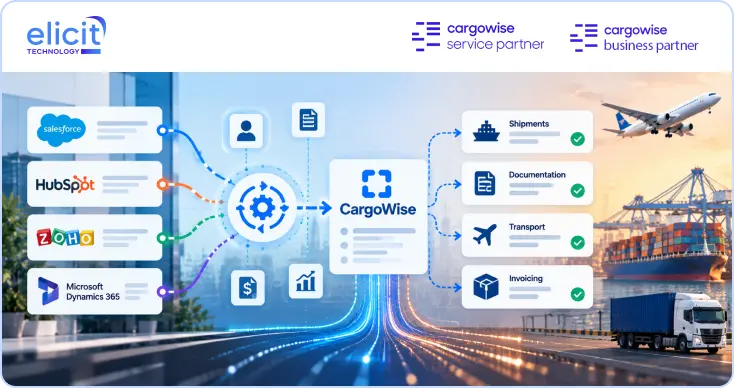
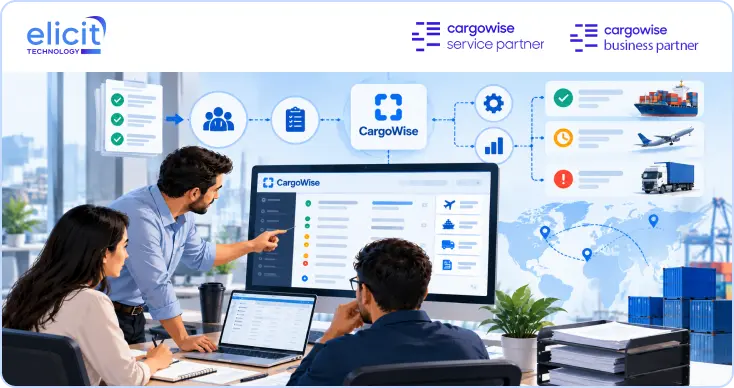




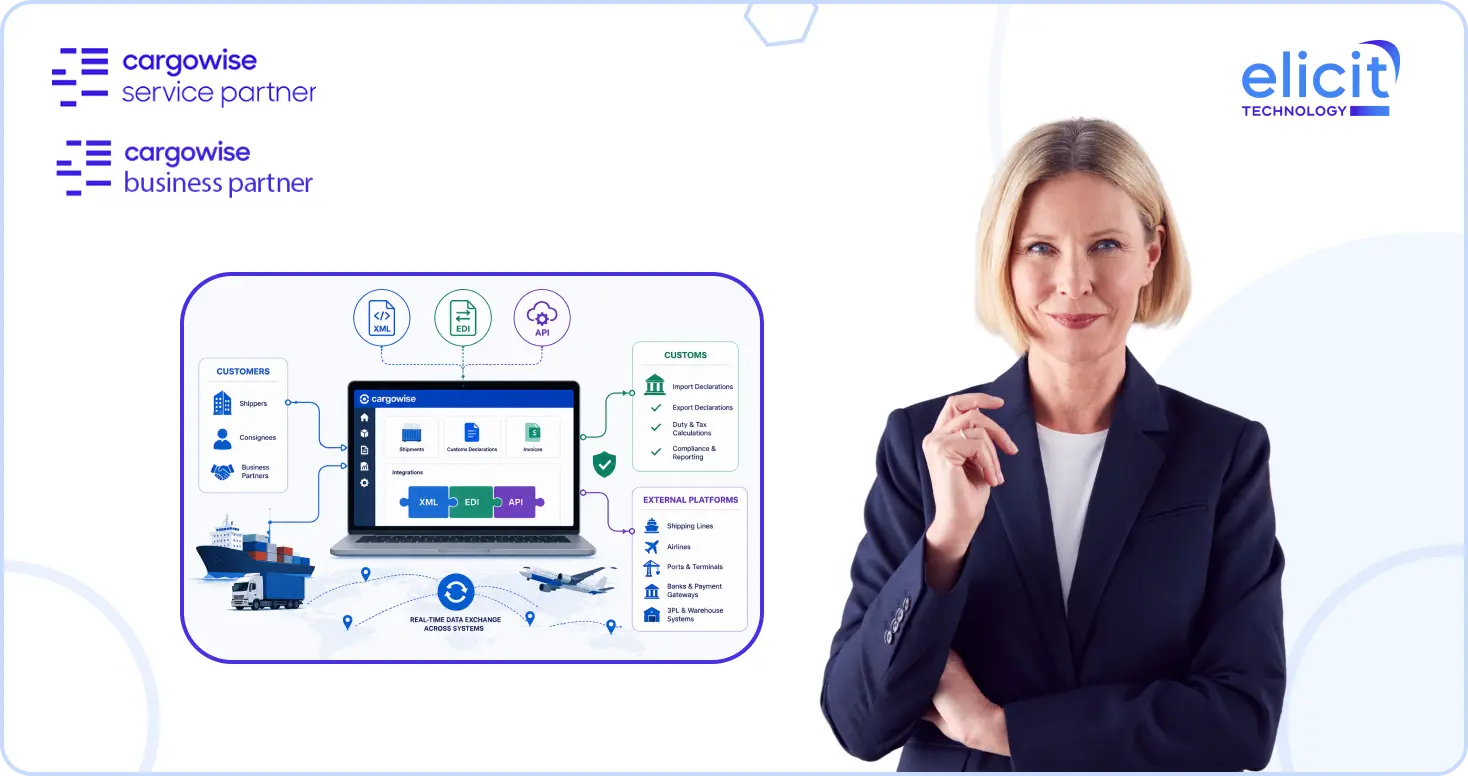
CargoWise can sit at the center of a freight forwarding operation, but it rarely works alone.
Customer systems send invoices in their own formats. Customs platforms need structured shipment data. Product feeds arrive from external systems. Carrier platforms exchange booking and status information. AMS solutions may need to transmit house bills using the forwarder’s own SCAC. Meanwhile, internal portals, CRMs, finance tools, and warehouse applications all expect CargoWise data to move in and out without someone manually re-entering it.
That is where CargoWise integration becomes critical.
The real value of integration is not simply connecting one piece of software to another. It is removing the gaps between systems where people are currently copying information, checking spreadsheets, uploading documents, correcting errors, and chasing updates.
For growing logistics companies, those gaps quickly become expensive.
Why does CargoWise Integration Matter So Much?
Most integration problems become visible only after operations scale.
At low shipment volumes, a team may manage by manually entering a customer booking, copying invoice details from an email, uploading customs information, or moving status updates into another portal.
One person doing that five times a day may not seem like a serious problem.
Hundreds of shipments later, it becomes one.
Every manual handoff creates another opportunity for duplicate entry, inconsistent information, delayed processing, or simple human error. More importantly, it means experienced operations staff are spending time moving data rather than managing freight.
A well-connected CargoWise environment changes that relationship.
Instead of asking employees to move information between systems, integrations allow the systems to exchange the information directly.
That is why CargoWise integration should not be treated as a technical add-on after implementation. It should be considered part of how the operating model is designed from the beginning.
What does XML Integration do in CargoWise?
XML is one of the most practical ways to exchange structured logistics data between systems.
It can be used both into CargoWise and out of CargoWise, depending on the process.
For example, an external product or order system may already contain item information needed inside CargoWise. Without integration, an operator could receive a spreadsheet, portal export, or document and then manually create each record.
With an XML-based connection, the structured information can be mapped and sent directly into the appropriate CargoWise process.
That removes one layer of re-entry.
The same principle applies outbound.
CargoWise data can be transformed into XML required by customs, brokerage, clearance, or other external platforms. If another system requires structured information for customs documentation or entry processing, the relevant CargoWise data can be mapped into the expected format rather than assembled each time manually.
The benefit is not simply speed.
When information is electronically transferred from an existing source rather than retyped, businesses can reduce transcription errors and create more consistent downstream processes.
How does EDI Integration Reduce Repetitive Work?
Electronic Data Interchange, or EDI, remains valuable where businesses exchange large volumes of standardized transactions.
Customer invoicing is a simple example.
Without integration, an invoice may arrive as a PDF or attachment. Someone opens it, reads the information, checks it against the job, and enters the required details into CargoWise.
Repeat that process across hundreds or thousands of invoices, and the cost becomes obvious.
With the appropriate CargoWise EDI integration, structured invoice information can pass between systems without requiring the finance team to manually recreate every transaction.
But EDI is not limited to invoices.
Depending on the connected parties and agreed message structures, it may also support transactions such as:
- Bookings
- Shipment instructions
- Status messages
- Carrier communications
- Customer data exchanges
- Financial transactions
The larger the transaction volume, the more valuable this becomes.
Instead of scaling administration every time shipment volume increases, an integrated operation allows a greater share of that volume to move electronically.
Where do APIs Fit Into CargoWise Integration?
EDI works well for standardized, structured exchanges.
APIs become especially useful when systems need more immediate application-to-application communication.
Think about a customer portal.
A customer creates an order. The business does not want an employee checking that portal every hour, copying the information, and creating the corresponding job manually.
With the right API-based integration, the external application can send information into the connected CargoWise process automatically.
The same principle can work in reverse.
A shipment milestone changes inside CargoWise. An external customer application needs that latest status. Instead of waiting for someone to send an update, the systems can exchange the relevant information electronically.
CargoWise API integrations can also support documents, order information, shipment data, operational updates, and other information required by connected cloud applications.
The distinction between API and EDI does not need to become an either-or decision.
Many logistics companies use both.
EDI can handle repeatable standardized business transactions, while APIs support more dynamic or real-time application interactions.
The important question is not which technology sounds more modern.
It is which connection method best suits the process being automated.
Why does Data Mapping Matter in CargoWise Integration?
Connecting two systems is only the beginning.
The systems also need to understand one another.
Imagine an external customer system stores a shipment reference under one field name, CargoWise expects it somewhere else, and the customs platform needs a variation of the same information in a third structure.
An integration has to determine how those fields relate.
That is data mapping.
Good mapping answers questions such as:
What external field corresponds with the correct CargoWise field?
Which values need to be transformed?
What happens if mandatory information is missing?
How should dates, codes, addresses, currencies, or reference numbers be formatted?
What should happen when the receiving system rejects the message?
Poor mapping can simply automate bad data faster.
That is why CargoWise integration work requires understanding both the technology and the underlying logistics process.
How Can CargoWise Integrate with Customs Processes?
Customs integration is one of the areas where reliable data exchange matters most.
Customs environments may require specific information structures, documentation, classification details, party data, and filing information.
If the information already exists inside CargoWise, repeatedly reconstructing it inside another customs or brokerage application creates unnecessary work and increases the risk of differences between systems.
A properly designed integration can allow relevant CargoWise data to move into the required external environment while responses or status information can flow back where appropriate.
This creates a more connected workflow between forwarding operations and customs processing.
It also highlights why the project cannot be treated purely as an IT exercise.
The integration needs to reflect how the customs process actually works, which information owns the source of truth, and which exceptions require human review.
What About AMS Integration and Your Own SCAC?
US ocean operations can introduce another important integration requirement.
Some freight forwarders or NVOCCs use dedicated AMS platforms alongside CargoWise. In that model, the systems need to communicate reliably so the required bill information does not have to be rebuilt manually.
A common operational requirement is transmitting a house bill under the forwarder or NVOCC’s appropriate SCAC, while maintaining the correct relationship with the ocean carrier’s master bill.
That makes AMS integration both a configuration and data-exchange issue.
CargoWise needs to contain the appropriate shipment and bill information. The connected AMS environment needs to receive that information correctly. The relevant identifiers need to be mapped appropriately. And the final process needs to support the filing workflow the business actually uses.
If those systems are disconnected, users can end up copying house bill information manually from CargoWise into an external AMS application.
That introduces another duplicate-entry point exactly where accuracy and timing matter.
What does a Connected CargoWise Operation Look Like?
A properly integrated environment feels very different from a disconnected one.
A customer sends structured order information, and it flows into the relevant process.
Product or item information arrives electronically rather than being copied from a spreadsheet.
Invoices move through EDI rather than being manually keyed.
Documents and shipment data pass between CargoWise and external applications through APIs.
Customs information moves in the required structured format.
AMS data can be exchanged with the appropriate filing platform instead of being reconstructed from scratch.
Shipment updates can also flow back outward to customers or other systems.
At that point, the operations team is no longer acting as the integration layer.
The technology is.
Employees become responsible for reviewing exceptions, making decisions, handling customers, and resolving unusual situations rather than copying information between screens.
Why is Exception Management Important?
No integration is perfect simply because it has been switched on.
Messages can fail.
A mandatory field may be missing.
A customer can send an unexpected format.
An API can return an error.
An external system may reject a transaction.
This means integration design needs to include exception management, not just successful transactions.
Teams should know when a connection fails, what information caused the problem, where the transaction is sitting, and who is responsible for fixing it.
Without that visibility, integration can actually make operational problems harder to see.
With appropriate monitoring and workflows, exceptions can be routed to the right people while the majority of successful transactions continue automatically.
That is the model businesses should be aiming for: automation for the routine, human attention for the exceptions.
When should You Review Your CargoWise Integrations?
You do not need to wait until an integration completely fails.
There are usually earlier warning signs.
If users repeatedly copy the same information between CargoWise and another platform, a connection may be missing.
If customers send large volumes of structured data but staff still create records manually, there may be an integration opportunity.
If customs or finance teams maintain separate spreadsheets because data does not move reliably between applications, the existing integration architecture may need review.
The same applies when a company expands.
New branches, customers, carriers, countries, platforms, and services may create data flows that did not exist when CargoWise was first implemented.
An integration model that worked three years ago may no longer reflect how the business operates today.
How Elicit Helps Connect CargoWise with Your Wider Technology Environment?
CargoWise provides the operational platform, but getting external systems to communicate with it reliably requires the right combination of CargoWise knowledge, integration experience, and logistics process understanding.
As an official CargoWise Service and Business Partner, Elicit Technology helps logistics companies connect CargoWise with the systems surrounding their operation.
Our team supports XML and customs integration, EDI and e-invoicing, API services, carrier and wider CargoWise integration services based on the business process being connected.
The objective is not to integrate everything simply because it can be integrated.
We first look at where your team is duplicating work, where data is being re-entered, which systems need real-time communication, what external formats are required, and which processes create the greatest operational risk.
From there, the integration can be designed around the actual workflow rather than forcing the operation to work around the technology.
Conclusion
The strength of CargoWise is not only what happens inside the platform.
It is also how effectively CargoWise communicates with everything around it.
XML can reduce repeated entry of structured logistics and customs data. EDI can automate high-volume business transactions. APIs can create real-time connections with customer portals and modern cloud applications. AMS integrations can reduce the manual gap between CargoWise and external filing environments.
Together, these connections turn CargoWise from a standalone operating platform into the center of a broader digital logistics ecosystem.
If your team is still copying data between CargoWise, customer systems, customs platforms, AMS applications, invoices, or internal tools, those manual handoffs are good places to start looking for integration opportunities.
Elicit Technology’s certified CargoWise consultants can review your current data flows and help design the right mix of XML, EDI, API, customs, carrier, and AMS integrations around the way your operation actually works.
Explore CargoWise integration services or schedule a call to discuss where your CargoWise environment can become more connected.