








For a freight forwarder, an ocean shipment heading into Europe can look perfectly ready operationally, booking confirmed, documents received, container moving, customer updated.
But under ICS2 Release 3, customs authorities need more than a shipment that is operationally ready. They need accurate safety and security data before the goods arrive, and for maritime shipments that increasingly means detailed information at house level.
That puts freight forwarders much closer to the compliance process.
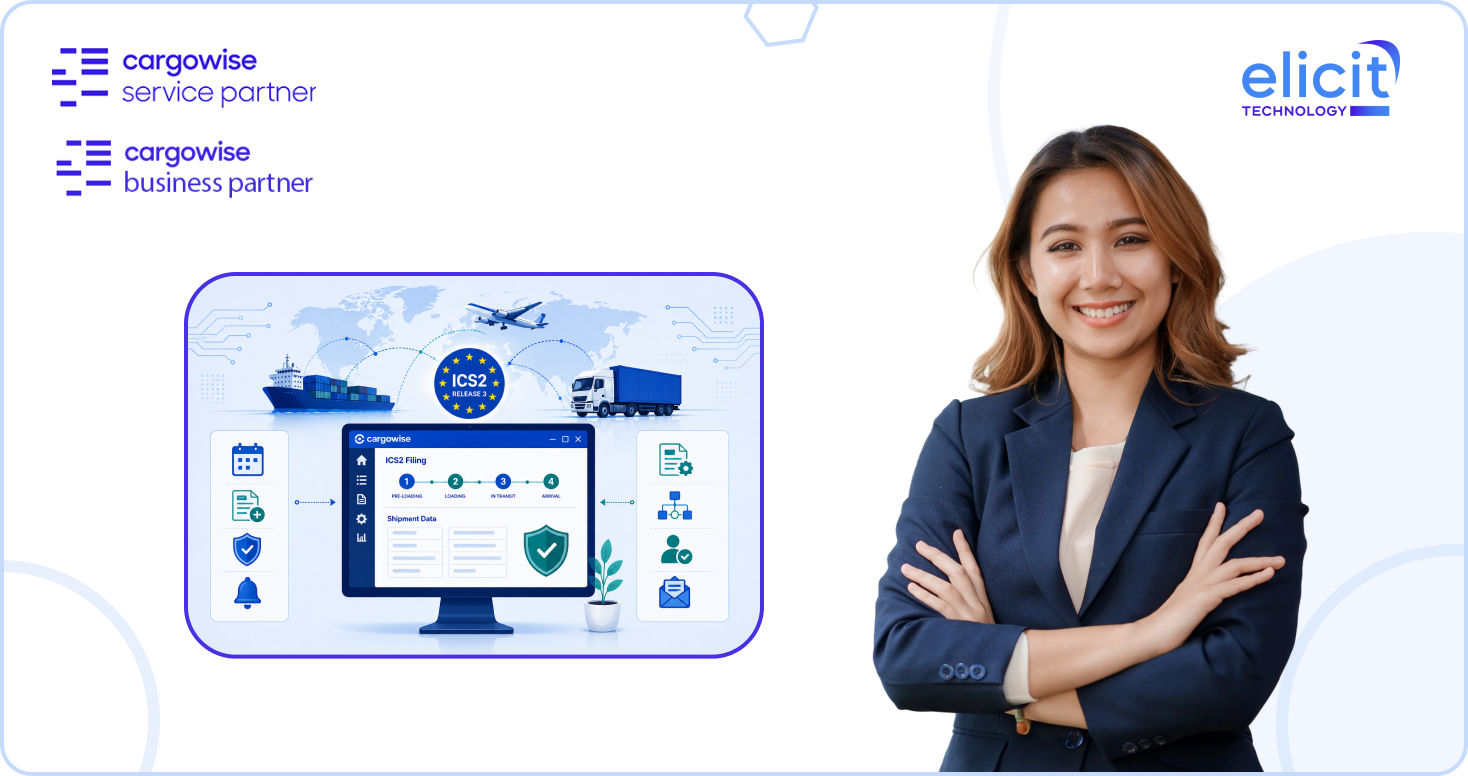
ICS2 Release 3 extended the European Union’s Import Control System 2 to maritime and inland waterways, followed by road and rail. CargoWise responded with changes around ENS-related data capture, EORI information, HS codes, CUS codes, shipping instructions, and validations designed to help users prepare compliant data.
For CargoWise users, the important question now isn’t simply “What is ICS2?”
It’s “Is our CargoWise configuration and operational data actually ready for it?”
What is ICS2 Release 3?
ICS2, or Import Control System 2, is the EU’s advance cargo information system for safety and security. Economic operators bringing goods into or through the EU must provide Entry Summary Declaration (ENS) information before arrival so customs authorities can perform advance risk analysis.
The program was introduced progressively.
Release 1 focused primarily on pre-loading data for postal and express air consignments. Release 2 extended the new ENS requirements to air cargo. Release 3 extended them to maritime and inland waterways and ultimately road and rail traffic.
For freight forwarders, the maritime house-level requirement was particularly significant because the necessary information isn’t always held entirely by the ocean carrier.
That changes who needs to capture, validate, and potentially submit the data.
What Changed for Freight Forwarders Under ICS2 Release 3?
Previously, some forwarders could rely heavily on carriers to handle advance security declarations.
ICS2 Release 3 makes that assumption much harder to maintain.
For maritime movements, CargoWise highlighted that many ocean carriers were shifting responsibility for providing the required house-level ENS data toward freight forwarders. Forwarders therefore need to establish whether they will provide the complete required information to the carrier or handle the relevant filing responsibilities separately according to the applicable filing arrangement.
ICS2 supports both single and multiple filing models, depending on contractual arrangements and which supply-chain participant possesses the required information.
That makes responsibility one of the first things a forwarding business should clarify.
Who is filing what, and who owns the accuracy of each data element?
If that isn’t clearly defined, the technology alone won’t solve the compliance problem.
What Information does ICS2 Require?
The ENS requires considerably more structured information than a vague shipment description and basic routing details.
CargoWise’s ICS2 guidance highlights important data including:
- Complete and accurate commercial goods descriptions
- Six-digit HS commodity codes
- Relevant trading-party information, including seller, buyer, consignee and consignor
- EORI information
- CUS codes where applicable
- Other mandatory shipment and shipping-instruction data
The European Commission emphasizes that a complete ENS must contain all data elements required for the relevant transport mode and business model.
This is why ICS2 should not be treated purely as a customs filing issue.
It is also a data-quality issue.
If the correct information never enters CargoWise upstream, there is very little a downstream declaration process can do to repair it automatically.
What has Changed in CargoWise for ICS2 Release 3?
CargoWise introduced several changes specifically intended to support the additional ICS2 requirements.
One important addition is the ICS2 Declarant EORI field.
CargoWise provides a dedicated field for identifying the relevant filing party’s EORI, with validations applying where shipments involve applicable discharge locations in the EU, Northern Ireland, Norway, or Switzerland.
This matters because an EORI isn’t simply another reference to type somewhere in the job.
The correct declarant needs to be identified within the appropriate process.
CargoWise has also strengthened data capture and validation in other areas, particularly commodity and shipping-instruction information.
Why is the Six-Digit HS Code Important?
One of the clearest ICS2 data requirements is the six-digit HS commodity code.
CargoWise’s ICS2 changes enforce the required six-digit HS-code format to support compliant filing.
For freight forwarders, this means generic descriptions or incomplete commodity information can’t simply be allowed to flow through the shipment lifecycle unchecked.
Consider descriptions such as:
“Parts”
“Equipment”
“Samples”
“General cargo”
Those descriptions may make sense to the person who created the booking, but they may not provide customs authorities with sufficient information to understand what is actually being transported.
ICS2 pushes data quality further upstream.
Your operations team therefore needs a process for collecting accurate commodity information from customers before the filing deadline, not after a declaration has already failed validation.
What are CUS Codes and What Changed in CargoWise?
CargoWise also introduced an editable CUS Code(s) field under Goods Details or Goods and Equipment Details.
According to CargoWise, users can enter up to nine CUS codes per pack line, supporting appropriate reporting for relevant harmless and dangerous-goods chemicals.
CargoWise also includes error handling around this information.
If an invalid CUS code is entered, users can receive an error directing them toward the correct value available through the Global Codes module.
That’s an important example of how CargoWise compliance configuration should work.
The objective isn’t simply to create another field operators have to remember.
It’s to place structured data and validation into the workflow so errors can be identified before they become filing problems.
What Changed in CargoWise Shipping Instructions?
Shipping instructions are another critical part of ICS2 readiness because much of the information required for the ENS originates from operational shipment data.
CargoWise has added validations intended to make sure required information, such as Marks & Numbers, is completed appropriately.
The practical implication is worth emphasizing.
An ICS2 problem might begin long before anyone opens a customs declaration.
It may begin when a shipment is created with incomplete parties, poor commodity descriptions, missing references, or inconsistent master data.
If that information moves through booking, documentation, and carrier messaging without being corrected, the compliance team inherits the problem at the worst possible point: close to the filing deadline.
Good CargoWise configuration should therefore prevent weak data from progressing unnoticed wherever possible.
What About the House Bill Payment Method?
CargoWise also added support for specifying the House Bill payment method when the carrier is responsible for filing the ENS.
CargoWise lists available payment-method options including cash, credit card, cheque, electronic funds transfer, and account-holder payments.
This may look like a small field compared with an HS code or EORI, but ICS2 compliance depends on completing the required dataset, not simply capturing the fields that operations teams consider most important.
That’s why businesses should review the entire data requirement rather than fixing individual validation errors as they appear.
What does House-Level Filing Mean in Practice?
Suppose an NVOCC or freight forwarder consolidates several house shipments under one master ocean bill.
The carrier knows the master movement.
But the forwarder may hold much more detailed information about the individual house shipments, their parties, and commodities.
ICS2 accommodates situations where ENS information may be supplied through multiple filings by different supply-chain participants. The European Commission explains that the filing model depends on contractual arrangements and who possesses the necessary data.
That means freight forwarders need clear operational rules covering questions such as who provides the house-level data, whether information is transmitted to the carrier or filed separately, when the information must be ready, and who responds when validation or customs feedback requires action.
Without those responsibilities being defined, teams can end up assuming another party has completed a filing that is actually waiting on them.
What should CargoWise Users Configure and Review?
There isn’t one universal CargoWise checkbox that makes every forwarding operation “ICS2 compliant.”
Your setup needs to reflect your business model, filing responsibilities, customers, carriers, routes, and internal workflows.
At minimum, CargoWise users should review how their environment handles ICS2 Declarant EORI data, six-digit HS codes, CUS codes where applicable, Marks & Numbers, commercial goods descriptions, house-level party information, payment methods where relevant, and other required shipping-instruction data.
But configuration should go further than individual fields.
Organizations should also examine their master data, user responsibilities, shipment-creation process, document intake, validation points, exception handling, and workflow triggers.
The real objective is to identify missing information before the ENS needs to be submitted.
Can CargoWise Workflows Help Reduce ICS2 Errors?
This is where thoughtful CargoWise configuration becomes particularly valuable.
Imagine an operator creates a Europe-bound ocean shipment without the information required for the downstream ICS2 process.
Without appropriate controls, the missing data might not become visible until much later.
A better workflow is designed around prevention.
Depending on your CargoWise environment and business process, validations, workflow controls, and operational checks can be aligned so users know when mandatory information needs attention before the shipment advances.
That doesn’t remove the freight forwarder’s compliance responsibility.
It makes compliance part of the operating process instead of a last-minute data chase.
What Happens if ICS2 Data is Incomplete or Incorrect?
ICS2 isn’t simply a reporting exercise.
The European Commission has warned that inadequate declarations can be rejected or become subject to customs intervention, with possible sanctions for non-compliance. Goods may also be stopped at the border when the required advance information hasn’t been properly provided.
For freight forwarders, the operational consequences can spread quickly.
A filing problem can mean additional communication with carriers, customers, customs teams, and overseas offices. It can create delays and additional manual work and potentially affect customer commitments.
This is why fixing an ICS2 rejection after submission is the wrong optimization target.
The better target is getting the data right before submission.
Is ICS2 Release 3 Still a Future Change?
No, and this distinction is important in 2026.
Some older CargoWise guidance understandably refers to ICS2 Release 3 as an upcoming requirement because it was published during the rollout.
That transition has now occurred.
The European Commission stated that from September 1, 2025, ICS2 became fully operational across all modes of transport, including road and rail, although limited temporary derogations were granted in some jurisdictions during transition.
So businesses reading about ICS2 today shouldn’t approach this as a project to prepare for someday.
For affected movements, it is part of the current compliance environment.
How Elicit Helps CargoWise Users Configure for ICS2?
ICS2 compliance involves much more than adding an HS code to a shipment.
Your CargoWise environment needs to bring together accurate master data, forwarding processes, house-level shipment information, EORI details, commodity data, shipping instructions, validations, workflows, carrier responsibilities, and customs processes.
As a leading CargoWise service partner, Elicit Technology helps freight forwarders review their existing CargoWise configuration and identify where operational processes need to be aligned with requirements such as ICS2.
Our team can support CargoWise users with forwarding and customs configuration, workflow optimization, master-data review, document and data processes, integrations, automation, and ongoing CargoWise support. The aim isn’t to add unnecessary steps for operators. It’s to make sure the information required downstream is captured correctly upstream and that exceptions are identified early enough to act on them.
Conclusion
ICS2 Release 3 changes the compliance conversation for freight forwarders because customs authorities increasingly depend on detailed, accurate advance cargo information, including house-level data for relevant maritime movements.
CargoWise has introduced functionality to support that requirement, including the ICS2 Declarant EORI field, six-digit HS-code validation, CUS-code capture and validation, shipping-instruction controls, and House Bill payment-method data.
But having those fields available isn’t the same as having an ICS2-ready operation.
The bigger question is whether your CargoWise setup consistently captures the right information, from the right party, at the right point in the shipment workflow.
If your team is dealing with incomplete house-level information, repeated validation errors, unclear filing responsibilities, or manual checks for Europe-bound shipments, schedule a call with an experienced CargoWise Service Partner we can help review the configuration and build a more controlled compliance workflow.