







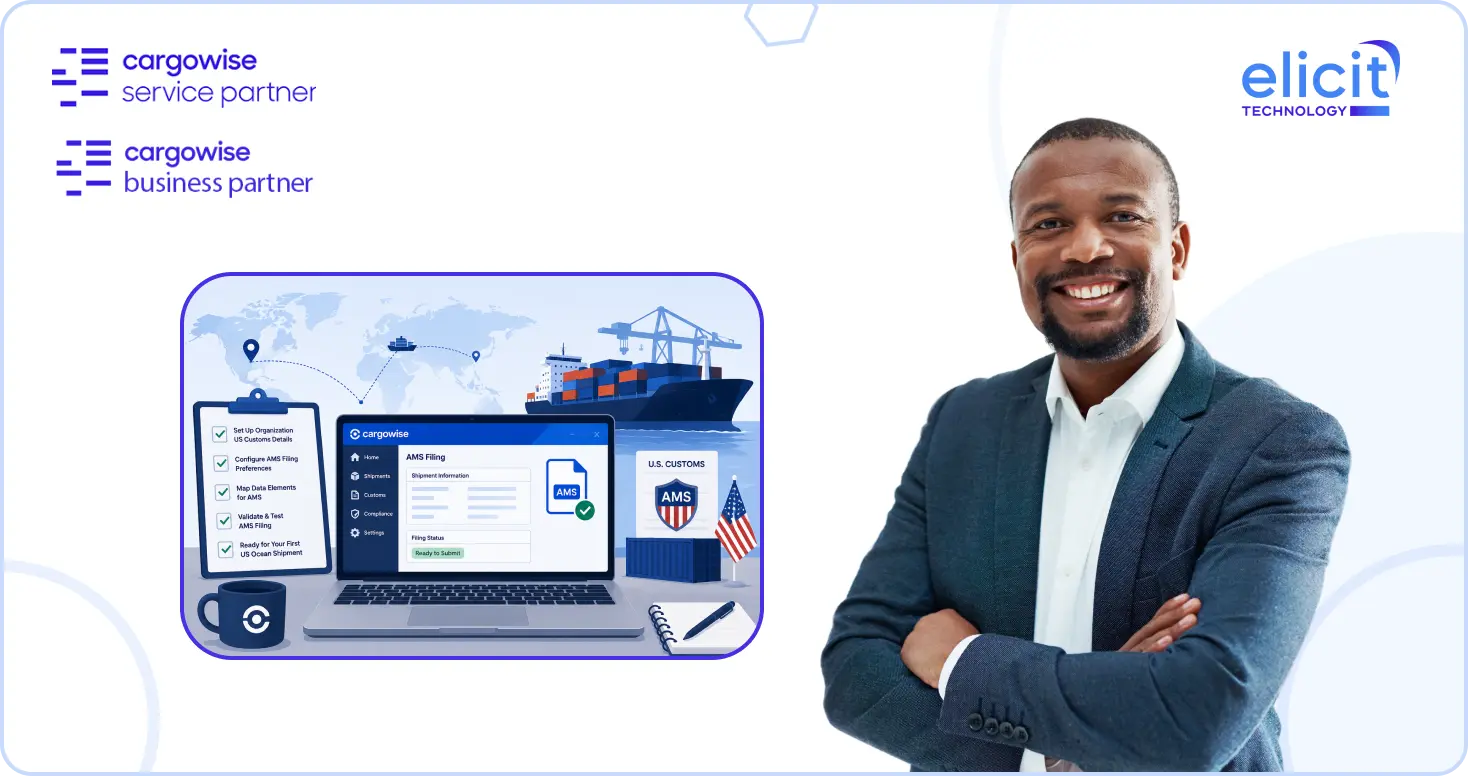
Most AMS filing problems do not begin inside CargoWise. They begin earlier.
A shipment is booked, the vessel cutoff is getting close, and the team is ready to transmit. Then someone discovers the SCAC is not properly set up, the filing credentials are incomplete, or the required CBP-side registration work was never finished.
At that point, the software may be ready, but the filer is not.
That is why a successful AMS filing in CargoWise starts with prerequisites. Before your team worries about manifest screens, field mapping, or workflow automation, you need to make sure the regulatory and identification requirements outside CargoWise are already moving in the right direction.
For first-time filers, this preparation can make the difference between a smooth go-live and a last-minute scramble.
What is AMS Filing in CargoWise?
AMS refers to the US electronic ocean manifest filing process now handled through CBP’s Automated Commercial Environment, or ACE.
For ocean cargo, CBP generally requires carriers to transmit required cargo declaration data at least 24 hours before cargo is loaded aboard the vessel at the foreign port, subject to specific exemptions for certain bulk and break-bulk cargo. CBP also notes that NVOCCs that self-file house bills are held to the same manifest data standards as major vessel-operating carriers.
CargoWise can support the operational side of that filing process, but CargoWise does not replace the registrations, codes, and authorizations required by US authorities.
That distinction is important.
The platform can help transmit the filing. It cannot make your company an authorized filer by itself.
Why do First-Time AMS Filers Get Delayed?
Most first-time delays come from treating software configuration as the whole project.
In reality, there are two workstreams happening at the same time.
One is the CargoWise setup: registries, company configuration, workflows, filing logic, user access, alerts, and testing.
The other is the external compliance setup: CBP registration, filer identification, SCAC, and any applicable licensing or financial-responsibility requirements tied to your operating model.
If the CargoWise side is ready before the external requirements are complete, your team can still end up unable to transmit.
That is why the project should be planned backward from the intended first filing date rather than from the date the CargoWise configuration is finished.
Do You Need a Letter of Intent Before Filing?
For certain CBP electronic filing activities, a Letter of Intent (LOI) is part of the onboarding process.
CBP’s current guidance states that filer codes for some non-entry filing types, including ISF-related requests, are handled through an LOI submitted to an ABI Client Representative. CBP also uses LOI processes for participation in certain electronic transmission programs and follows that with testing or certification where required.
The important point for CargoWise users is not to assume that installing or configuring software automatically establishes your electronic filing authority.
Your business should confirm the exact CBP onboarding path that applies to its filing model and start that process early.
Where testing or client-representative involvement is required, those timelines may sit outside your direct control.
What is a SCAC and Why does it Matter?
The Standard Carrier Alpha Code, or SCAC, is a unique two-to-four-character code used to identify transportation companies.
CBP states that SCAC codes are generally obtained through the National Motor Freight Traffic Association. Once obtained, the code may also need to be recognized appropriately in ACE depending on how it will be used.
For AMS ocean filing, the SCAC is fundamental.
CBP’s ACE Ocean Import Manifest specification identifies the carrier code as a mandatory SCAC representing the automated carrier, or NVOCC initiating the manifest.
For NVOCC house bill activity, SCAC relationships are especially important because the house-level record must connect correctly with the relevant master bill. CBP’s technical guidance specifically uses SCAC information within bill-level records and secondary-notify relationships for NVOCC filings.
If the wrong SCAC is used, missing, expired, or not aligned with the filing party, the issue is not something a CargoWise template change can solve.
The identity itself needs to be correct.
What About the Filer Code?
This is one area where terminology can create confusion.
CBP uses specific filer-code structures for different electronic filing activities. Its current guidance explains that traditional entry filer codes are assigned to licensed customs brokers and certain importers, while other filer-code requests may follow separate LOI-based processes.
For that reason, a freight forwarder should not simply assume that any three-character “filer code” used elsewhere in customs processing is automatically the same identifier needed for its AMS filing model.
The safer approach is to determine exactly which identifier CBP requires for your intended filing activity and make sure that same identifier is configured consistently in CargoWise.
This is where an experienced CargoWise Service Partner can help bridge the gap between CBP terminology and the corresponding system configuration.
Do You Need a Bond for AMS Filing?
This point needs a little more care than it often receives.
An FMC bond is not simply an AMS software prerequisite. It is part of the broader regulatory and financial-responsibility framework for Ocean Transportation Intermediaries.
The Federal Maritime Commission requires OTIs to maintain acceptable proof of financial responsibility. Current FMC guidance states that US ocean freight forwarders generally require $50,000, US-based and licensed non-US-based NVOCCs $75,000, and registered unlicensed non-US NVOCCs $150,000 in financial responsibility.
NVOCCs also have licensing or registration, tariff, and financial-responsibility obligations before offering services in US trades.
So if your business is acting as an NVOCC, the relevant FMC requirements need to be addressed as part of your overall US ocean operating model.
That is related to AMS readiness, but it should not be treated as though CargoWise itself creates or validates the FMC bond requirement.
What does CargoWise Need Once the External Prerequisites are Ready?
Once the required external identifiers and registrations are in place, the CargoWise configuration becomes much more meaningful.
Your CargoWise environment needs to reflect your filing identity and operating model accurately. Depending on your setup, this can include company and branch configuration, SCAC information, filing identifiers, manifest settings, permissions, notification groups, shipment and consol data, and workflow controls.
The key objective is consistency.
The company identified in CargoWise should match the filing identity recognized by the relevant US authorities.
The SCAC used in the transmission should be the correct one.
The shipment and bill hierarchy should reflect how your organization actually files.
And users should not be expected to remember every compliance requirement manually.
What Shipment Data should be Ready Before You File?
AMS filing also depends heavily on shipment data quality.
CBP’s current ocean manifest guidance requires information such as the foreign port, arrival details, shipper and consignee data, package quantity, and sufficiently precise cargo descriptions. CBP also accepts a six-digit HTS classification in place of a precise description in applicable contexts.
For NVOCCs, house-bill relationships also need to be structured correctly.
This means your CargoWise process should capture accurate data well before the filing deadline.
If your team waits until the AMS screen opens to discover that the shipper address is incomplete, the cargo description says “parts,” or the house bill is not linked correctly, the real problem is upstream data collection.
A stronger CargoWise workflow catches those gaps earlier.
Why does House Bill Structure Matter So Much?
For NVOCCs, AMS is not simply a master-level filing exercise.
CBP’s technical specifications distinguish bill types and use SCAC information to connect house-level data with the appropriate manifest structure.
That means your CargoWise house bills need to be created consistently and linked correctly to the corresponding consol and master bill.
If operations teams use inconsistent shipment structures, the manifest process becomes much harder to automate reliably.
This is one reason AMS readiness should be reviewed alongside forwarding configuration rather than treated as a standalone customs screen.
Should AMS Filing be Manual or Workflow-Driven?
A first-time filer may initially think the safest approach is to handle every filing manually.
That can work at very low volume.
But once filing volume grows, manual preparation creates more opportunities for missed deadlines, incomplete data, incorrect bill relationships, and delayed responses to CBP messages.
A better long-term approach is to build AMS into the wider CargoWise workflow.
That can mean ensuring required fields are completed earlier, aligning filing preparation with shipment milestones, routing exceptions to the right user, and making acceptance or rejection messages visible to the people responsible for taking action.
The goal is not to remove human control.
It is to stop compliance from depending on someone remembering every step at the last minute.
What should You Test Before Your First Live Filing?
Your first live shipment should not be the first time your team sees how the process behaves.
Testing should cover more than whether a transmission can technically leave CargoWise.
You should test realistic scenarios, including a straightforward master bill, NVOCC house bills where applicable, multiple house bills under one master, amendments, rejected data, missing mandatory information, and CBP response handling.
You should also confirm that the right users know how to interpret acceptance, rejection, and status messages.
CBP’s ACE environment uses EDI for import ocean manifest filings, and electronic participants must be able to send and receive the required data successfully.
A technically successful transmission is useful.
A team that knows what to do when the transmission fails is much more important.
What are the Most Common AMS Go-Live Mistakes?
The pattern is usually predictable.
Businesses wait too long to confirm their SCAC. External filing registration is assumed rather than verified. NVOCC licensing or financial-responsibility requirements are treated as someone else’s job. CargoWise registries are populated with inconsistent identifiers. House bill structures vary by user. And testing focuses only on successful filings instead of exceptions.
The result is a system that appears ready in a project plan but is not ready operationally.
A strong AMS implementation removes those dependencies one by one before the first live sailing.
How Elicit Helps Prepare CargoWise for AMS Filing?
AMS implementation sits at the intersection of forwarding operations, customs compliance, external registrations, CargoWise configuration, and user workflows.
That is why simply configuring a manifest screen is not enough.
As an official CargoWise Service and Business Partner, Elicit Technology helps freight forwarders prepare the CargoWise side of AMS filing while ensuring the external prerequisites are identified early enough to avoid blocking go-live.
Our CargoWise consultants can support registry configuration, forwarding and consol setup, SCAC and filer-identity mapping, event and milestone configuration, workflow design, notification setup, testing, exception handling, and user training.
We also help your team identify which CBP and FMC-side requirements need to be completed outside CargoWise so the software configuration and regulatory onboarding progress together rather than one waiting on the other.
Conclusion
The AMS screen in CargoWise is not where AMS readiness begins.
Before your first US ocean filing, your organization needs to understand its filing role, confirm the correct SCAC and filing identifiers, complete the applicable CBP onboarding steps, and make sure any wider NVOCC licensing, tariff, and financial-responsibility requirements are in place.
Only then does CargoWise configuration become the final piece of the process.
When the external prerequisites, shipment data, bill structure, workflows, and system configuration all line up, your first filing becomes much more predictable, and that matters when ocean manifest data is subject to a 24-hour pre-loading deadline.
If you’re planning to move AMS filing into CargoWise, schedule a call with us. Working with an experienced CargoWise Service Partner can help you avoid the common situation where the system is technically ready, but the business still cannot file.
Elicit Technology helps freight forwarders align the registrations, CargoWise configuration, workflow, testing, and operational readiness required for a cleaner AMS go-live.