











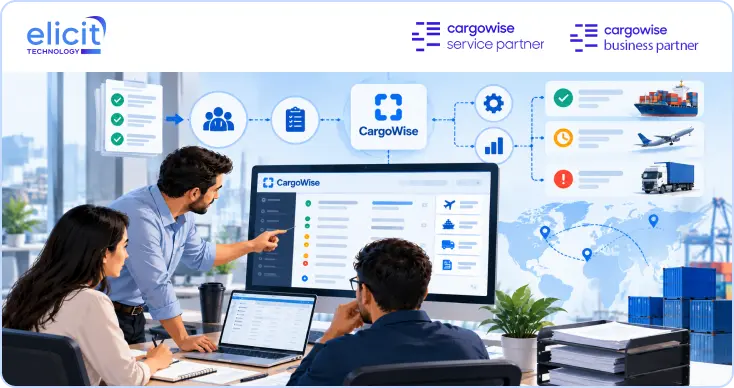
Implementing CargoWise is not just about configuring the system and reaching a go-live date.
The decisions made during implementation determine what happens afterward. Can operations process shipments without falling back to spreadsheets? Does finance receive the information it needs? Are users following consistent workflows? Can the business add new customers, branches, or processes without rebuilding its setup?
When these questions are addressed too late, implementation gaps quickly become everyday operational problems.
A structured CargoWise implementation should therefore focus as much on business requirements, data, users, testing, and adoption as it does on system configuration.
Here are 10 mistakes businesses should avoid when implementing CargoWise, and what to do differently.
1. Starting CargoWise Configuration Before Defining Business Requirements
One of the biggest implementation mistakes is moving into configuration before clearly understanding how the business needs CargoWise to work.
Start by mapping the operation.
How does a shipment move from booking to completion? Which teams are involved? What information needs to pass between operations and finance? What documents are required? Which steps require approval? Where do exceptions occur?
This is also why Elicit Technology places Business Requirement Analysis early in its CargoWise implementation process, before data migration and system configuration.
The goal should not be to configure CargoWise quickly. It should be to configure it against clearly documented operational requirements.
How Elicit avoids this: Conducts requirement discussions with the people who actually perform and manage the processes before finalizing the configuration scope.
2. Recreating Every Legacy Process in CargoWise
A new system does not automatically create a better process.
If your existing operation depends on spreadsheets, email approvals, duplicate data entry, manual reminders, or other workarounds, rebuilding every one of them around CargoWise can carry old inefficiencies into the new environment.
Some processes exist because they are genuinely required. Others exist because the previous system could not support a better approach.
Implementation is the right time to distinguish between the two.
Instead of asking:
“How do we recreate this process in CargoWise?”
Ask:
“Why do we currently do it this way, and does it still need to work this way?”
How Elicit avoids this: Reviews existing workflows before reproducing them. Preserves necessary business controls while removing steps that exist only because of legacy-system limitations.
3. Migrating Data Without Cleaning it First
Moving poor-quality data into CargoWise does not solve the data problem. It relocates it.
Duplicate organizations, outdated customer records, inconsistent naming, incomplete details, and obsolete information can make the new environment harder to manage from day one.
Data preparation should therefore be treated as an implementation stage of its own.
Elicit’s CargoWise implementation methodology includes extracting, cleansing, validating, and preparing legacy data before migration.
The same discipline should apply to the setup information required for the new environment, including relevant organization records, financial structures, users, charge codes, and other master data within the implementation scope.
How Elicit avoids this: Decides what needs to migrate, cleans and validates it, identifies duplicates, and determines what should be archived rather than automatically carrying everything forward.
4. Configuring Each CargoWise Area in Isolation
A forwarding setup can work correctly on its own. So can finance.
The real test is what happens when a live transaction passes between them.
Logistics operations are connected. Shipment information can influence documents, charges, invoicing, accounting, reporting, and downstream processes. Where multiple CargoWise capabilities are included in an implementation, configuration decisions need to be considered across that wider flow.
Instead of validating only individual functions, follow realistic transactions from beginning to end.
For example:
Customer requirement → Shipment → Operations → Documentation → Charges → Invoice → Finance
The exact journey will depend on the company’s CargoWise scope.
How Elicit avoids this: Tests the handoffs between configured processes and departments, not just whether individual functions work independently.
5. Leaving Users, Roles, and Permissions Until the Last Minute
User access is not a final administrative checklist item.
CargoWise users can have very different responsibilities. An operations user, finance user, supervisor, administrator, or manager may need different access depending on the organization’s structure and processes.
Elicit’s CargoWise onboarding scope includes user creation, security groups, role assignment, permissions, and access configuration.
If this work is left until immediately before launch, businesses risk discovering that employees cannot access what they need, or that access has been granted too broadly simply to get everyone working.
How Elicit avoids this: Defines users and responsibilities alongside the operational design. Test access during UAT using the same roles employees will have in production.
6. Testing Only the Perfect Shipment
A clean test shipment proves only that a clean test shipment works.
Production is rarely that simple.
Information can be missing. Different customers can have different requirements. Users may work across different branches. Documents may arrive late. Operational scenarios can vary. Financial outcomes may not always follow the simplest path.
User Acceptance Testing should therefore represent the work users will actually perform after go-live.
Create scenarios covering the important variations within the implementation scope rather than testing one ideal transaction repeatedly.
If an exception is common in day-to-day operations, it belongs in UAT.
How Elicit avoids this: Builds a UAT plan around real business scenarios, expected results, exceptions, different user roles, and end-to-end processes.
7. Signing Off UAT Before Critical Issues are Resolved
A UAT checklist should not become a race to mark every item complete.
When a test fails, the important questions are:
What failed?
Why did it fail?
Was the configuration corrected?
Was the scenario tested again?
Is the expected outcome now confirmed?
Moving unresolved critical issues into production can turn known implementation gaps into live operational problems.
Elicit’s implementation approach treats UAT and sign-off as a distinct stage before production go-live, providing an opportunity to validate the configured environment with the customer team.
How Elicit avoids this: Maintains a clear record of testing, issues, fixes, retesting, outstanding items, ownership, and final business approval.
8. Giving Every CargoWise User the Same Training
Knowing CargoWise and knowing how to perform your job in CargoWise are not necessarily the same thing.
Different teams use the platform differently.
A forwarding operator needs training relevant to operational processing. Finance teams need to understand the processes affecting their work. Supervisors need to know how to manage the areas they oversee. Administrators require deeper knowledge of the responsibilities assigned to them.
Generic training can leave users familiar with CargoWise but uncertain about the exact process they should follow on Monday morning.
Training also works better when users can connect it with the configuration they will actually use.
How Elicit avoids this: Makes training role-based, process-focused, and close enough to UAT and go-live for users to apply what they learn.
9. Treating CargoWise Go-Live as the End of the Implementation
Reaching production is an important milestone, but real-world use begins at that point.
Once actual shipments, users, customers, invoices, and exceptions enter the environment, questions that did not appear during testing can emerge.
Users may repeatedly struggle with one process. A configuration may need refinement. An overlooked operational scenario may appear. Teams may start developing manual workarounds if issues are not addressed quickly.
Elicit’s implementation methodology includes Post-Production Support after go-live, including monitoring, issue resolution, and optimization.
That period is valuable because it shows how the configuration performs under genuine operating conditions.
How Elicit avoids this: Plans post-go-live support before launch. Track recurring issues and user questions rather than treating each one as an isolated incident.
10. Implementing CargoWise Without Planning What Happens Next
The CargoWise environment that works for the business today may not be the environment it needs later.
The company might open another branch, add users, introduce services, expand into another country, change workflows, integrate another system, or adopt additional CargoWise capabilities.
If nobody owns the environment after implementation, small changes can gradually create inconsistent configuration and processes.
Before the implementation closes, the business should understand who is responsible for ongoing CargoWise administration and how future changes will be evaluated, tested, documented, and deployed.
How Elicit avoids this: Establishes ownership and change-management practices from the beginning. Treat the initial CargoWise implementation as the foundation rather than the final version of the environment.
What should a Well-Planned CargoWise Implementation Include?
There is no single implementation plan that fits every CargoWise customer.
A business implementing a limited scope for one company will have different requirements from a multi-company or multi-country operation involving several modules, integrations, financial structures, and large user groups.
For the same reason, businesses should be careful with generic promises such as “CargoWise can be implemented in 8–12 weeks.”
The appropriate timeline depends on factors such as implementation scope, operational complexity, data readiness, configuration requirements, user availability, testing, and training.
Elicit Technology structures its CargoWise Implementation & Onboarding process around eight stages:
Acceptance Sign-Off → Business Requirement Analysis → Data Preparation & Migration → Implementation & System Configuration → User Training → UAT & Sign-Off → Production Go-Live → Post Production Support
This creates a logical progression.
Requirements inform configuration. Prepared data enters the environment. Users are trained. The setup is tested against business scenarios. Approved processes move into production. Support continues while the new environment settles into day-to-day operations.
Skipping one of those foundations simply to reach go-live faster can move unfinished implementation work into production.
Avoid Implementation Problems Before They Become Operational Problems
The costliest CargoWise implementation mistakes are not necessarily dramatic technical failures.
They can be much smaller.
A process nobody discussed. Data nobody cleaned. A permission nobody tested. An exception missing from UAT. A user who knows the system but not the company’s required workflow.
After go-live, those small gaps can turn into repeated manual work, inconsistent system use, billing issues, operational delays, and workarounds outside CargoWise.
A successful implementation therefore needs to prepare the business, data, configuration, processes, and users together.
As an official CargoWise Service and Business Partner, Elicit Technology provides CargoWise Implementation & Onboarding support covering requirement analysis, data preparation and migration, system configuration, user and security setup, training, UAT, production go-live, and post-production support.
The objective is not simply to get CargoWise live.
It is to get the implementation right enough that teams can rely on it once the real work begins.