










A freight forwarder in Poland completes an international shipment and prepares an invoice for transportation, customs clearance, and handling charges.
The invoice is ready in CargoWise, but posting it is only part of the process. The finance team must also consider how the invoice is submitted to Poland’s national electronic invoicing system, whether the tax information is correct, and how to confirm that the submission has been accepted.
Poland’s Krajowy System e-Faktur (KSeF) introduces a centralized approach to electronic invoicing. For logistics businesses, this connects invoicing compliance with the accuracy of the financial information already maintained in CargoWise.
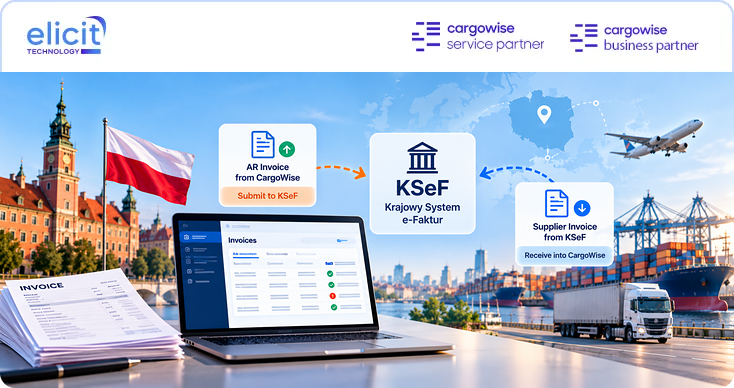
WiseTech Global’s Set up CargoWise for Poland E-Invoicing guide, published on 21 October 2026, confirms that CargoWise integrates directly with KSeF through its electronic invoice APIs. Eligible Accounts Receivable (AR) transactions can be submitted to KSeF, while supplier invoices can be received into CargoWise for Accounts Payable (AP) processing.
For freight forwarders, the important question is how to prepare their CargoWise finance environment for these requirements without disrupting everyday billing operations.
What is Poland’s KSeF E-Invoicing System, and Why does it Matter for CargoWise Users?
KSeF is Poland’s national electronic invoicing system, designed to manage structured electronic invoices through a centralized government platform.
Unlike electronic invoicing models that rely primarily on exchanging documents between businesses through a network such as PEPPOL, Poland’s model involves direct interaction with the national invoicing system.
For a freight forwarding company, this affects how invoices are issued, validated, and recorded.
Consider a logistics provider handling ocean freight shipments from Gdańsk. Its customer invoice may include freight charges, inland transportation, customs-related services, and other operational costs.
Each charge must be represented correctly in the financial transaction, including its applicable VAT treatment.
When an eligible AR invoice is posted in a Polish CargoWise login company, CargoWise can prepare and submit the electronic invoice to KSeF.
The national system validates the submitted information and returns a response that CargoWise records against the transaction.
This introduces an important distinction: an invoice being posted in CargoWise does not automatically mean KSeF has accepted it.
Finance teams must understand the electronic reporting status and investigate transactions that fail validation.
For companies operating across several countries, Poland’s requirements should also be considered separately from those of other markets. Our guide on CargoWise e-invoicing across countries explains how different national invoicing models affect implementation planning.
How does CargoWise Integrate with Poland’s KSeF System?
CargoWise supports Poland’s e-invoicing process through a direct integration with the KSeF APIs.
According to WiseTech Global’s October 2026 documentation, eligible receivables transactions posted in a Polish login company are automatically lodged with KSeF when the required functionality is configured.
The integration also supports receiving supplier invoices issued through KSeF.
For Accounts Receivable, the process involves generating the electronic invoice message, transmitting it through the supported CargoWise messaging process, and receiving the validation response.
For Accounts Payable, electronic invoices addressed to the company’s Polish taxpayer registration number can be imported into CargoWise for review and processing.
The guide also identifies separate environments for testing and production.
| CargoWise environment | KSeF connection |
| CargoWise test environment | KSeF Pre-Production (Demo) |
| CargoWise production environment | KSeF Production |
WiseTech specifically notes that CargoWise test environments do not connect to the separate KSeF TEST environment.
This distinction matters during implementation because certificates, permissions, and testing activities must align with the correct environment.
For logistics businesses, the value of the integration lies in connecting electronic invoicing with the financial transactions already managed in CargoWise.
However, that connection depends on accurate configuration, valid credentials, and properly maintained invoice data.
What must Freight Forwarders Check Before Setting Up Poland E-Invoicing in CargoWise?
WiseTech Global’s setup guide identifies several areas that businesses need to review before using Poland’s e-invoicing functionality.
These requirements involve both system configuration and financial master data.
KSeF Digital Certificate and Authentication
CargoWise requires a valid KSeF-issued digital certificate for electronic invoice authentication.
The certificate is used to support the digital signature associated with the company’s electronic invoices.
WiseTech’s documentation specifies that CargoWise supports certificates issued by KSeF and that the certificate must have the correct authentication purpose and permissions.
The certificate must also correspond to the Polish taxpayer registration number associated with the relevant CargoWise login company.
A certificate created for an incorrect purpose or environment can prevent successful authentication.
For businesses preparing their implementation, certificate validity, access permissions, and alignment with company registration details should be reviewed before electronic invoicing begins.
Polish Taxpayer Registration Numbers
The Polish taxpayer registration number, identified in CargoWise as PTU, is another essential requirement.
WiseTech’s guide explains that the relevant Polish company or branch registration information must be maintained in the associated Organization Proxy.
This information identifies the business issuing invoices through KSeF.
Customer registration details also require attention.
CargoWise supports registration information for Polish buyers, customers elsewhere in the European Union, and buyers outside the EU.
For an international freight forwarder, this is particularly relevant because its customer base may include local importers, European manufacturers, and overseas trading companies.
Accurate customer registration data supports the preparation of invoices containing the appropriate buyer information.
VAT Treatment and Invoice Tax Messages
Freight forwarding invoices frequently contain charges with different VAT treatments.
A single customer invoice may include transportation services, handling charges, and other services subject to different tax rules.
Poland’s KSeF process requires tax information to be reported for individual invoice charge lines.
WiseTech’s guide identifies Poland Tax Group Codes that distinguish treatments such as standard-rated VAT, zero-rated transactions, exports, exemptions, reverse charges, and transactions outside the scope of VAT.
CargoWise uses Invoice Tax Messages associated with Tax IDs to support this information.
For finance teams, the priority is ensuring that the applicable tax treatment is correctly represented in the invoice data.
An incorrect tax mapping can create validation issues even when the underlying shipment and customer information is accurate.
Businesses should have the relevant VAT treatment confirmed by their qualified tax advisers, while a CargoWise specialist reviews how the approved tax rules are represented in the system.
Invoice Numbering and Date of Supply
Invoice numbering is another important consideration.
WiseTech’s documentation explains that CargoWise can use a Compliance Number as the invoice number submitted to KSeF when compliance numbering is enabled.
Otherwise, the standard invoice number is used.
The submitted invoice number must be unique.
The guide also describes how the Date of Supply is represented when it is the same across all invoice lines or differs between individual charges.
For freight forwarders, these requirements deserve attention because shipment services and associated charges may relate to different operational dates.
Finance teams should review their existing invoice numbering and date-handling practices as part of implementation planning.
Registry Settings and Error Notifications
CargoWise includes system registry controls for electronic invoicing and reporting.
The Poland guide covers separate receivables and payables functionality, supplier invoice importing, error notifications, and additional Poland-specific settings.
These settings influence which transactions are processed and how the system handles electronic invoicing activities.
An error notification group is particularly useful for identifying submissions that fail validation or are rejected by KSeF.
Rather than treating the implementation as a single configuration change, businesses should review the complete invoicing workflow and determine how exceptions will be managed.
How can CargoWise Users Track KSeF Invoice Submission and Validation?
One of the most important operational aspects of Poland e-invoicing is understanding what happens after an invoice is posted.
WiseTech’s guide documents the electronic reporting statuses used during the KSeF submission process.
| E-Reporting status | Meaning |
| QUE – Queued | The invoice has entered the electronic reporting process |
| BCH – Batched | The invoice has been included in a processing batch |
| SNT – Sent | The electronic invoice message has been sent |
| SUC – Success | KSeF has successfully validated the invoice |
| FAL – Failed | An error has occurred, and the transaction requires attention |
These statuses help finance teams distinguish between invoices awaiting processing, invoices transmitted for validation, and invoices successfully accepted by KSeF.
Consider a freight forwarder issuing several customer invoices at the end of the day.
The accounting team needs to know which invoices have been successfully processed and which require correction.
A failed submission may relate to incorrect information, authentication problems, or another issue identified during electronic processing.
CargoWise records the relevant reporting information so the responsible team can investigate the transaction.
What Happens After KSeF Accepts an Invoice?
Once KSeF successfully validates an electronic invoice, it returns an official receipt certificate known as UPO.
According to WiseTech, the receipt contains information such as the KSeF invoice number, the original invoice number, submission details, and the acceptance date.
The receipt is attached to the invoice record in CargoWise eDocs.
The guide also explains that CargoWise DocBuilder invoice templates can be customized to include the KSeF number and a QR code.
The QR code becomes available after successful KSeF lodgment and links to the invoice’s validation information.
For finance teams, these records provide useful evidence when reviewing the electronic invoicing history of a transaction.
Can CargoWise Receive Supplier Invoices Directly from KSeF?
Yes. WiseTech Global’s October 2026 documentation confirms that CargoWise supports importing supplier invoices issued through KSeF to the company’s Polish PTU registration number.
This is particularly relevant for freight forwarders that receive invoices from local transportation providers, warehouses, and other service partners.
For example, a Polish trucking subcontractor may issue an electronic invoice for an inland delivery.
Instead of relying solely on a manually received invoice document, the freight forwarder’s finance team can receive the electronic invoice information through the supported KSeF integration.
CargoWise provides two documented processing options.
Transactions Pending Allocation: Supplier invoices are imported for review, allocation, and subsequent processing.
Payables Invoice Processing Portal: Supplier invoices can be imported into the portal, which supports job matching, accrual reconciliation, and review and approval workflows.
The selected process depends on the company’s CargoWise configuration.
The guide also notes that copies of the KSeF XML and PDF are attached to imported invoice records in eDocs.
For freight forwarders managing substantial supplier invoice volumes, this can help connect incoming invoices with the operational and financial records used to manage shipment costs.
Why does the Payables Import Start Date Matter?
WiseTech identifies a specific configuration controlling the start date for supplier invoice imports.
According to the guide, if no date is specified, enabling the functionality causes CargoWise to download invoices dated 1 July 2026 onward.
Where a start date is entered, only invoices after that date are downloaded.
This matters when introducing electronic supplier invoice processing into an existing accounting environment.
Finance teams need to consider which historical invoices have already been processed and how to avoid unnecessary duplication or reconciliation work.
A controlled implementation should therefore include a review of existing payables records and the intended import period.
For additional context on the operational benefits of connected invoicing, read What Is E-Invoicing Integration in CargoWise?.
What Common KSeF E-Invoicing Issues should CargoWise Users Prepare For?
Although CargoWise supports direct KSeF integration, several issues can affect successful electronic invoicing.
Understanding these risks before implementation helps finance teams establish appropriate checks and support procedures.
Certificate authentication errors: WiseTech documents authentication failures associated with incorrect certificates, permissions, taxpayer registration numbers, or KSeF environments.
Incorrect customer registration information: Missing or inconsistent buyer details can affect the information submitted in the electronic invoice.
Tax mapping problems: Charge lines require the appropriate tax information and Poland Tax Group Codes.
Duplicate invoice numbers: Invoice numbers submitted to KSeF must be unique, making numbering configuration an important consideration.
Unsuccessful invoice validation: An invoice may be transmitted but subsequently rejected, requiring investigation and correction.
Supplier invoice import configuration: Incoming invoices will not follow the intended Accounts Payable workflow unless the relevant functionality is enabled and configured.
Incorrect testing environment: Testing must use the KSeF environment supported by the corresponding CargoWise environment.
These issues illustrate why KSeF integration should be approached as a complete finance workflow rather than a standalone technical connection.
For multinational freight forwarders, the challenge can be even greater when Polish operations share accounting processes with branches in other countries.
Elicit’s article on CargoWise e-invoicing and compliance automation explores why managing these country-specific requirements is increasingly important.
How Can Elicit Technology Help with CargoWise Poland KSeF E-Invoicing Integration?
Preparing CargoWise for Poland’s KSeF requirements involves several connected areas.
Businesses must review authentication credentials, company registration numbers, customer records, VAT mapping, invoice numbering, electronic reporting settings, and supplier invoice processing.
These requirements should be assessed against the company’s existing CargoWise environment and daily finance operations.
As an official CargoWise Service and Business Partner, Elicit Technology helps freight forwarders and logistics businesses evaluate and configure their CargoWise environments for country-specific electronic invoicing requirements.
Our team can assist with reviewing existing Accounts Receivable and Accounts Payable workflows, identifying configuration gaps, assessing integration requirements, and supporting testing and exception handling.
For businesses operating in Poland and other European markets, Elicit can also help plan how different electronic invoicing requirements fit into a wider CargoWise finance environment.
Explore our CargoWise Global E-Invoicing Integration services to understand how Elicit supports businesses managing country-specific electronic invoicing requirements.
The objective is to help logistics businesses establish a dependable invoicing process while maintaining visibility over transactions that require review or correction.
Conclusion: Prepare Your CargoWise Finance Operations for Poland KSeF E-Invoicing
Poland’s KSeF system introduces specific requirements for how businesses issue, validate, and receive electronic invoices.
For freight forwarders using CargoWise, the important considerations extend beyond electronic invoice transmission.
Digital certificate authentication, taxpayer registration numbers, VAT mapping, invoice numbering, validation statuses, and supplier invoice processing all contribute to a reliable finance workflow.
WiseTech Global’s October 2026 guide confirms that CargoWise supports direct KSeF integration for eligible receivables and payables transactions.
Businesses should use this capability as an opportunity to review their current invoicing environment, strengthen financial data accuracy, and establish clear processes for managing exceptions.
If your organization needs assistance reviewing or configuring Poland e-invoicing in CargoWise, Elicit Technology can help assess your requirements and support the implementation.
Book a consultation with our CargoWise specialists to discuss your KSeF integration requirements.