








A freight forwarding company may use CargoWise across several countries, but that does not mean electronic invoicing works the same way in every location.
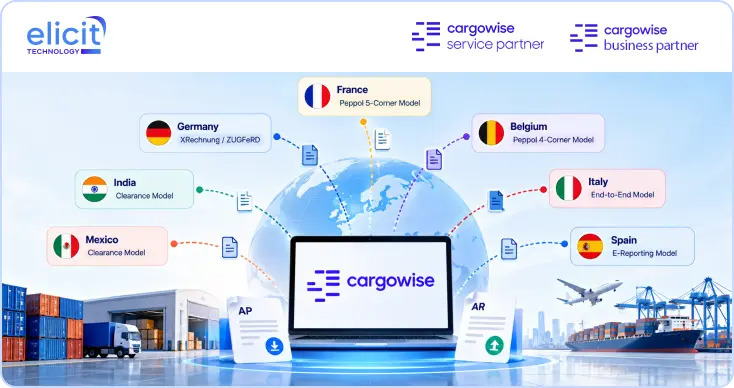
A finance team in France may need to exchange invoices through PEPPOL and meet government reporting requirements. In India, invoices may require clearance through the Invoice Registration Portal. In Germany, teams may work with XRechnung and ZUGFeRD formats. Each country has its own requirements, and the supported CargoWise processes can differ.
For businesses managing international operations, understanding these differences is essential before configuring electronic invoicing.
On 2 October 2026, WiseTech Global published its E-Invoicing: List of Supported Countries, detailing CargoWise’s electronic invoicing capabilities across different markets, including Accounts Receivable (AR), Accounts Payable (AP), and supported invoicing models.
This guide explains which countries CargoWise supports, how the different CargoWise e-invoicing models work, what finance teams should check before implementation, and how Elicit Technology can help businesses configure country-specific invoicing processes.
Which Countries Support CargoWise E-Invoicing in 2026?
CargoWise supports electronic invoicing capabilities across multiple countries, but the scope of support is not identical everywhere.
According to WiseTech Global’s October 2026 support matrix, all 29 listed countries and territories support issuing electronic receivables invoices. However, receiving electronic payables invoices is supported only in certain locations.
The distinction matters because a company may be able to issue a compliant electronic sales invoice through CargoWise while needing a different process to receive or process supplier invoices.
The following table summarizes the official support matrix.
CARGOWISE E-INVOICING COUNTRY SUPPORT
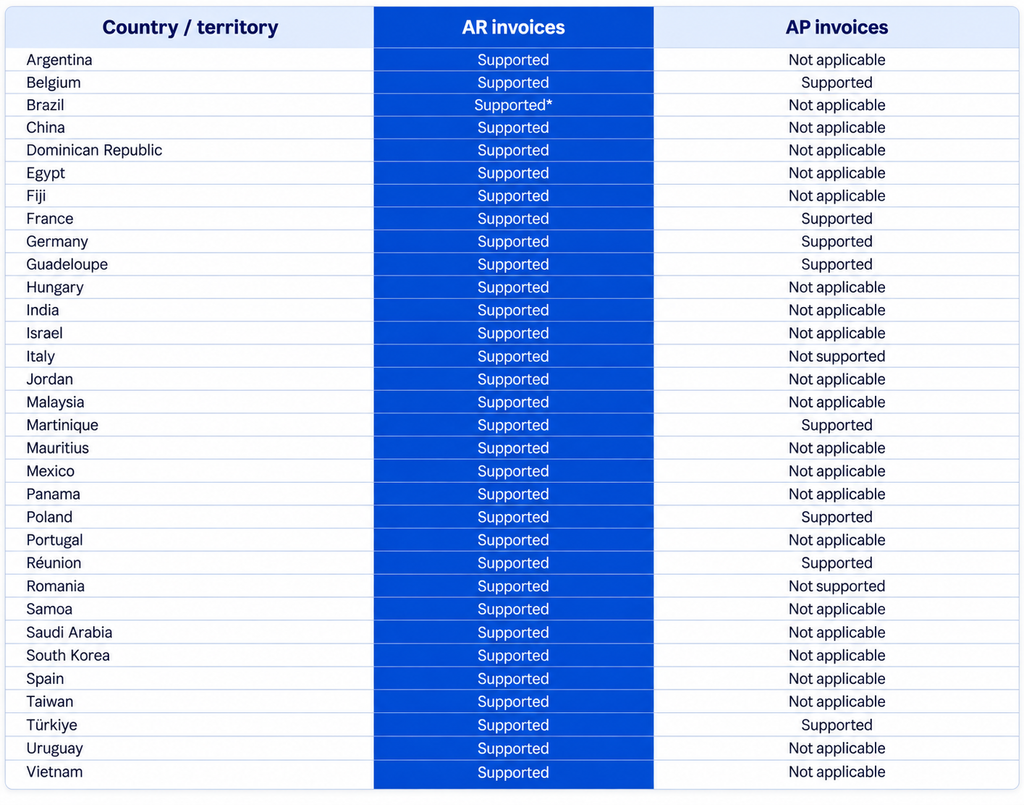
For multinational freight forwarders, this matrix is a useful starting point. However, it should not be treated as confirmation that every invoice type, branch, legal entity, or local compliance requirement is automatically covered.
The business must confirm the applicable country model and supported transaction scope before implementation.
How do CargoWise E-Invoicing Models Differ Between Countries?
Electronic invoicing is more than sending an invoice as a PDF. Depending on the country, an invoice may need to be exchanged in a structured format, transmitted through an approved network, reported to a government authority, or cleared before being delivered to the customer.
WiseTech’s October 2026 documentation identifies six electronic invoicing models.
1. Clearance Model
Under a clearance model, invoice information is submitted electronically to the relevant authority for authorization. Once authorized, the invoice and required clearance information can be shared with the recipient in an approved format.
India, Saudi Arabia, Malaysia, and several other markets use clearance-based approaches.
For finance teams, this means invoice preparation must account for required tax identifiers, invoice data, validation, and the authority’s response.
2. PEPPOL 4-Corner Model
In a PEPPOL 4-corner model, electronic invoices are exchanged between trading partners through the PEPPOL network.
Belgium is listed under this model in WiseTech’s support matrix, with both receivables and payables supported through the WiseTech PEPPOL Access Point.
This enables structured electronic invoice exchange between participating businesses without government participation in the transaction flow described in the matrix.
3. PEPPOL 5-Corner Model
The PEPPOL 5-corner model includes electronic invoice exchange between businesses and a government reporting component.
France is listed under this model, with both receivables and payables supported through WiseTech’s Accredited Platform and PEPPOL Access Point.
Businesses using CargoWise in France therefore need to consider both invoice exchange and the applicable government-connected reporting requirements.
4. End-to-End E-Invoicing Model
In this model, invoices pass electronically through a government system and are delivered electronically to the recipient.
WiseTech identifies Italy and Poland among the countries using an end-to-end model, although their CargoWise payables support differs.
5. E-Reporting Model
Under an e-reporting model, invoice information is transmitted electronically to the government, while the invoice is shared separately with the recipient.
Hungary and Spain are examples in the support matrix.
This distinction is important because electronic tax reporting does not necessarily mean that the government system delivers the invoice to the customer.
6. Qualified Digital Invoice Model
This model uses a qualified digital signature to authenticate an invoice exchanged directly with the recipient, without government clearance in the delivery flow.
Portugal is listed under this model.
CargoWise supports the relevant Portuguese invoicing process described by WiseTech, including external digital signing and specified invoice reporting capabilities. However, the documentation explicitly states that this does not constitute a complete Portuguese accounting certification solution.
The key takeaway: Selecting the correct e-invoicing configuration requires understanding the country’s invoicing model, not simply enabling electronic invoice generation.
Why is AR and AP E-Invoicing Support Different?
One of the most important details in the WiseTech support matrix is the separation between issuing receivables invoices and receiving payables invoices.
Accounts Receivable (AR) relates to invoices issued to customers for services provided. Accounts Payable (AP) relates to invoices received from suppliers, carriers, transport providers, and other vendors.
For freight forwarders, both processes are important because a single shipment can involve multiple supplier costs and customer charges.
Consider a logistics business operating in France and Italy.
In France, the October 2026 matrix confirms support for both electronic receivables and payables invoices. In Italy, electronic receivables are supported, but electronic payables are marked as not supported.
That difference affects how finance teams should plan their processes.
A business should not assume that enabling electronic sales invoicing automatically provides electronic supplier invoice receiving. It must review the supported functionality for each country and identify whether additional processes or integrations are required.
This is particularly important for companies that centralize accounting across multiple branches while maintaining local invoicing obligations.
What should You Check Before Setting Up CargoWise E-Invoicing?
Before implementing CargoWise e-invoicing, finance and IT teams should review the requirements of each legal entity rather than applying one configuration across every country.
The first consideration is the country and applicable invoicing model. A clearance-based process may require authorization before an invoice is delivered, while another jurisdiction may use PEPPOL exchange or electronic reporting.
The second is the company’s invoicing scope. Does the business need electronic receivables only, or does it also require electronic payables processing? Are there specific invoice types, credit notes, or reporting transactions that need separate treatment?
Next comes invoice data quality. Tax registration numbers, customer and supplier information, addresses, invoice references, currencies, tax details, and other required fields must be reviewed against the applicable local requirements.
Finance teams should also confirm how CargoWise communicates with the relevant government system, PEPPOL network, or third-party provider.
The WiseTech matrix illustrates why this matters:
- India: The clearance connection is handled through Adaequare, a GST Suvidha Provider.
- Saudi Arabia: CargoWise connects directly to ZATCA through FATOORA.
- France: WiseTech’s Accredited Platform and PEPPOL Access Point handle the relevant connectivity.
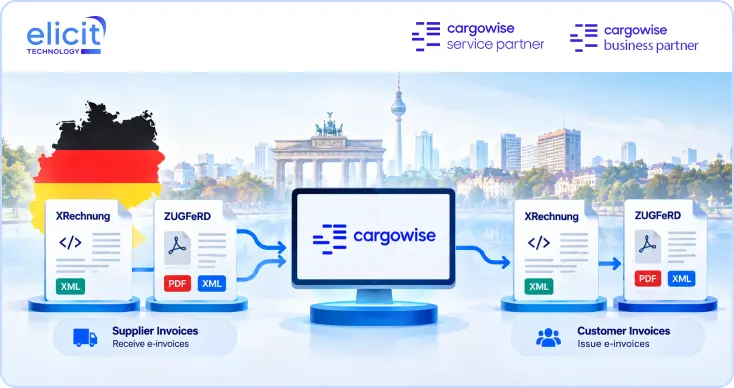
- Germany: The documented optional process supports XRechnung receivables output and XRechnung or ZUGFeRD payables import, without a government connection in that model.
- Poland: CargoWise supports receivables and payables through a direct connection to the National e-Invoice System (KSeF).
These are not interchangeable configurations. Each requires an implementation approach aligned with its documented capabilities.
Finally, teams should establish how rejected invoices, missing information, corrections, and other exceptions will be managed. Successful electronic transmission is only one part of an effective invoicing process.
How can You Prepare CargoWise for E-Invoicing Implementation?
A reliable implementation begins with the finance process already operating inside CargoWise.
For example, an invoice may contain correct shipment charges but still lack a mandatory tax identifier required for electronic submission. Alternatively, a country’s connection may be configured correctly while the underlying invoice data does not meet the expected format.
The implementation should therefore consider both CargoWise financial configuration and the external electronic invoicing requirements.
A practical approach begins by identifying the countries, legal entities, and transaction types in scope. The team can then compare those requirements with WiseTech’s supported capabilities and determine which processes need configuration, integration, or additional handling.
Once the scope is established, invoice data and relevant mappings should be reviewed. This includes confirming the information required by the applicable authority or network and understanding how it is represented in CargoWise.
Testing should cover realistic receivables and, where supported, payables scenarios. It should also include incomplete records, rejected submissions, corrections, and the handling of responses returned through the relevant connection.
For multinational businesses, the goal is to establish a repeatable implementation approach while respecting the differences between local invoicing models.
A process that works in one country should not automatically be copied into another without validating its requirements.
How does Elicit Technology Help with CargoWise E-Invoicing Integration?
As an official CargoWise Service and Business Partner, Elicit Technology helps logistics businesses implement electronic invoicing processes within their CargoWise environment.
Our approach begins with understanding the customer’s existing finance configuration, operating countries, invoicing requirements, and supported CargoWise capabilities.
From there, Elicit can assist with country-specific configuration, invoice data mapping, relevant integration requirements, testing, and exception-handling processes. This helps businesses align their CargoWise invoicing workflows with the applicable electronic invoicing model rather than relying on a generic setup.
For companies operating across several countries, Elicit can also help identify differences between receivables and payables support, review the relevant technical requirements, and prepare users to manage the configured process.
The objective is to help finance teams establish a reliable electronic invoicing workflow while maintaining visibility into transactions that require review or correction.
Explore Elicit’s CargoWise e-invoicing integration services to understand how our team can support your implementation.
How can Freight Forwarders Manage E-Invoicing Across Multiple Countries?
For a freight forwarder operating internationally, the challenge is not necessarily issuing an electronic invoice in one country. It is maintaining a reliable invoicing process when different branches must follow different requirements.
A company may use CargoWise as its central operational and financial platform while individual countries require different invoice formats, clearance procedures, reporting connections, and supporting information.
The practical solution is to standardize what can be shared across the business while configuring country-specific requirements where necessary.
Finance teams should maintain clear ownership of invoice data, monitor transactions requiring attention, and review supported functionality when entering new markets or expanding existing operations.
Prepare Your CargoWise E-Invoicing Processes for Country-Specific Requirements
Electronic invoicing is becoming an increasingly important part of international finance operations, but the requirements are not uniform across countries.
WiseTech’s October 2026 support matrix provides a useful reference for understanding where CargoWise supports electronic receivables, where payables capabilities are available, and which invoicing models apply.
For logistics businesses, the next step is to turn that information into a practical implementation plan.
With the right configuration, data mapping, integration approach, and testing, finance teams can establish invoicing processes suited to their operating countries while reducing avoidable manual intervention.
Elicit Technology supports businesses with CargoWise configuration, integration, and ongoing assistance, helping connect the platform’s available capabilities with real operational requirements.
Need help configuring CargoWise e-invoicing for your business? Book a consultation with Elicit Technology to discuss your countries, invoicing processes, and integration requirements.