












A freight forwarding company in Belgium completes a shipment and prepares an invoice for its customer. The shipment charges, customer details, and tax information are already available in CargoWise.
Previously, the finance team may have sent the invoice as a PDF by email. But for Belgian business-to-business transactions covered by the country’s electronic invoicing mandate, that process alone is no longer sufficient.
Since 1 January 2026, Belgium has required structured electronic invoicing for applicable domestic B2B transactions between VAT-registered businesses.
For CargoWise users, this introduces requirements around invoice formats, PEPPOL connectivity, customer registration numbers, VAT treatment, and supplier invoice processing.
WiseTech Global’s Set up CargoWise for Belgium E-Invoicing guide, published on 22 October 2026, explains how CargoWise supports the country’s electronic invoicing requirements through its integrated e-Invoicing/e-Reporting solution.
The important question for freight forwarders is whether their CargoWise finance environment is configured to issue and receive the required electronic invoices.
What are Belgium’s E-Invoicing Requirements for CargoWise Users in 2026?
Belgium’s B2B electronic invoicing mandate took effect on 1 January 2026.
For applicable domestic transactions, businesses must issue structured electronic invoices that comply with the European EN 16931 standard and PEPPOL BIS Billing 3.0 requirements.
This is different from sending an ordinary PDF invoice by email.
A PDF may be readable by a person, but it does not automatically provide the structured invoice data required for electronic exchange.
Belgium’s approach enables invoice information to move between compatible business systems through the PEPPOL network.
For freight forwarders, this affects the finance processes associated with shipment billing, customer invoicing, and supplier payments.
CargoWise supports the relevant Belgian electronic invoicing processes, but availability depends on the installed software release.
These release requirements matter because a business may have outgoing e-invoicing functionality available while still needing a later release to receive supplier invoices through CargoWise.
Before reviewing the configuration, companies should establish which functionality their current CargoWise environment supports.
Businesses operating in multiple countries should also remember that Belgium’s requirements differ from those in Germany, France, and other European markets.
Our article on CargoWise e-invoicing across countries explains why country-specific requirements must be considered when planning electronic invoicing.
How does CargoWise Support Belgium E-Invoicing Through PEPPOL?
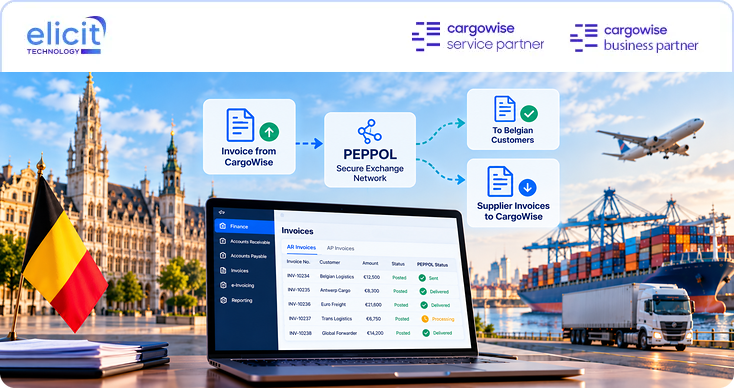
CargoWise’s Belgium e-invoicing functionality supports both outgoing customer invoices and incoming supplier invoices through the PEPPOL network.
For Accounts Receivable, eligible invoices issued by Belgian CargoWise login companies can be exchanged with Belgian debtors as structured UBL XML invoices.
WiseTech Global operates its own PEPPOL Access Point for this process.
For Accounts Payable, Belgian businesses can receive electronic invoices from local suppliers through the network and bring them into CargoWise for processing.
This creates two distinct finance requirements.
Outgoing invoices: The business needs to ensure that eligible customer invoices contain the information required for successful electronic delivery.
Incoming invoices: The business needs a suitable PEPPOL receiving arrangement and an appropriate CargoWise process for reviewing and posting supplier invoices.
Both activities rely on structured invoice information, but they involve different operational responsibilities.
For a freight forwarding company, this means the Accounts Receivable and Accounts Payable teams should not assume that enabling one capability automatically completes the other.
What Is the PEPPOL Four-Corner Model?
Belgium’s CargoWise e-invoicing process uses the PEPPOL four-corner model.
The four participants are the invoice issuer, the issuer’s PEPPOL Access Point, the recipient’s PEPPOL Access Point, and the receiving customer.
When an eligible invoice is posted in CargoWise, the relevant transaction information is prepared for electronic exchange through WiseTech’s e-invoicing solution.
The invoice is then delivered through the PEPPOL network to the receiving business’s registered endpoint.
For CargoWise users, the key consideration is that invoice delivery depends on accurate recipient identification and valid electronic invoice information.
This makes master data and finance configuration especially important.
What must Freight Forwarders Review Before Enabling Belgium E-Invoicing in CargoWise?
The WiseTech Global guide identifies several configuration areas that support Belgium’s electronic invoicing functionality.
These are not simply technical settings. Each affects the accuracy, delivery, or processing of financial transactions.
1. Belgian Company and Branch Registration Numbers
Belgian companies and branches must have the relevant BTW registration information recorded in CargoWise.
The BTW identification represents the business’s Belgian VAT registration information.
WiseTech’s guide explains that CargoWise can recognize the registration number with the Belgian prefix or the corresponding enterprise number without that prefix.
For businesses operating several Belgian branches, registration information should be reviewed across the relevant company and branch records.
Missing or inconsistent identifiers can create problems when preparing electronic invoices.
2. Customer Registration Numbers and PEPPOL Identification
The customer record is equally important.
CargoWise uses the Belgian debtor’s BTW registration information to identify the recipient’s PEPPOL endpoint.
By default, the system uses the relevant Belgian registration identifier for recipient identification.
The WiseTech guide also describes an optional PEPPOL ID for customers using alternative endpoint arrangements.
This becomes relevant when a customer has specific electronic invoice routing requirements.
For freight forwarders managing numerous customer accounts, reviewing registration information is an important part of e-invoicing readiness.
An invoice may contain the correct shipment charges and still encounter delivery problems if the recipient’s electronic invoicing details are incorrect.
3. Customer References on Electronic Invoices
Some customers require a specific reference on every invoice.
For example, a manufacturing customer may use an internal account reference to identify invoices belonging to a particular business unit.
CargoWise supports an optional Accounts Receivable Customer Reference that can be included as the buyer’s reference in the electronic invoice.
This can help receiving businesses identify and reconcile invoices within their own finance systems.
For freight forwarders serving enterprise customers, understanding these requirements can reduce invoice clarification requests and unnecessary payment delays.
4. VAT Exemption Reasons and Tax Configuration
Electronic invoicing also places greater emphasis on accurate tax information.
The WiseTech guide explains that exempt charges require an appropriate exemption reason in the electronic invoice.
CargoWise supports this through Invoice Tax Messages associated with the relevant charges.
The guide also identifies specific requirements for separating charges outside the scope of VAT from charges within its scope.
For finance teams, this is particularly important when invoices contain different tax treatments.
An incorrect tax configuration may cause an electronic invoice to fail validation or require correction.
Because VAT treatment depends on the nature of the transaction, companies should have their tax rules reviewed by appropriately qualified finance and tax professionals.
5. E-Invoicing Registry Settings and Error Notifications
CargoWise provides system registry controls associated with electronic invoicing.
WiseTech’s Belgium guidance includes the receivables e-reporting functionality and an error notification group for unsuccessful transactions.
These controls help businesses manage electronic invoice processing and identify transactions requiring attention.
For example, if an invoice fails validation, the relevant finance or support team needs to know that the transaction has not been processed successfully.
Without appropriate exception monitoring, employees may assume an invoice has been delivered when further action is required.
A properly managed e-invoicing environment should therefore include both invoice submission and exception handling.
6. PEPPOL Document Exchange Processing
WiseTech also identifies a PEPPOL document exchange processing service task as part of the Belgium e-invoicing environment.
This is a technical prerequisite for the relevant CargoWise functionality.
Its availability and configuration should be reviewed by an experienced CargoWise specialist rather than treated as an isolated administrative change.
For businesses preparing to use the functionality, the broader objective is to confirm that the relevant components are supported, correctly configured, and operating together.
How can CargoWise Receive Belgian Supplier Invoices through PEPPOL?
Receiving supplier invoices is an important part of Belgium’s electronic invoicing requirements.
A freight forwarder may receive invoices from transport providers, subcontractors, warehouses, and other local suppliers.
These invoices must be associated with the correct financial records and, where relevant, the corresponding shipment costs.
WiseTech’s October 2026 guide explains that Belgian businesses can register CargoWise as their PEPPOL receiving system.
Registration requires coordination with WiseTech Global.
Once the receiving arrangement is established, electronic invoices addressed to the company’s registered identifier can be delivered through the CargoWise PEPPOL Access Point.
CargoWise supports two processing approaches.
| Supplier invoice processing option | What it means for finance teams |
| Transactions Pending Allocation | Received invoices are available for review, allocation, and posting |
| Payables Invoice Processing Portal | Invoices can be processed through draft invoice, reconciliation, review, and approval capabilities |
The first approach is the default method described in the guide.
The second is available through the CargoWise Value Pack and requires the relevant configuration.
For freight forwarders, the choice affects how supplier invoices enter the daily Accounts Payable workflow.
Why is the Invoice Processing Portal Relevant?
A freight forwarder receives an invoice from a shipping line containing several charges.
The finance team needs to identify the corresponding shipment, review the charges, and determine whether they match the expected costs.
CargoWise’s Payables Invoice Processing Portal supports invoice information and operational references, including job numbers, bills of lading, master air waybills, and container references.
It also supports reconciliation against accruals and associated review and approval workflows.
This can help finance teams investigate differences between expected and invoiced costs without relying entirely on separate spreadsheets or email exchanges.
Supporting invoice attachments and electronic invoice records are also retained in CargoWise eDocs as described in the WiseTech guide.
The objective is to improve the connection between supplier invoicing and freight forwarding financial operations.
What Common Belgium E-Invoicing Issues should CargoWise Finance Teams Watch For?
Even when a business uses supported CargoWise functionality, electronic invoices can encounter problems.
Some issues originate from customer records, while others relate to tax information, configuration, or the receiving arrangement.
For Belgian freight forwarders, several areas deserve particular attention.
Incorrect debtor identification: A missing or incorrect BTW registration number can affect recipient identification through PEPPOL.
Customer-specific routing requirements: Some customers may use alternative PEPPOL identifiers that need to be considered.
Missing VAT exemption information: Charges requiring exemption reasons must contain appropriate information for the electronic invoice.
Inconsistent tax posting groups: Different VAT treatments need to be managed according to the relevant CargoWise configuration requirements.
Unsuccessful electronic invoice processing: Failed validation or delivery requires investigation rather than assuming the transaction has reached the customer.
Supplier invoice receiving arrangements: Businesses must confirm their PEPPOL receiving registration and the selected CargoWise Accounts Payable process.
These issues demonstrate why Belgium e-invoicing should be treated as a finance configuration and process-management requirement, not merely an invoice format change.
For a broader explanation of the operational value, explore how e-invoicing integration benefits CargoWise operations.
How can Elicit Technology Help with CargoWise Belgium E-Invoicing Configuration?
Belgium’s e-invoicing mandate introduces several connected requirements across CargoWise finance operations.
A business needs to consider software compatibility, Belgian company registrations, customer master data, tax configuration, PEPPOL connectivity, invoice processing, and error handling.
These areas should be evaluated together.
As an official CargoWise Service and Business Partner, Elicit Technology helps logistics businesses review their CargoWise environments and prepare for country-specific electronic invoicing requirements.
Our team can assist with assessing the existing Accounts Receivable and Accounts Payable processes, reviewing relevant configuration requirements, identifying master data gaps, and supporting testing and troubleshooting.
For businesses operating across several countries, Elicit can also help evaluate how Belgium’s requirements fit within their wider CargoWise financial environment.
Our CargoWise Global E-Invoicing Integration services support businesses managing different electronic invoicing standards and regional requirements.
Where PEPPOL receiving registration or product-specific authorization requires WiseTech involvement, Elicit can help customers understand the relevant requirements and coordinate the appropriate next steps.
The objective is to establish a reliable invoicing process that supports daily finance operations while meeting the applicable Belgian requirements.
Conclusion: Is Your CargoWise Finance Environment Ready for Belgium E-Invoicing?
Belgium’s mandatory B2B e-invoicing requirements have changed how businesses issue and receive invoices.
For freight forwarders using CargoWise, the transition involves more than generating an electronic document.
Company registration numbers, customer identification, VAT treatment, PEPPOL connectivity, invoice processing, and error monitoring all contribute to a reliable electronic invoicing process.
WiseTech Global’s October 2026 guidance confirms that CargoWise supports both outgoing and incoming Belgian electronic invoices, subject to the relevant software and configuration requirements.
Businesses should now focus on reviewing their existing environment, identifying outstanding configuration needs, and confirming that their finance teams can manage electronic invoicing exceptions.
Need assistance reviewing or configuring Belgium e-invoicing in CargoWise?
Elicit Technology can help you assess your current setup and prepare the relevant finance workflows.
Book a consultation with our CargoWise specialists to discuss your Belgium e-invoicing requirements.