








Finance automation in CargoWise does not begin with automating invoices. It begins much deeper in the accounting setup.
A supplier invoice can be captured faster. A customer invoice can be generated with fewer manual steps. Charges can move from operations into billing. But if the General Ledger (GL), Chart of Accounts (COA), and charge codes underneath those transactions are not configured correctly, automation can simply move incorrect financial information faster.
For freight forwarders and logistics businesses, this is why CargoWise finance automation should be approached as more than an AP or AR project. The accounting structure needs to be right first.
Why does Finance Automation Start with Configuration?
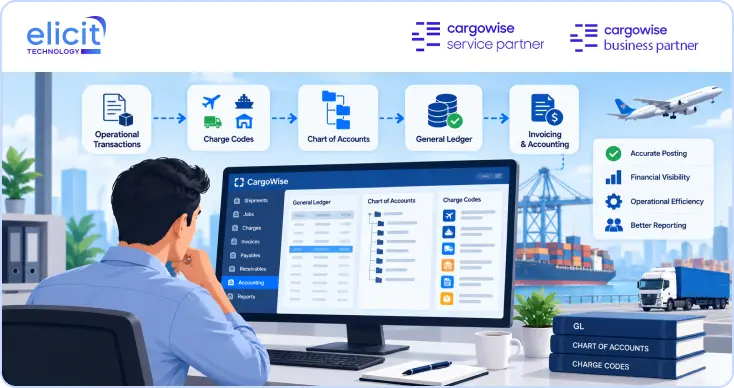
CargoWise connects operational activity with accounting. Jobs generate costs and revenue, charges become payable or receivable transactions, invoices are posted, payments are processed, and financial activity ultimately contributes to accounting and reporting.
That connection is one of the major advantages of having operations and finance within the same environment. But it also means configuration decisions made at the beginning can influence transactions much further downstream.
Consider a charge created on a forwarding job. To an operator, it may simply represent freight, documentation, handling, customs clearance, transport, or another service. From the finance perspective, that transaction eventually needs the correct accounting treatment.
This is why GL, COA, and charge-code configuration should not be viewed as background setup completed once and forgotten. They form part of the financial foundation that allows CargoWise accounting processes to work consistently.
What Role does the Chart of Accounts Play in CargoWise?
The Chart of Accounts provides the structure used to organize the company’s financial activity.
It determines how different types of financial transactions are categorized so finance teams can understand what the business is earning, spending, owning, and owing.
For a logistics business, the COA needs to reflect the financial reporting requirements of the organization without becoming unnecessarily complicated.
The problem often appears when businesses approach CargoWise implementation by simply copying their previous Chart of Accounts.
A legacy COA may contain accounts created years ago for processes that no longer exist. Similar accounts may have been added by different branches. Naming may be inconsistent. Some accounts may no longer provide meaningful reporting value.
Moving all of that into CargoWise can preserve the same accounting complexity in the new environment.
Finance teams should instead ask what reporting structure the business actually needs, how the organization is structured, and how operational transactions should ultimately be represented financially.
Why does General Ledger Configuration Matter?
The General Ledger sits at the center of financial reporting.
CargoWise integrates finance with operational activity, meaning transactions generated through areas such as receivables, payables, billing, and job costing can ultimately affect financial reporting.
That makes GL configuration more than a finance-only discussion.
Suppose operations uses one charge for a particular service, but the accounting setup does not reflect how finance needs that revenue or cost categorized. The shipment itself may still progress normally. The problem may only become visible later when finance reviews the resulting accounts or management reporting.
When this happens repeatedly across hundreds or thousands of transactions, manual journal corrections and reconciliation work can begin to grow.
Finance automation should reduce this type of intervention, not create more of it.
The GL structure therefore needs to be considered alongside the operational processes that generate financial transactions.
Why are Charge Codes So Important to Finance Automation?
Charge codes sit close to the point where operations and finance meet.
Freight forwarders use charges to represent the services, costs, and revenue associated with jobs. Depending on the organization’s CargoWise configuration, those charges become part of costing, billing, invoicing, and subsequent accounting processes.
This makes the charge-code structure important.
A business may have accumulated multiple charge codes describing nearly identical activities. Different branches may use different codes for the same service. Some descriptions may be too broad, while others may have been created for one customer and then reused elsewhere.
That creates a difficult foundation for automation.
If users cannot consistently determine which charge code should be used, automation rules also have an unclear starting point.
Before expanding finance automation, businesses should therefore review their charge-code structure and determine whether each code represents a clear business purpose.
The goal is not necessarily to have fewer charge codes. It is to have the right charge codes used consistently for the right transactions.
How Are GL, COA and Charge Codes Connected?
These three areas should not be configured independently.
The Chart of Accounts establishes the financial structure. The General Ledger records the resulting accounting activity. Charge codes help connect the commercial and operational activity surrounding jobs with the accounting process.
That means a configuration decision in one area can affect what appears elsewhere.
For example, the business may want to understand profitability across different services. If operational charges are inconsistently structured, finance may struggle to obtain the required distinction from downstream reporting even if the GL itself is well organized.
The opposite problem can also occur.
Operations may use carefully structured charge codes, but the financial configuration may group the resulting activity in a way that does not provide management with the reporting detail it expects.
This is why finance and operations should both be involved when designing the CargoWise accounting foundation.
Where should AP Automation Fit?
Once the underlying finance configuration is reliable, Accounts Payable becomes a logical area to examine for automation.
Supplier invoice processing can create substantial repetitive work. Invoices need to be received, information captured, transactions checked, approvals obtained, exceptions resolved, and payable transactions prepared for further processing.
CargoWise has been expanding its AP automation capabilities, including invoice processing designed to help capture, match, approve, and post supplier invoices and credit notes.
But AP automation should not be treated as an isolated document-processing project.
If supplier costs are being matched against poorly structured charges or the accounting treatment behind transactions is inconsistent, faster invoice processing will not resolve the underlying problem.
The stronger sequence is to establish the finance structure first and then determine which repetitive AP activities can be automated safely.
Where does AR Automation Fit?
Accounts Receivable presents a different automation opportunity.
Here, the objective is to reduce unnecessary intervention between performing the logistics work and getting the customer invoiced correctly.
CargoWise can connect job charges, rating, billing, receivables, credit control, collections, and accounting processes. When those elements are configured correctly, businesses have an opportunity to reduce repetitive billing work while maintaining stronger consistency between operational and financial information.
Again, the quality of the foundation matters.
If charge codes are inconsistently used, rates are not maintained correctly, or accounting configuration does not reflect the intended treatment, automatically progressing transactions can create downstream corrections.
AR automation works best when the business can trust the information entering the billing process.
What should You Review Before Automating More Finance Work?
Before expanding automation, look at where finance users are still making repetitive corrections.
Are accountants frequently changing the treatment of transactions after posting? Are similar services being represented by different charge codes? Are branches following different practices? Does finance regularly need to ask operations what a particular charge represents? Are invoice corrections common? Is management reporting dependent on offline spreadsheet adjustments?
These are useful signals.
They can indicate that the first automation project should not be another workflow or integration. The immediate priority may be improving the configuration already supporting the financial process.
This review should cover the business’s accounting requirements, Chart of Accounts, relevant GL configuration, charge-code structure, organization accounting settings, currencies, tax requirements, security, and AP/AR processes according to the company’s CargoWise scope.
Do Not Automate a Process You do Not Yet Trust
There is a simple test for finance automation:
Would you be comfortable allowing this transaction to progress with less manual checking?
If the answer is no, understand why before automating it.
Perhaps users do not trust the charge codes. Perhaps finance regularly changes accounting treatment. Perhaps customer billing needs manual correction. Perhaps supplier invoices frequently fail to align with expected costs.
Those problems tell you where configuration or process work is still required.
Automation delivers more value when human attention is reserved for genuine exceptions rather than being used to check every routine transaction because the underlying setup cannot be trusted.
What does a Stronger CargoWise Finance Setup Look Like?
A well-configured finance environment should make routine transactions easier to understand and process.
Operations should know which charges to use. Finance should understand how operational activity translates into accounting. The Chart of Accounts should support the reporting structure the business needs. GL activity should reflect the intended financial treatment. AP and AR teams should spend less time correcting routine transactions after they have already progressed.
This does not mean finance becomes completely hands-off.
Exceptions, approvals, unusual transactions, regulatory requirements, and commercial decisions will continue to require human involvement.
The objective is to stop treating every transaction like an exception.
When the underlying configuration is reliable, automation can take on more repetitive processing while finance teams concentrate on transactions that genuinely require judgment.
Build the Finance Foundation Before Scaling Automation
The most visible parts of finance automation are often invoice capture, approvals, automated billing, payment processing, and collections.
But those processes sit on top of something less visible: the CargoWise finance configuration underneath them.
Your General Ledger, Chart of Accounts, and charge codes influence how operational and financial activity comes together. If that foundation is inconsistent, automation can magnify the problem. If it is structured correctly, automation has a much stronger platform to build on.
Book a demo with a leading CargoWise service partner who can help logistics businesses configure and optimize CargoWise finance and accounting processes, including General Ledger and Chart of Accounts setup, charge-code configuration, AP and AR processes, financial workflows, and related accounting controls.
The objective should not be to automate finance simply because CargoWise can support more automation.
It should be to create a CargoWise finance environment where routine transactions can move with less manual intervention because the underlying configuration is trusted.