




Giving a new employee access to CargoWise does not mean they are ready to use it.
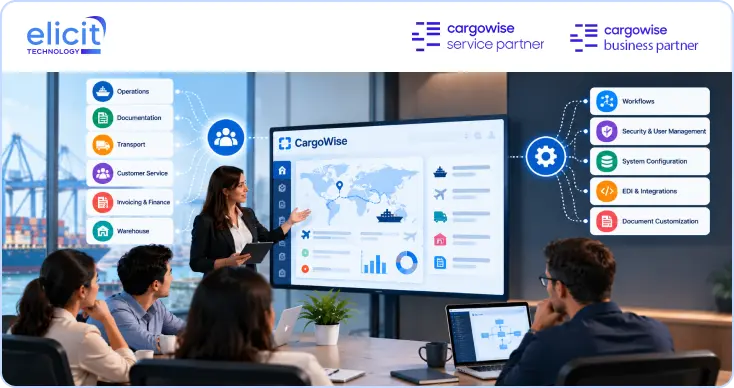
A forwarding operator needs to understand how to process the shipments they handle every day. A finance user needs confidence in invoicing, receivables, payables, and accounting processes. An administrator responsible for workflows, security, system configuration, or integrations needs a very different depth of knowledge.
This difference has become even more important as CargoWise continues to expand. WiseTech Academy now provides more than 200 courses, while new CargoWise product learning continues to be released around areas such as CarrierConnect C3, container yard operations, warehouse autorating, and revenue recognition.
For logistics businesses, the question is therefore no longer simply, “Have our employees received CargoWise training?”
A better question is: “Are they being trained for what they are actually responsible for?”
That is where separating functional and technical CargoWise user training becomes useful.
Why does CargoWise Training Matter More in Today’s Logistics Environment?
Modern freight forwarding teams are expected to manage increasingly connected processes. Shipment operations can interact with documentation, rates, customs, warehouse activity, transport, accounting, workflow automation, reporting, and customer-facing information.
At the same time, CargoWise itself continues to evolve.
WiseTech Academy regularly introduces new product and industry learning, meaning CargoWise knowledge cannot realistically be treated as something an employee learns once during onboarding and never revisits. Its September 2026 releases alone included new learning for CarrierConnect C3, Container Yard Instructions, and Revenue Recognition.
This creates a practical challenge.
A company may have invested heavily in CargoWise implementation, configuration, automation, and integration, but employees can still fall back on spreadsheets, emails, manual notes, or inconsistent processes when they do not understand how the configured environment should be used.
Training therefore has a direct connection to adoption.
The objective is not to teach every employee everything inside CargoWise. It is to give each person enough knowledge to perform their responsibilities confidently and consistently.
What is Functional CargoWise Training?
Functional training focuses on using CargoWise to perform the job.
For a forwarding operator, that might mean understanding the CargoWise processes relevant to bookings, forwarding operations, consolidations, transport bookings, documentation, or job costing.
A finance employee may need training around invoicing, Accounts Receivable, Accounts Payable, General Ledger processes, or revenue recognition.
Warehouse, customs, transport, customer service, and other users require training aligned with the CargoWise areas involved in their day-to-day work.
This approach closely reflects CargoWise’s own certification structure. Official learning pathways cover operational areas including Forwarding, Customs, Warehouse, Transport, Carrier, invoicing, and job costing, while advanced learning expands into areas such as Finance & Accounting and Tariff Management.
Functional CargoWise training should therefore answer a simple question:
What does this employee need to know to complete their work correctly in CargoWise?
The answer should determine the training, not a generic presentation of every function available in the platform.
What is Technical CargoWise Training?
Technical training goes deeper into how the CargoWise environment is configured, controlled, and extended.
This type of training is more relevant to administrators, super users, implementation teams, technical consultants, and employees responsible for maintaining or improving the CargoWise environment.
Official CargoWise Professional certification reflects this distinction. Advanced learning covers areas including Workflow Foundations, Workflow Configuration and Logic, Workflow Security and Interface Customization, Document Customization Fundamentals, EDI and XML Integration, Core System Configuration, and User Administration and Security.
These users need more than knowledge of how to complete a shipment.
They may need to understand why a workflow behaves in a particular way, how user access is structured, what happens when configuration changes, or how information moves between CargoWise and another system.
Technical training therefore answers a different question:
What does this employee need to understand to manage, support, configure, or improve the CargoWise environment?
That distinction matters because technical access without sufficient understanding can affect more than one user’s work.
Should Every CargoWise User Receive Technical Training?
Usually, no.
Trying to teach every employee advanced system configuration can make training unnecessarily complicated.
An ocean export operator does not necessarily need to understand EDI and XML Integration to process their shipments effectively. Similarly, an employee responsible for CargoWise system administration needs more than basic instructions on creating a job.
Training should follow responsibility.
A new operational employee may begin with CargoWise fundamentals and role-specific functional training. A super user may need deeper knowledge of workflows and related configuration. A system administrator may require technical learning around security, setup, integrations, or other areas they maintain.
This is also visible in the official CargoWise certification pathway.
CargoWise certifications progress sequentially from Certified Operator to Certified Specialist and then Certified Professional. The Operator level establishes core knowledge, Specialist develops more advanced functionality and specialization, and Professional covers deeper technical competencies including workflow, configuration, and electronic messaging.
Not everybody needs to reach the same depth immediately.
They need the right depth for their responsibilities.
Why isn’t Generic CargoWise Training Always Enough?
Official CargoWise training provides an important foundation. WiseTech Academy offers structured courses, tutorials, guides, assessments, and thousands of on-demand learning resources for users ranging from beginners to advanced professionals.
But there is another layer that logistics businesses need to consider.
How has your company configured CargoWise?
Two freight forwarders can both use CargoWise while operating differently.
They may have different branches, workflows, customer requirements, user permissions, documents, financial structures, approval processes, integrations, and internal operating procedures.
A course can teach an employee how a CargoWise capability works. Company-specific training needs to connect that knowledge with how the employee is expected to use it inside that particular organization.
For example, a user may understand how to perform an action in CargoWise but still not know when their company expects it to be completed, who owns the next step, which internal procedure applies, or what to do when an exception occurs.
This is where role-based training becomes valuable.
What should Role-Based CargoWise User Training Look Like?
Role-based training should begin with the employee’s responsibilities rather than the software menu.
Take an ocean export operator.
Their training should follow realistic ocean export work from the point at which they become responsible for the shipment through the activities they need to complete, documents they handle, information they maintain, and handoffs they make.
Finance training should similarly follow actual financial responsibilities rather than presenting unrelated forwarding functionality.
A CargoWise administrator requires another path altogether.
Elicit Technology’s CargoWise User Training approach begins with a Training Needs Analysis to identify skill gaps and usage patterns before developing role-based materials around the customer’s actual CargoWise environment.
The training then uses hands-on scenarios rather than relying entirely on passive instruction.
This is important because knowing where a field is located is not the same as knowing how to handle a real operational situation.
How Does Elicit Deliver CargoWise User Training?
As an official CargoWise Service and Business Partner, Elicit Technology delivers training around each customer’s actual CargoWise environment rather than using the same approach for every team. Training begins by understanding user roles, skill gaps, configured workflows, and daily responsibilities before developing role-based materials and hands-on scenarios. Pasted markdown
This helps operations, finance, customs, administrators, and other users learn how CargoWise applies to the work they are actually responsible for, while ongoing support and refresher training help maintain that knowledge as teams and configurations evolve. Pasted markdown
How should WiseTech Academy and Company-Specific Training Work Together?
Businesses do not need to choose between them.
They solve different parts of the learning requirement.
WiseTech Academy provides official CargoWise product education and structured certification pathways. Its CargoWise learning includes on-demand resources for different experience levels, and certification gives users a recognized way to validate their knowledge.
Company-specific CargoWise training can then show employees how those capabilities are used within their organization’s configured environment.
A practical learning model could therefore be:
Learn the CargoWise capability → Understand your company’s process → Practice realistic scenarios → Use it in production → Reinforce knowledge where gaps appear.
This avoids unnecessarily recreating the official CargoWise learning ecosystem while still addressing something generic product training cannot fully provide: the organization’s own processes.
What should New CargoWise Users Learn First?
A common training mistake is giving a new user too much information at once.
Instead, start with what they need to perform their immediate responsibilities.
A new CargoWise user may first need to understand basic navigation, records, actions, grids, filters, processes, tools, and eDocs before progressing into their operational specialization. This broadly aligns with the CargoWise Certified Operator pathway, which begins with core general functions before moving into areas such as Forwarding, Customs, Warehouse, Transport, or Carrier.
Once users are comfortable with their core responsibilities, training can expand.
Employees taking on more complex roles can develop specialist knowledge. Super users and administrators can progress toward workflow, system configuration, security, integrations, and other technical competencies.
The learning path should grow with the responsibility of the user.
Why should CargoWise Training Continue After Go-Live?
Training should not end because an implementation has reached production.
New employees join.
Existing employees move into different roles.
Workflows change.
New CargoWise functionality becomes available.
The business adds services, branches, customers, or integrations.
WiseTech’s current approach to Academy learning demonstrates how continuously the knowledge requirements can evolve. New CargoWise product courses continued to appear throughout 2026, including learning around Tariffs & Rates, Product Warehouse autorating, CarrierConnect C3, Container Yard Instructions, and Revenue Recognition.
A training program designed only around the original go-live environment will gradually become outdated.
Elicit therefore includes ongoing support and refresher training within its CargoWise User Training capability so learning can continue as the customer’s environment and team evolve.
Build Different CargoWise Training Paths for Different Responsibilities
There is no single CargoWise training course that every employee should receive in exactly the same way.
Operations users need strong functional knowledge of the processes they perform. Finance, customs, warehouse, transport, and other teams need learning relevant to their own responsibilities. Super users and administrators require deeper technical understanding of areas such as workflows, configuration, security, and integrations.
Official WiseTech Academy courses and CargoWise certifications provide an important foundation for developing that product knowledge. Company-specific training then connects those capabilities to the workflows, roles, and configuration employees actually encounter every day.
Elicit Technology’s CargoWise User Training combines training needs analysis, role-based material development, hands-on sessions, e-learning resources, and ongoing refresher support around the customer’s CargoWise environment.
Book a call today to teach every employee everything CargoWise can do.
This is to make sure each user knows exactly how to use CargoWise confidently for the work they are responsible for.