



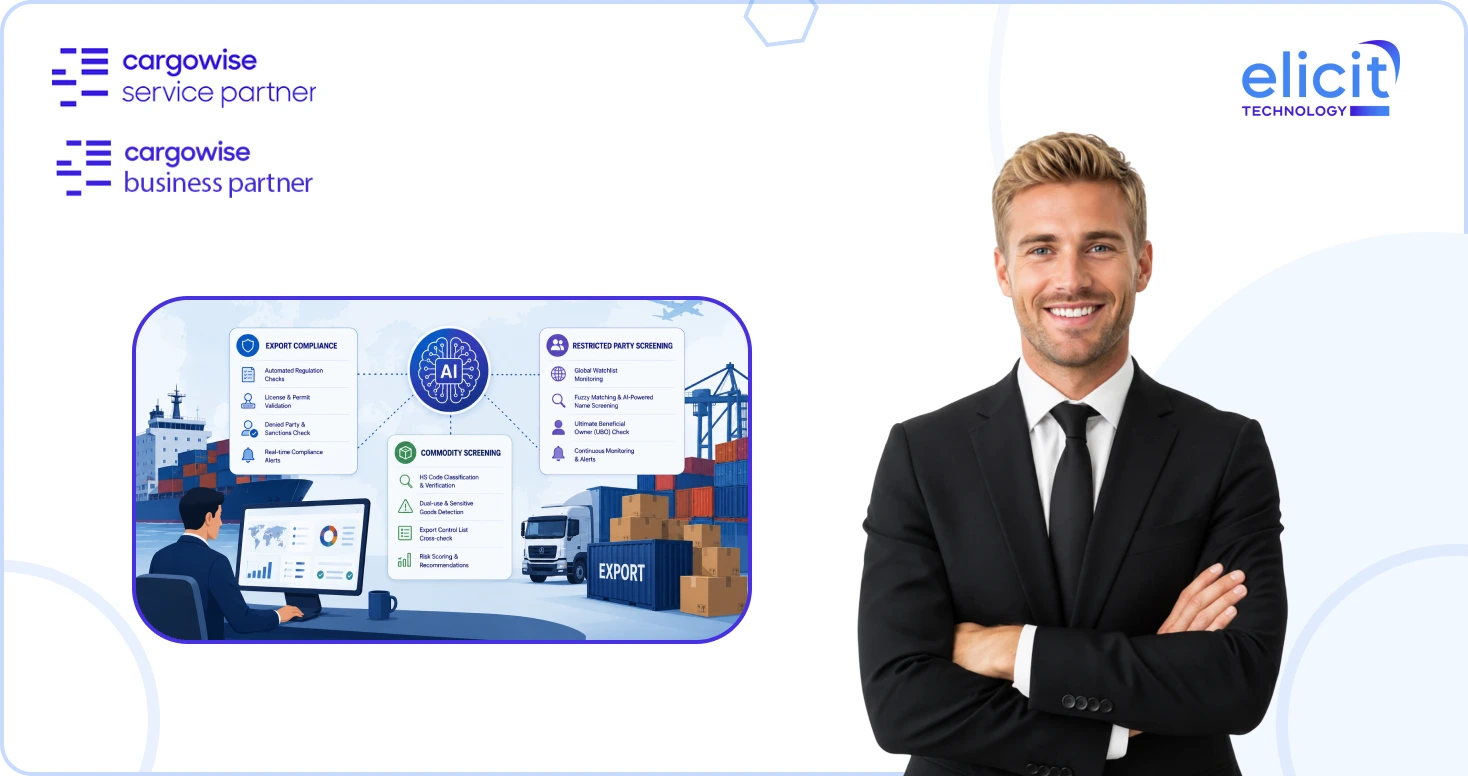
Export compliance used to feel like a back-office checkpoint. A shipment came in, documents were reviewed, parties were screened, classifications were checked, and the cargo either moved forward or got flagged.
That world is disappearing fast.
Today, export compliance is no longer a simple “check before shipment” process. Freight forwarders and logistics providers are dealing with rapidly changing sanctions, dual-use goods controls, export restrictions, routing risks, vague product descriptions, complex end-use questions, and regulatory expectations that keep getting sharper.
At the same time, shipment volumes are growing, customers expect faster movement, and compliance teams are under pressure to review more cargo with the same resources.
This is exactly where AI-powered export compliance is starting to add real value.
Not by replacing compliance teams, but by helping them move faster, screen better, research deeper, and focus their expertise where human judgment matters most.
Why has Export Compliance become more complicated?
Export compliance is difficult because it does not involve one rulebook. It involves multiple jurisdictions, multiple control lists, different destination rules, sanctioned party databases, dual-use goods regulations, military-use concerns, and route-based risks.
A shipment may need to be reviewed against origin country controls, destination country rules, transit country risks, sanctions lists, restricted party databases, export license requirements, and commodity-specific restrictions.
For freight forwarders, this becomes even more challenging because they often receive limited product information from shippers. A commercial invoice may say “electronic parts” or “industrial equipment,” but that description may not be enough to determine whether the goods are controlled, dual-use, restricted, or high-risk.
This means compliance teams spend a lot of time researching before they can even make a decision.
Why is Manual Export Compliance Screening Struggling?
Manual screening still plays an important role, but it is becoming harder to scale.
Compliance teams need to review product specifications, understand commodity use, check HS codes or ECCN relevance, compare goods against export control lists, screen all parties, review ownership risk, and assess whether the route creates diversion concerns.
When teams handle hundreds or thousands of shipments, the manual workload becomes heavy.
The real problem is not only speed. It is consistent.
Manual screening can miss risks when:
- Product descriptions are vague
- Party names are slightly different from sanctions list entries
- End-use details are unclear
- Routes involve sensitive transshipment points
- Technical specifications are not reviewed deeply
- Classifications are copied from previous shipments without review
This is where AI can help reduce exposure.
What is AI-Powered Export Compliance?
AI-powered export compliance uses intelligent automation to support compliance research, commodity screening, party screening, risk identification, and audit trail creation.
Instead of requiring teams to start every review from scratch, AI can analyze available shipment data, documents, product details, parties, routes, and regulatory signals to identify possible risks.
Purpose-built systems such as ComplianceWise are designed to help freight forwarders screen goods, parties, and destinations against export control lists, with AI agents supporting commodity research and classification.
The value is not just faster processing. The real value is better preparation before a human reviewer makes the final call.
Where AI Adds Real Value in Export Compliance?
AI is useful when it handles the research-heavy parts of compliance.
Before a compliance officer can decide whether a shipment is safe to move, they need information. AI can help gather and structure that information much faster than manual research.
It can support:
- Commodity research
- Product classification review
- Dual-use risk detection
- Restricted party screening
- Sanctions list comparison
- Route and destination risk assessment
- End-use risk flagging
- Audit trail creation
This changes the workflow. Instead of spending most of the time searching for risk, compliance teams can spend more time reviewing flagged risks and making informed decisions.
AI Commodity Screening: Why it Matters?
Commodity screening is one of the most difficult parts of export compliance.
A product may look harmless at first glance, but its technical specifications may place it under export control. This is especially true for electronics, semiconductors, sensors, aerospace parts, encryption items, high-performance computing equipment, chemicals, machine components, and dual-use technologies.
AI-assisted commodity screening helps by reviewing product-level data and identifying potential control risks.
For example, AI can help assess whether a product description suggests:
- Dual-use technology
- Military application
- Controlled components
- Sensitive destination risk
- Possible export license requirement
- Need for deeper technical review
This helps compliance teams avoid relying only on surface-level document descriptions.
Restricted Party Screening and Sanctions Risk
Restricted party screening is another area where AI can improve compliance quality.
Manual screening can fail when party names are slightly misspelled, translated differently, abbreviated, or hidden through ownership structures. Bad actors often use indirect relationships, intermediaries, or vague company identities to avoid detection.
AI-supported screening can improve the ability to detect suspicious patterns, close name matches, ownership concerns, and contextual risk.
It can also help reduce false positives by applying more context to screening results. That matters because too many low-quality alerts can overwhelm compliance teams and slow down legitimate shipments.
Better screening means compliance officers can focus attention on the risks that actually matter.
From Detection to Review: How the Compliance Role Changes
AI does not remove the need for compliance professionals. It changes where their time is spent.
In manual workflows, compliance teams spend much of their time collecting information and performing repetitive checks. With AI, routine research and screening can happen faster, allowing people to focus on the more complex questions.
Those questions include:
Is the stated end-use believable?
Does the customer profile match the order?
Is the shipment route consistent with normal trade?
Is the commodity description too vague?
Is there a risk of diversion?
Is additional documentation required?
These are not questions AI should answer alone. They require human judgment, experience, and industry knowledge.
Why Human Expertise Still Matters?
Export compliance involves context, intent, and judgment.
AI can flag patterns, screen data, and identify risks, but human experts are still needed to interpret difficult cases. This is especially true when dealing with unclear end-use statements, unfamiliar customers, unusual trade routes, high-risk destinations, or goods with possible military or dual-use applications.
Bad actors may intentionally obscure information. They may misclassify goods, hide end-users, use intermediaries, or create misleading documents. AI can help detect some of these risks, but it cannot replace experienced compliance judgment.
The best model is not AI instead of people.
It is AI supporting people.
Why Audit Trails are Becoming More Important?
Regulators increasingly expect businesses to prove that compliance checks were performed properly.
This means freight forwarders need more than a simple “screened” status. They need a record of what was checked, when it was checked, what risks were identified, who reviewed the result, and what decision was made.
AI-powered compliance tools can support stronger audit readiness by recording screening actions, flags, recommendations, and decisions inside a structured workflow.
This helps create a repeatable compliance process that is easier to review during audits or internal investigations.
For high-volume logistics operations, this is a major advantage because compliance documentation itself can become a heavy administrative burden.
Regulators are Also Using AI
AI is not only being adopted by companies. Regulators are also using AI and advanced analytics to detect suspicious trade behavior, review export license applications, analyze declarations, and identify inconsistencies across shipment histories and trading relationships.
This means logistics companies need to strengthen their own compliance processes.
If regulators are becoming more data-driven, freight forwarders must also become more structured, consistent, and audit-ready in how they manage export compliance.
AI can help, but it must be governed properly with transparency, human oversight, and clear decision records.
What Freight Forwarders should Look for in an AI Export Compliance Solution?
Not every AI tool is suitable for export compliance. Freight forwarders need solutions built for the reality of global trade.
A strong AI export compliance solution should support:
- Commodity-level screening
- Restricted party screening
- Sanctions checks
- Dual-use goods assessment
- Destination and route risk review
- Document-based data extraction
- Clear audit trails
- Human review workflows
- Explainable risk results
- Integration with logistics systems
The solution should not simply generate alerts. It should help teams understand why something was flagged and what should be reviewed next.
How ComplianceWise Supports Modern Export Compliance?
ComplianceWise helps freight forwarders screen goods, parties, and destinations against export control lists. With purpose-built AI agents, it can support commodity research and classification, helping teams identify risks earlier and reduce manual research effort.
This is especially valuable for logistics providers handling high shipment volumes, complex trade lanes, sensitive commodities, or customers operating across multiple jurisdictions.
By combining document intelligence, commodity screening, party screening, and compliance workflow visibility, ComplianceWise helps teams move from reactive checking to more structured risk management.
Why this Matters for CargoWise Users?
For CargoWise users, AI-powered export compliance becomes even more valuable when compliance checks are connected to operational workflows.
When shipment data, commercial invoice data, product details, parties, routes, and compliance screening work together, teams can reduce duplicate effort and identify risks earlier in the shipment lifecycle.
This supports faster decisions, better governance, and fewer last-minute shipment holds.
It also helps freight forwarders improve customer service because compliance issues can be detected before cargo reaches a critical execution stage.
Conclusion
AI is changing export compliance by shifting the work from manual research to intelligent risk review.
For freight forwarders, customs brokers, and logistics providers, this matters because export compliance is becoming more complex, more data-driven, and more closely monitored by regulators.
AI can help teams screen commodities, review restricted parties, identify sanctions risk, assess route concerns, support audit trails, and reduce repetitive research effort.
But AI does not replace compliance expertise. It helps compliance professionals focus their judgment where it matters most.
Contact us today, the future of export compliance belongs to teams that combine intelligent automation with strong human oversight.
For CargoWise users and logistics providers looking to strengthen export compliance, working with the right CargoWise service partner can help align AI-powered screening, compliance workflows, and operational processes into one smarter, more reliable system.