





Every freight forwarder, customs broker, and logistics professional has, at some point, heard the name CargoWise. It appears on job descriptions, shapes RFP decisions, and sits at the operational heart of how the world’s largest logistics companies move goods across borders. Yet for all its ubiquity, a surprisingly large portion of the logistics community, from seasoned operators to decision-makers evaluating enterprise platforms, lacks a clear, comprehensive picture of what CargoWise actually is, where it came from, how it has evolved, and where it is heading in 2026 and beyond.
This guide exists to change that. Written from the perspective of Elicit Technology, an official CargoWise Service and Business Partner with over 25 years of combined logistics and IT expertise, this is the most thorough, up-to-date overview of CargoWise available anywhere. Whether you are a freight forwarder researching your first enterprise logistics platform, a logistics manager navigating the shift from CargoWise One to CargoWise Next, or a finance director deciphering the new CargoWise Value Pack (CVP) pricing model, this guide will give you clear, well-researched answers.
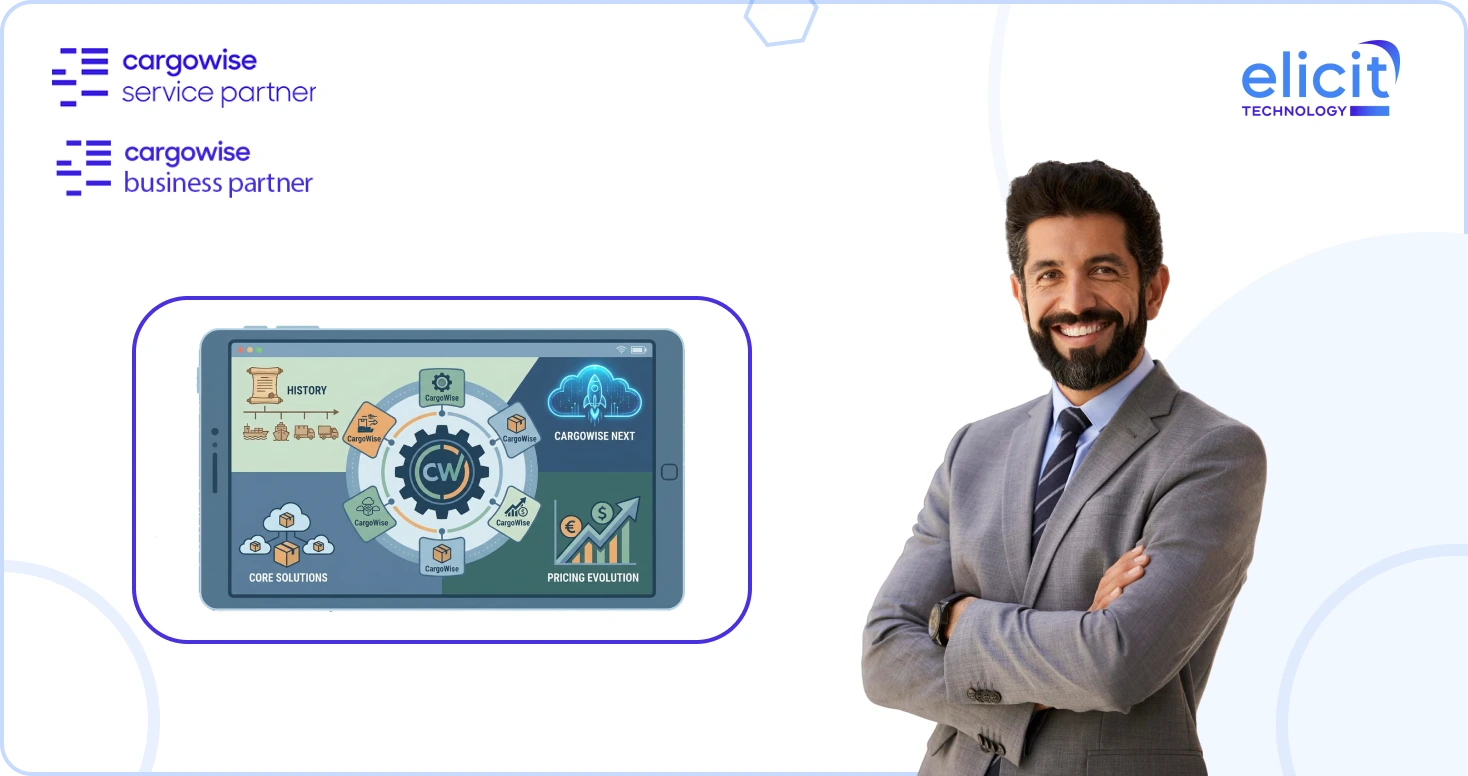
We will cover the full arc: the platform’s generational evolution, current statistics, every core solution module, the complete pricing history from Transaction Processing Fees to CargoWise Value Packs, the CargoWise One-to-Next transition, and the AI transformation that is reshaping the platform right now. Let us start at the very beginning.
The Genesis of CargoWise: A Story that Started with Code and Freight
To understand CargoWise, you first need to understand the man who built it. In 1994, Richard White founded a software company in Sydney, Australia, with a clear focus on improving the way freight forwarders managed complex logistics operations, alongside Maree Isaacs. The company that would eventually become WiseTech Global was not born in a university computer lab or a Silicon Valley accelerator. It emerged from a practical frustration with the tools that freight forwarders actually had available to them at the time: fragmented, manual-intensive, and incapable of handling the complexity of modern international logistics.
White’s founding conviction was architectural. He believed that logistics software needed to be genuinely integrated, not merely a collection of modules from different vendors loosely connected by exports and imports. He envisioned a single system where every operational domain, forwarding, customs, transport, warehouse, accounting, and compliance, shared the same data in real time. That vision, held stubbornly through three decades of development, is precisely what CargoWise became.
By 1999, WiseTech made its first strategic acquisitions to expand its product capability and customer base. Then in 2004 came a significant milestone: the launch of ediEnterprise, the company’s second-generation software platform, built with Electronic Data Interchange (EDI) capabilities at its core. EDI was the language of international logistics, the standard through which shipping lines, airlines, customs authorities, and cargo handlers communicated. Building EDI into the platform’s DNA gave WiseTech a foundation for global ambition.
In 2006, that ambition moved from aspiration to action. WiseTech expanded offshore for the first time, shifting its strategic focus to multi-regional logistics service providers. Two years later, in 2008, the company introduced software-as-a-service and on-demand licensing, a move that positioned CargoWise ahead of the cloud-first wave that would reshape enterprise software over the following decade.
The 2014 launch of CargoWise’s third-generation platform, what the market knows as CargoWise One, was the moment the company transformed from a respected regional player to a genuine global force. The single-database, fully integrated architecture that White had envisioned in 1994 was now deployed on a global scale. By the time WiseTech listed on the Australian Securities Exchange in 2016, valued at A$1 billion, the trajectory was clear.
In October 2024, Richard White stepped down as CEO following personal controversies that drew significant industry attention. Zubin Appoo, a seasoned technology executive, was named the company’s new Chief Executive and officially welcomed in 2025. That same year, WiseTech closed its largest-ever acquisition, e2open, bringing its global workforce to more than 7,000 people and significantly extending its supply chain intelligence capabilities.
The company White built from a Sydney office in 1994 is today, by a substantial margin, the world’s leading developer of logistics execution software. Its revenues in FY2024 approached A$1.05 billion. Its platform is active in 193 countries. Its R&D investment, A$261.9 million in FY2023 alone, exceeds the total revenues of most logistics software companies globally.
CargoWise in Numbers: The Scale that Defines the Platform in 2026
Numbers tell their own story. The following figures reflect the CargoWise ecosystem as of mid-2026, a snapshot of a platform that has, by any reasonable measure, become the dominant operating system of global logistics.
| Metric | Data Point |
| Active logistics organizations | 17,000+ across 170+ countries |
| Operational country coverage | 193 countries |
| Supported languages | 30 |
| Supported currencies | 162 |
| Global WiseTech employees (2025) | 7,000+ (post e2open acquisition) |
| R&D investment (FY2023) | A$261.9 million |
| CargoWise Certified Practitioners | 29,500+ globally |
| Top 25 global freight forwarders | All 25 use CargoWise |
| Top 50 third-party logistics providers | 41 of 50 use CargoWise |
| FY2024 revenue | ~A$1.05 billion |
| EBITDA margin (FY2024) | 45%+ |
| Workforce on product development | 60% of the total WiseTech staff |
| Value Pack modules & functions | 216+ included per shipment |
| New capabilities released (past year) | 125+ new functions and features |
These are not abstract figures. They represent an ecosystem of extraordinary depth, a platform whose network effects compound year on year, making CargoWise increasingly difficult to displace once it becomes embedded in a logistics organization’s operations. A Morningstar analysis cited by CargoWise found that the average CargoWise customer delivers roughly 10 times the share price performance of the average industry peer, a remarkable data point that speaks to the operational leverage the platform generates.
Four Generations of Innovation: The Platform’s Technical Evolution
CargoWise’s journey from a lean Australian freight-forwarder tool to the world’s leading logistics cloud-based ERP platform has passed through four distinct technological generations. Understanding this arc provides essential context for where the platform stands today and where it is heading.
Generation 1 (1994–2003): Writing Code for Australian Freight
The first generation was defined by proximity to the problem. WiseTech’s software was built by people who understood freight operations from the inside. It was practical, operationally grounded, and genuinely useful in a market where most available tools were generic business software poorly adapted to logistics realities. The architectural ambitions were modest; the immediate usefulness was not.
Generation 2 (2004): ediEnterprise and the Gateway to Global
The launch of ediEnterprise in 2004 was the first major leap toward globalization. Electronic Data Interchange capabilities opened CargoWise to the international logistics community, where EDI was not merely convenient but essential for communicating with shipping lines, customs authorities, and cargo handling facilities around the world. ediEnterprise laid the technological groundwork for everything that followed.
Generation 3 (2014): CargoWise One — The Integrated Logistics Operating System
The 2014 launch of CargoWise One was a genuine industry inflection point. This third-generation platform was built on a single-instance, single-database model: forwarding, customs, warehouse, transport, accounting, CRM, and compliance all in the same system, sharing the same data in real time. No duplicate data entry. No inter-module reconciliation. No exporting from one system to import into another.
This architecture became CargoWise’s defining competitive advantage. Over the following decade, WiseTech invested hundreds of millions of dollars expanding CargoWise One’s scope: adding 30 supported languages, launching global vessel and container tracking, building customs integrations for dozens of countries, and continuously extending the platform’s functional depth. By 2020, all 25 of the world’s top 25 freight forwarders operated on CargoWise One. It had become not merely a software product but the infrastructure of global trade.
Generation 4 (2025): CargoWise Next — A Platform Built for the AI Era
In 2025, WiseTech Global rolled out CargoWise Next, the fourth generation of the platform. This is not a rebranded version of CargoWise One. It represents a fundamental modernization of the underlying architecture: improved cloud infrastructure, current-generation security standards, AI-readiness, and a new set of capabilities that were structurally impossible to deliver on the previous foundation.
By design, the transition has been made as smooth as possible for existing users. The operational workflows, terminology, screen layouts, and job management logic that CargoWise users have spent years mastering carry over to CargoWise Next without a steep relearning. What changes is what is available above and beneath that familiar interface, dramatically expanded automation, AI-powered tools, and a platform architecture built for the next decade of logistics technology.
WiseTech has been explicit on one key point: it will no longer develop new features for CargoWise One. All innovation, all AI investment, and all new capability development are happening inside CargoWise Next. The platform transition is a one-way door, but it is a door into the future of the system.
Core Solutions Inside CargoWise: A Module-by-Module Breakdown
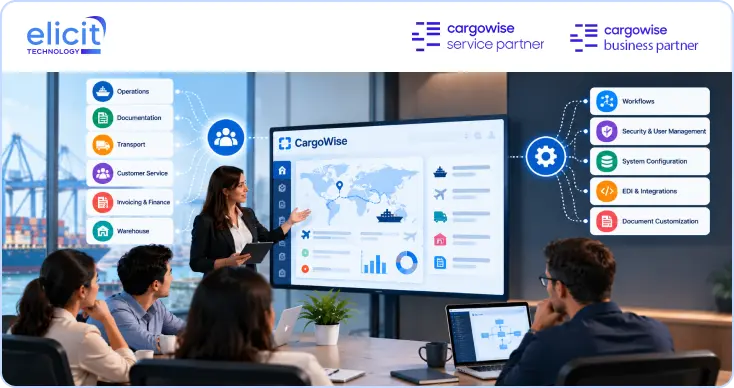
CargoWise is often described simply as ‘logistics software,’ but that description dramatically understates its operational scope. The platform covers virtually every functional domain that a freight forwarder, customs broker, warehouse operator, or logistics carrier could require. Here is a breakdown of the platform’s major solution areas.
International Freight Forwarding
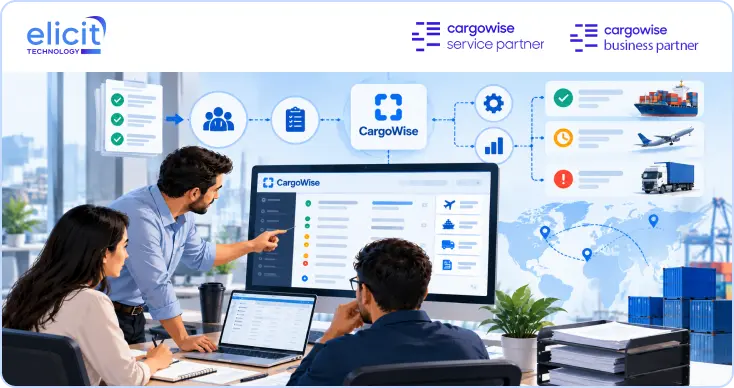
The forwarding module is CargoWise’s operational core for most freight forwarders. It manages the complete lifecycle of an international shipment: booking and capacity planning, connection to vessel and airline schedules, origin and destination service management, document generation, milestone tracking, cost management, and final delivery. It covers all transport modes, air, ocean, and road/rail, in a single unified job structure, so a multimodal shipment requiring ocean main leg with road pre-carriage and air express for urgent cargo does not require separate records in separate systems.
The platform connects directly with carriers, airlines, and shipping lines through eHub, CargoWise’s built-in integration network. Booking confirmations, sailing schedules, rate cards, track-and-trace events, and carrier communications flow electronically, reducing manual data entry and the compounding errors it produces.
Customs and Compliance
CargoWise’s customs module is one of its most widely recognized differentiators. CargoWise supports customs connectivity across 75+ countries, giving freight forwarders and customs brokers access to a broad global customs filing network from within the same ERP environment. Compliance screening against government-sanctioned party lists, tariff classification support, duty calculation, and country-specific regulatory requirements are all embedded in the same operational workflow.
The 2025 launch of ComplianceWise, CargoWise’s AI-assisted compliance intelligence engine, has extended these capabilities significantly. In an environment where export control regulations, dual-use goods restrictions, and customs authority requirements are tightening across multiple major trade corridors simultaneously, ComplianceWise provides the automated compliance guardrails that modern logistics operations increasingly depend on.
Warehouse Management
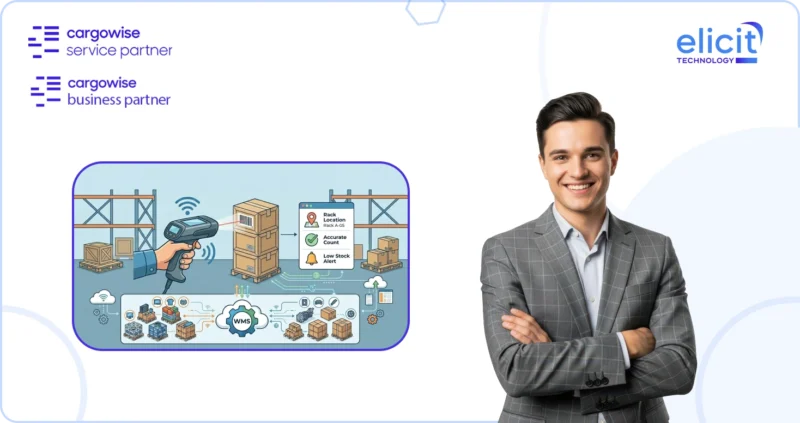
CargoWise’s warehouse management system (WMS) comes in three primary configurations: Transit Warehouse (for goods-in, goods-out temporary storage linked to forwarding operations), Product Warehouse (for 3PL contract warehousing and distribution), and Bonded Warehouse (for duty-deferred storage with integrated customs controls). All three connect directly with the forwarding and customs modules, eliminating the functional gap that typically exists between a freight management system and a standalone WMS.
Under the new CargoWise Value Pack model, RF device charges, previously levied per handheld scanner and forklift-mounted terminal, have been eliminated entirely. For warehouse-heavy operations, this represents a meaningful and immediate cost reduction.
Transport Management
The transport module covers domestic and cross-border road operations, including linehaul, full truckload (FTL), less-than-truckload (LTL), and distribution management. Capacity planning, load optimization, route planning, real-time ETA alerts, and customer-facing delivery visibility tools are all integrated with the core CargoWise database. For port-adjacent drayage operations, CargoWise’s Landside suite provides specialized container transport optimization tools — including Container Transport Optimization (CTO) to reduce repositioning costs and eliminate empty repositioning movements.
Carrier Connectivity
CargoWise serves logistics intermediaries and carriers alike. The carrier connectivity suite includes Liner and Agency tools for ocean carrier vessel scheduling, container tracking, and agency operations management, as well as AirlineConnect for rate management and booking integration with air cargo capacity providers. CargoWise also provides built-in connectivity to many of the world’s leading ocean carriers and NVOCCs, giving users direct access to sailing schedules, bookings, rates, tracking milestones, shipping instructions, and bill of lading information from within a single platform. In early 2026, WiseTech and Hapag-Lloyd launched an IoT container tracking pilot that enables Hapag-Lloyd’s fleet of two million containers to transmit real-time location data directly into the CargoWise ecosystem, a development that signals the direction of carrier-platform integration over the coming years.
Enterprise Tools
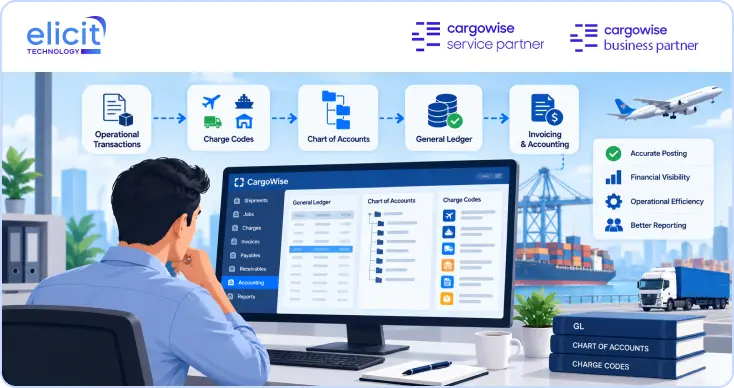
Underpinning every operational module is a suite of enterprise tools: integrated A/P and A/R accounting with multi-currency and multi-entity support, country-specific invoicing compliance (including e-invoicing integrations for markets like Uruguay, Brazil, and across the EU), CRM and tariff management, event and milestone configuration, scheduler automation, document management, and management reporting. These are not peripheral add-ons, they are foundational components of the single-database architecture that makes CargoWise genuinely integrated rather than merely connected.
CargoWise Neo
CargoWise Neo is among the most significant product additions to CargoWise in recent years. It is a fully web-based, real-time supply chain visibility portal, designed primarily as a customer-facing interface through which shippers, importers, and exporters can access live data on their shipments, orders, declarations, invoices, and documents, directly from the CargoWise system managing their freight. Neo also includes Market Intelligence capabilities, providing analytics drawn from the platform’s unparalleled global logistics dataset, helping customers make more informed routing and carrier decisions. It integrates natively with CargoWise Next, ensuring that customer-facing visibility is always synchronized with operator-side operational reality.
The Pricing Story: From Transaction Fees to CargoWise Value Packs (CVP)
Few topics in the CargoWise ecosystem have generated more discussion, confusion, or strategic concern over the past twelve months than pricing. The transition from the legacy Site Transaction License (STL) structure and the various transaction processing fees it encompassed to the new CargoWise Value Pack (CVP) commercial model represents the most significant change in how CargoWise is sold and billed since the platform introduced cloud delivery.
To understand where things stand in 2026, it is worth understanding where they started.
The Legacy Model: STL, Seat Licenses, and Fragmented Billing
For most of CargoWise One’s operational life, customers operated under a Site Transaction License structure. Under STL, pricing was multi-layered and, for larger operations, genuinely complex. Companies paid for user seat licenses, the number of named individuals with system access. They paid cloud hosting fees based on database size and compute consumption. They paid transaction processing fees for specific operational events, customs filings, for example, or specialized carrier integrations. And they paid for a range of additional modules and features that had been commercialized separately as the platform’s scope expanded.
The STL model reflected a time when CargoWise’s functional scope was more limited, its cloud infrastructure was newer, and the economics of logistics software were more straightforwardly analogous to traditional enterprise software. As the platform grew, however, the model became increasingly misaligned with operational reality. Invoices grew more complex. The cost of adding new users, even trained staff who would clearly improve platform utilization, became a budget decision. Cloud costs fluctuated based on processing intensity. And the growing volume of AI and automation investments required a commercial structure that could support them.
The New Commercial Model: CargoWise Value Packs (CVP) — Launched December 1, 2025
On October 31, 2025, WiseTech Global announced the CargoWise Value Packs. The new commercial model went live for notified customers on December 1, 2025, the most significant pricing restructure in CargoWise’s history, and for many logistics companies, the single most consequential operational change they have faced in their CargoWise journey.
The CVP model replaces the multi-layered STL structure with a fundamentally simpler logic: a single Automation Fee per logistics transaction, charged based on shipment mode (air, ocean, road), direction (import, export, domestic), and job type (forwarding or standalone customs). There are no seat licenses, no standard cloud hosting charges, no volume tiers, and no discounts.
This is the central commercial innovation of the CVP model. Because the Automation Fee is treated as a pass-through disbursement rather than a software overhead, the logistics provider’s internal CargoWise cost, when correctly configured, can be dramatically reduced, or effectively eliminated from the P&L altogether. The fee appears on the customer invoice as a logistics service charge, similar to any other disbursement made on the customer’s behalf.
What is Included in the CargoWise Value Packs?
The scope of what is bundled into the Value Packs is extensive. The Forwarding Value Pack includes all forwarding workflows, all related customs processes tied to forwarding jobs, and formal import/export procedures, meaning no separate customs charge on top of forwarding for standard shipment types. The Customs Value Pack covers standalone customs clearance for brokers without a forwarding job. Separate Value Packs cover Warehousing and Land Transport.
Across these Value Packs, more than 216 forwarding, customs, warehouse, and land transport functions and modules are included. Capabilities previously sold as separate add-ons are now bundled. WiseTech Academy training content, including the Diploma of International Forwarding, Diploma of Customs Brokerage, and the management-focused Black Belt in Thinking program, is now included at no additional charge. All 30 supported languages are included. RF device licenses for warehouse operations are eliminated.
Critically, future features and enhancements that logically belong to a given Value Pack are included as they are released. This means that the platform’s innovation pipeline, including AI capabilities currently in development, will continue to reach customers without triggering additional commercial negotiations or licensing conversations.
The Transition: What Happened and What it Means?
For notified customers, the transition to CVP was automatic. No action was required. The STL model was retired for notified accounts, with no option to revert. Commitment-contract customers were engaged separately to review how CVP affected their specific arrangements.
The initial billing cycle under the new model was not without friction. Some customers reported confusion where Transitional Pricing Protection credits appeared alongside new Automation Fee charges on the same invoice, making the net cost picture difficult to interpret. This is a natural consequence of a complex commercial transition, and it is precisely the kind of challenge where working with a CargoWise Service and Partner makes a tangible difference. Correctly configuring the Automation Fee as a disbursement, aligning accounting setup for proper balance-sheet treatment, and ensuring that branch-level and entity-level reporting remain accurate are all areas where expert guidance significantly accelerates the adjustment period.
CargoWise One vs. CargoWise Next: What Changed, What Stayed, and Why it Matters?
For the many thousands of logistics professionals who have built their operational expertise on CargoWise One, the transition to CargoWise Next raises practical questions. Here is a clear, honest picture of what the change involves.
Architecture and infrastructure: CargoWise Next modernizes the underlying technical architecture while preserving the operational database structure and business logic. This means faster performance, improved cloud efficiency, better security, and the ability to integrate AI capabilities that were not architecturally possible in CargoWise One.
User experience: WiseTech was deliberately conservative in preserving the user interface. The same workflows, screens, terminology, and operational logic carry over. Users do not face a blank-sheet relearning experience. What changes is the expanded set of capabilities accessible within that familiar environment.
New capabilities exclusive to CargoWise Next: Advanced Order Manager (enabling online customer order placement with supplier controls for bookings, cargo releases, and packing manifests), Greenhouse Gas Emissions Calculator (automated carbon accounting for sustainability reporting), Neo integration, Market Intelligence analytics, and the complete AI toolkit.
Security: CargoWise Next was built with current-generation security standards: end-to-end data encryption, real-time threat monitoring, integrated compliance features, and automatic security patching managed centrally by WiseTech, removing the customer-side burden of scheduling and applying critical security updates.
Update management: Under CargoWise One’s STL model, customers paid separately for cloud hosting and had some control over update timing. With CargoWise Next, WiseTech manages updates centrally, publishing a progressive rollout schedule across DPR, STD, and GPR rings. Critical security patches are applied urgently when required. This reflects the expectations of a modern SaaS platform.
Rollback: There is none. Once transitioned to CargoWise Next, the migration is permanent. The platform is a one-way door, but it is a door into the platform that will receive every future WiseTech investment, every new AI capability, and every major innovation for the foreseeable future.
For organizations that have not yet made the transition, the strategic implication is straightforward: every month spent on CargoWise One is a month without access to AI Classification, ComplianceWise, Agentic AI workflows, Neo’s Market Intelligence, and the growing suite of capabilities that will define competitive logistics operations in the coming years.
AI and Technology Transformation: CargoWise in 2025–2026
Artificial intelligence is not a theoretical future for CargoWise, it is a present operational reality. From December 1, 2025, a meaningful suite of AI-powered tools became available to all CargoWise Value Pack customers. More are in active development, governed by a roadmap that reflects WiseTech’s significant ongoing R&D investment. Understanding the current AI landscape, what is available, what is coming, and what it means for logistics operations is essential for any organization planning its technology strategy for the next three to five years.
AI Classification Assistant
Tariff classification is among the most consequential and time-consuming tasks in customs brokerage. Getting an HS code wrong can produce incorrect duty payments, compliance failures, post-clearance audit exposure, and regulatory penalties. The AI Classification Assistant accelerates and improves classification accuracy using machine learning trained on CargoWise’s unparalleled global dataset of trade transactions. It does not replace human expertise; it augments it, flagging likely classifications for review, surfacing relevant regulatory notes, and reducing the time operators spend on routine classification decisions from hours to minutes.
ComplianceWise
ComplianceWise is CargoWise’s dedicated compliance intelligence engine, bringing together sanctioned party screening, export control management, dual-use goods classification, and customs authority requirement tracking in a centralized, automated environment. The regulatory landscape has grown dramatically more complex in recent years, tightening export controls on emerging technologies, stricter sanctions enforcement across multiple jurisdictions, new EU compliance requirements, and increasingly aggressive customs authority scrutiny in major trade corridors. ComplianceWise addresses this complexity at scale, helping compliance teams transition from reactive, manual screening to proactive, automated risk management. CargoWise’s own research in early 2026 noted that AI is actively shifting how export compliance teams allocate human expertise, from routine screening to exception handling and strategic oversight.
ACE AI Chatbot
The ACE AI Chatbot is an AI-powered assistant embedded within the CargoWise platform, trained specifically on the platform’s operational logic, procedural workflows, and support knowledge base. For organizations with diverse user populations, spanning experienced operators and newer staff still building their CargoWise proficiency, ACE reduces the volume of support tickets, accelerates onboarding, and provides immediate, contextual guidance at the point of need. It functions as an intelligent, always-available in-system guide that scales support capacity without scaling headcount.
AI-Assisted Document Ingestion
One of the most persistently labor-intensive activities in freight operations is the manual extraction and entry of data from commercial documents, invoices, packing lists, bills of lading, certificates of origin, dangerous goods declarations, and more. AI-Assisted Document Ingestion applies machine learning to automatically extract, validate, and structure data from these documents into CargoWise’s data model. For standard, well-formatted document types, modern document ingestion AI operates at accuracy rates that make manual re-entry genuinely difficult to justify, freeing operators to focus on discrepancies, exceptions, and customer-facing work rather than data transcription.
Agentic AI Workflow Engine
The most transformative AI development on CargoWise’s active roadmap is the Agentic AI Workflow Engine, currently in development and available to selected customers through the Trial Access Addendum (TAA) program. Agentic AI refers to task-focused AI systems that do not merely assist human operators but actually complete defined operational tasks autonomously. In the CargoWise context, this means AI agents capable of processing formal import and export procedures end-to-end, executing compliance checks, managing documentation workflows, and handling routine job management steps without human intervention.
Unlike general-purpose AI assistants, CargoWise’s agentic models are purpose-designed for specific, high-stakes logistics workflows. They follow strict procedural logic to minimize hallucination risk, are designed to escalate to human operators when uncertainty arises, and are built around the data model and compliance requirements of international trade. The ambition, as WiseTech has articulated it, is substantial labor reduction: not replacing logistics professionals, but enabling smaller teams to manage larger shipment volumes with greater accuracy and lower error rates.
All AI capabilities, current and future, are exclusive to CargoWise Next under the Value Pack commercial model. Organizations on CargoWise One will not have access to these tools.
WiseTech Academy: Learning, Certifications, and Industry Training
WiseTech Academy is the official learning platform for CargoWise users and logistics professionals. It offers CargoWise certifications, product training, and structured learning paths to help users improve their system knowledge and operational skills.
Beyond CargoWise training, WiseTech Academy also provides industry-related courses covering freight forwarding, customs, compliance, dangerous goods, air freight, sea freight, and other logistics topics. This makes it a useful learning hub for both CargoWise users and professionals looking to strengthen their logistics knowledge.
Why has CargoWise Become Indispensable to Global Logistics?
It is worth stepping back from the feature inventory and asking a more fundamental question: why has CargoWise become so deeply embedded in global logistics that it is trusted by every one of the world’s top 25 freight forwarders? The answer is not simply the scale of adoption or marketing investment. It is the combination of architectural decisions WiseTech made, single-database, deeply integrated, cloud-first, continuously updated, globally compliant, that has created a platform that generates compounding value the longer it is used and the more deeply it is embedded.
Consider what that means in practice. When a forwarding agent enters shipment data into a CargoWise job, that data automatically flows to the customs declaration, the warehouse management event, the transport booking, the client invoice, and the management dashboard, without re-keying, without synchronization delays, without version mismatches. One data entry; everywhere it needs to be, instantly.
Now multiply that across 17,000 logistics organizations, all connected to the same carrier networks, customs authority integrations, and compliance intelligence systems through a shared platform architecture. The network effects are enormous. A new EDI integration with a port authority system, a new AI-assisted customs workflow, or a new ocean carrier tracking connection is deployed once and becomes available to every CargoWise user simultaneously. The platform improves for every user every time WiseTech invests.
This is the architecture of a network, not merely a product. And networks, as any economist will tell you, grow stronger as they grow larger. The competitive moat around CargoWise is not just the quality of its software, it is the depth of its global integration ecosystem, the size of its certified practitioner community, and the compounding data advantage that comes from processing a significant fraction of all internationally traded goods.
How Elicit Technology Helps You Get More From CargoWise?
CargoWise is a powerful cloud-based ERP platform. But power without deep configuration, correct implementation, and expert guidance produces underperformance, and underperformance at scale is expensive. The difference between a CargoWise environment that has been properly implemented, configured, and optimized by specialists and one that has been set up by generalists following a manual is the difference between a tool that transforms your operations and one that adds complexity without extracting value.
Elicit Technology is an official CargoWise service and business partner, as well as a platinum partner in Accounting and Workflow, built specifically around helping logistics companies get the full value of their CargoWise investment. Our team works with CargoWise every day as active practitioners, not as consultants who have read the documentation, but as operators who understand the platform’s capabilities and intricacies at a working level. This is what makes our support genuinely different.
Our services span the complete CargoWise lifecycle:
- Implementation Support: CargoWise setup, new company onboarding, user management, registry configuration, eHub adaptor setup, and patch update management.
- Customization and Configuration: Screen and document customization, label and report customization, custom field configuration, scheduler and event configuration, milestone and document delivery setup.
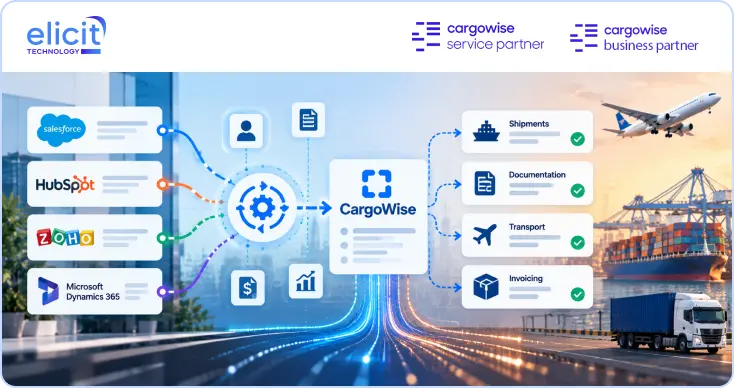
- Integration Services: SAP integration, carrier and customs integrations, e-invoicing integration for country-specific compliance, vessel and container tracking.
- AI Automation and API Services: Automating purchase orders, sale orders, commercial invoice processing, packing list management, bill of lading handling, and job management workflows.
- Business Intelligence: Reporting and analytics built on CargoWise data, delivering the operational insights your management teams need.
- CargoWise Value Pack Transition Support: Ensuring your Automation Fee configuration, accounting setup, disbursement treatment, and billing workflows are correctly aligned with the new CVP commercial model, so your organization captures the intended P&L benefit rather than absorbing costs unnecessarily.
- AI Readiness and Adoption: Helping your teams adopt CargoWise’s AI tools, Classification Assistant, ComplianceWise, Document Ingestion, and preparing your CargoWise environment for the Agentic AI capabilities on the platform’s roadmap.
Whether you are implementing CargoWise for the first time, optimizing an environment that has been running for years, navigating the CVP transition, or preparing for CargoWise Next, Elicit Technology provides the specialist expertise to make the process efficient, accurate, and aligned with your business objectives.
Conclusion: The CargoWise Story is Not Finished, it is Accelerating
From a small Sydney software company writing code for Australian freight forwarders in 1994 to a global platform trusted by 17,000+ logistics organizations across 170+ countries, the CargoWise story is one of sustained, compounding innovation built on a clear architectural vision. That vision, held consistently through three decades of development, has produced a platform that is not merely widely adopted but genuinely indispensable for the organizations that rely on it most.
For freight forwarders, customs brokers, warehouse operators, and logistics providers, the questions raised by these developments are not merely technical. They are strategic. How should your organization configure the Automation Fee to capture the intended P&L benefit? How do you prepare your team for CargoWise Next? How do you position yourself to leverage AI capabilities as they mature from trial programs into production-grade workflows? These questions do not have generic answers, they depend on your specific operational model, your markets, your customer mix, and your current CargoWise configuration.
That is where specialist guidance makes the difference. Schedule a call with Elicit Technology to optimize CargoWise every day, implementing, configuring, customizing, integrating, and automating the platform for logistics companies across the globe.