




Everyone is talking about artificial intelligence.
Every conference presentation, technology roadmap, industry webinar, and boardroom discussion seems to revolve around AI. Logistics providers are exploring AI assistants. Freight forwarders are evaluating AI-powered automation tools. Supply chain leaders are investing heavily in digital transformation initiatives.
Yet despite all the excitement, many organizations are asking the wrong question.
The question isn’t whether AI can transform supply chains.
The real question is: what makes AI useful enough to create meaningful business outcomes?
Because here’s the truth.
AI by itself doesn’t create a competitive advantage.
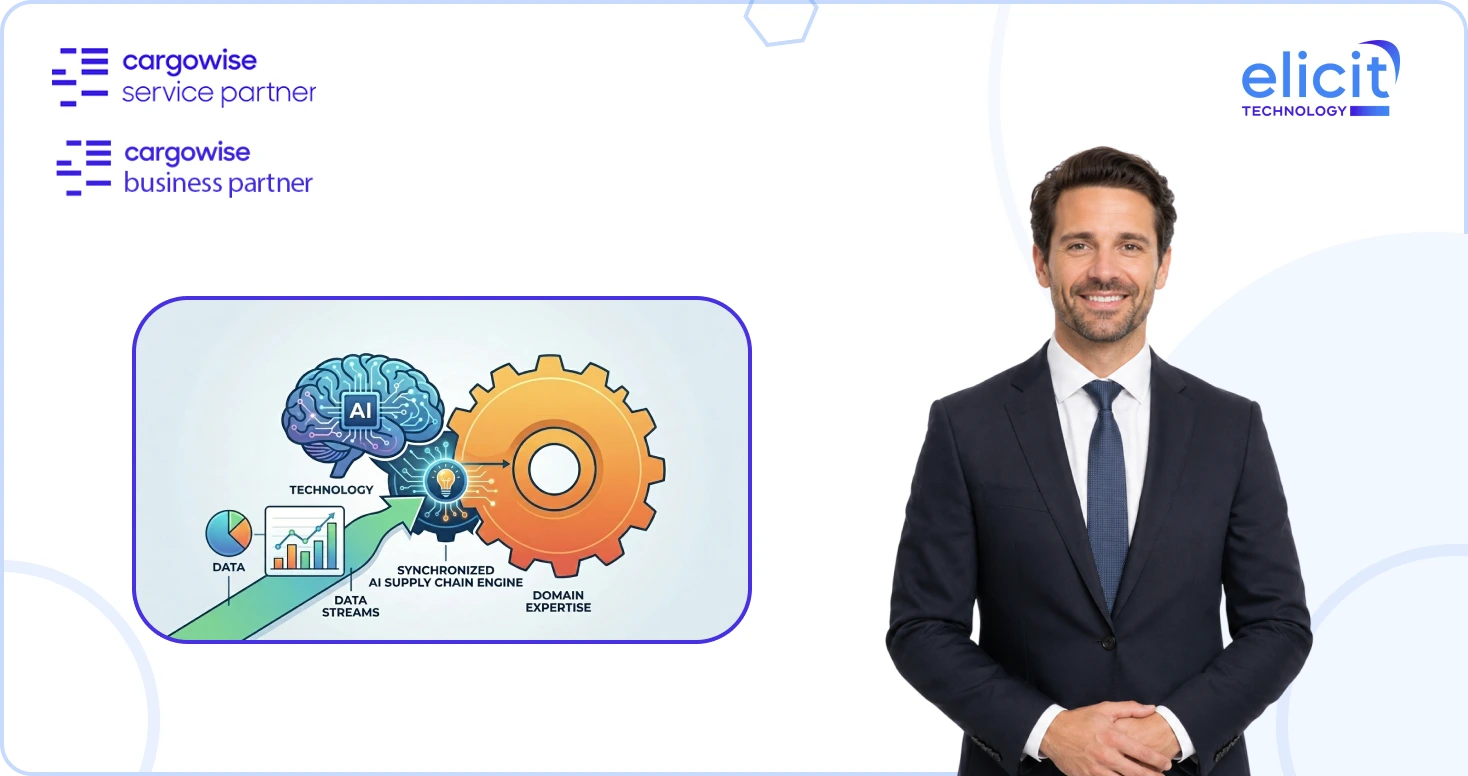
The organizations that will benefit most from AI won’t necessarily be the ones with access to the latest models. They’ll be the companies with the best operational data, the strongest logistics expertise, and the most connected supply chain ecosystems.
That’s where real transformation happens.
Why AI Alone is not Enough?
It’s easy to be impressed by what modern AI can do.
It can summarize information, generate reports, answer questions, automate repetitive tasks, and analyze large volumes of data faster than any human team.
But AI is only as good as the information available to it.
A generic AI model may understand language extremely well, but it doesn’t automatically understand your shipments, customers, carrier relationships, customs requirements, operational workflows, or financial structures.
Without access to meaningful business data, AI can only provide generic answers.
That’s why many early AI initiatives fail to deliver long-term value.
They improve interfaces but don’t fundamentally improve operations.
Organizations add chatbots, assistants, or automation layers on top of existing systems, but the underlying workflows remain unchanged.
The result is incremental improvement rather than transformational change.
The Difference Between AI Features and AI Infrastructure
Many businesses today are implementing AI as a feature.
This often includes:
- Chat interfaces
- Automated responses
- Workflow assistants
- Productivity tools
- Data summarization
These capabilities certainly have value.
They help users work faster and reduce manual effort.
However, truly transformative AI operates much deeper within the organization.
Instead of simply helping people navigate processes faster, it helps redesign processes altogether.
This shift occurs when AI becomes part of the operational infrastructure rather than just another software feature.
When AI is connected directly to logistics operations, shipment data, customer information, compliance records, financial transactions, carrier performance metrics, and supply chain events, it moves beyond automation and becomes operational intelligence.
Why is Operational Data Becoming the Most Valuable Asset?
One of the biggest misconceptions surrounding AI is that the model itself creates the advantage.
In reality, operational data is becoming the true differentiator.
Today’s leading AI models continue to improve rapidly. The performance gap between major providers becomes smaller with every release.
What cannot be easily replicated is decades of operational data.
For logistics organizations, this includes:
- Shipment histories
- Customs records
- Carrier performance data
- Freight costs
- Trade lane performance
- Compliance activities
- Customer interactions
- Operational workflows
- Financial transactions
When AI can access this information, it starts delivering insights that generic tools simply cannot provide.
Instead of telling users what happened, AI can help explain why it happened and recommend what to do next.
That’s where AI becomes truly valuable.
Why Connected Supply Chain Networks Matter?
Supply chains are not isolated systems.
Every shipment involves multiple participants:
- Shippers
- Freight forwarders
- Carriers
- Customs brokers
- Warehouses
- Ports
- Terminals
- Inland transportation providers
- Government agencies
Each participant generates valuable operational data.
The challenge is that this information often remains fragmented across disconnected systems.
When data becomes connected, AI gains broader context.
A delay at a port is no longer just a delay.
It becomes a potential customer service issue, inventory risk, production disruption, revenue impact, or compliance concern.
Connected supply chain ecosystems allow AI to understand relationships between events rather than evaluating each event independently.
This creates significantly better decision-making capabilities.
Why does Human Expertise Still Matter?
AI can analyze data, identify risks, and generate recommendations faster than ever before, but global trade still requires human judgment. Regulations change, customs requirements vary by country, and supply chain decisions often involve complex operational and commercial considerations. While AI helps process information and surface insights, experienced logistics professionals are essential for interpreting those insights, managing customer relationships, making strategic decisions, and handling exceptions. The best results come when AI and human expertise work together, AI handles the data, while people provide the judgment and experience needed to act on it effectively.
Turning Supply Chain Intelligence Into Action
Information alone does not create value.
Execution does.
Organizations don’t gain a competitive advantage from dashboards.
They gain an advantage from acting on insights faster than competitors.
Modern AI helps organizations move from reactive decision-making to proactive planning.
Instead of waiting for disruptions to occur, businesses can identify risks earlier and prepare response strategies before problems escalate.
This includes:
- Route optimization
- Capacity planning
- Carrier selection
- Shipment prioritization
- Compliance management
- Risk assessment
- Customer communication
- Operational forecasting
The faster organizations can convert intelligence into action, the more resilient and competitive they become.
What this Means for CargoWise Users?
For CargoWise users, AI represents a significant opportunity.
CargoWise already manages enormous volumes of operational information across forwarding, customs, accounting, warehousing, transportation, and compliance functions.
When AI is integrated into these workflows, organizations gain access to far more than simple automation.
They gain:
- Faster operational insights
- Better exception management
- Improved decision-making
- Reduced manual effort
- Stronger compliance visibility
- Enhanced customer service
- Greater operational efficiency
However, realizing these benefits requires more than simply enabling new features.
It requires proper configuration, workflow optimization, integration strategy, and ongoing system enhancement.
How Elicit Helps CargoWise Users Build an AI-Ready Operation?
Many logistics companies recognize the potential of AI but struggle to understand how to implement it effectively within their CargoWise environment.
This is where Elicit delivers value.
As a certified CargoWise Service and Business Partner, Elicit helps organizations build the operational foundation required for successful AI adoption.
Our expertise includes:
- CargoWise implementation
- System optimization
- Workflow automation
- API integrations
- EDI connectivity
- AI-driven automation solutions
- Reporting and analytics
- Configuration services
- Custom development
- Process optimization
AI is only as effective as the quality of the data, workflows, and systems supporting it.
By helping organizations optimize their CargoWise environments, Elicit ensures businesses are positioned to leverage current and future AI capabilities effectively.
Conclusion
The future of supply chain AI won’t be determined by who adopts AI first.
It will be determined by who builds the strongest foundation beneath it.
Operational data, connected ecosystems, and deep logistics expertise are becoming the real drivers of competitive advantage.
Organizations that combine these elements with AI will make faster decisions, respond more effectively to disruptions, improve operational efficiency, and deliver better customer outcomes.
For CargoWise users, the opportunity already exists.
The key is ensuring your CargoWise environment is optimized, connected, and ready to support the next generation of AI-powered logistics operations.
Schedule a call with Elicit, as it helps freight forwarders, logistics providers, customs brokers, and supply chain organizations unlock greater value from CargoWise through implementation, optimization, automation, integration, and AI-driven transformation solutions.