






Financial compliance in global logistics is rarely straightforward.
A freight forwarder may invoice customers in one currency, pay suppliers in another, apply different tax rules across jurisdictions, and still need every transaction to flow correctly into financial reporting.
As operations expand across countries, these requirements become harder to manage manually. A process that works for one market may not meet the invoicing, tax, currency, or reporting requirements of another.
This is where CargoWise financial compliance capabilities become increasingly important, helping logistics businesses build local financial requirements into a centralized global accounting environment.
🌍 Global Operations Need Local Financial Accuracy
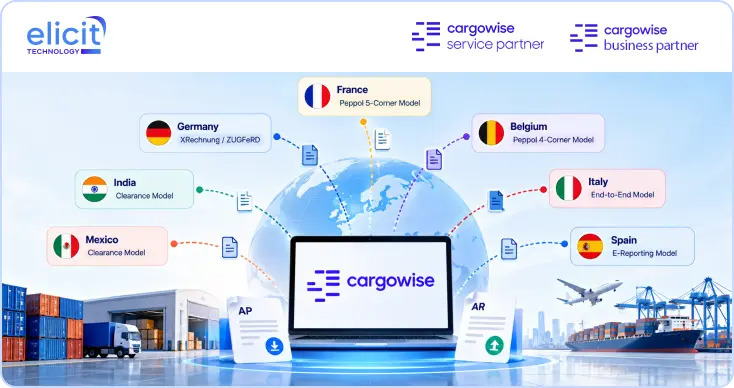
International logistics businesses operate globally, but financial obligations remain highly local.
Different countries can have their own requirements around invoicing, reporting, GST, VAT, sales tax, currencies, and financial records. Managing these requirements through separate processes increases complexity and places more responsibility on individual finance teams.
CargoWise takes a more centralized approach. Its accounting capabilities are designed to support financial accuracy at scale while allowing country-specific requirements to be incorporated into system-driven workflows.
The objective is simple: operate globally without losing control of local financial requirements.
🧾 Invoicing is also a Compliance Process
An invoice may look like the final financial output of a shipment, but behind it sits a range of compliance requirements.
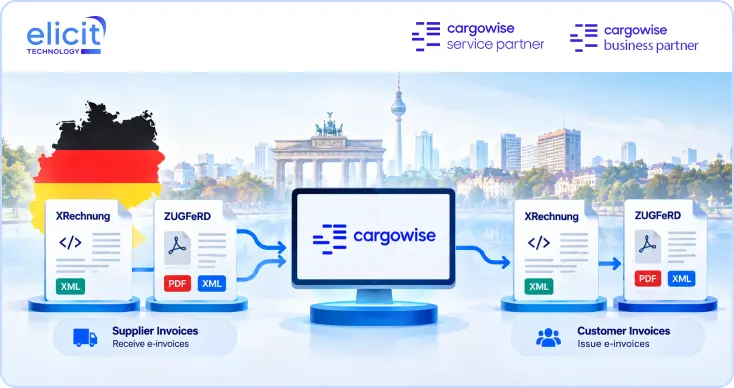
The way invoices are prepared and reported can differ significantly between countries. When businesses operate across several jurisdictions, manually keeping track of these differences can introduce unnecessary risk.
CargoWise supports country-specific invoicing and reporting requirements, helping finance teams maintain both regulatory and financial accuracy.
This becomes particularly valuable for global freight forwarders looking to standardize their accounting operations without treating every country as an entirely separate financial environment.
💱 Managing Multiple Currencies with Greater Control
Currency management is another everyday reality of international freight forwarding.
A shipment may generate revenue in one currency while freight, handling, customs, and other supplier costs are incurred in several others. Exchange-rate movements can further affect the local value of those transactions.
CargoWise supports multi-currency transaction control, allowing businesses to define operating currencies, apply exchange rates, and capture dual-currency values.
For finance teams, this creates clearer global cost visibility and helps maintain consistency when transactions cross currencies and markets.
It also supports a more reliable financial picture when businesses assess job profitability and overall performance.
🧮 Tax Rules cannot be One-Size-Fits-All
GST, VAT, and sales tax requirements vary considerably between jurisdictions.
For international logistics businesses, applying the wrong tax treatment can affect invoice accuracy, landed cost calculations, reporting, and ultimately financial compliance.
CargoWise allows businesses to configure local tax logic within their accounting environment, supporting the appropriate treatment of GST, VAT, and sales tax requirements.
Rather than depending entirely on manual decisions for every transaction, relevant financial rules can form part of structured accounting workflows.
That matters at scale. The more transactions a business processes, the more important consistency becomes.
📊 Why Centralized Financial Oversight Matters?
Financial compliance isn’t simply about satisfying regulatory requirements. It also affects how confidently management can understand business performance.
When currency values, taxes, invoices, and reporting processes are handled across disconnected systems, gaining a consistent financial view becomes difficult.
Centralized accounting creates a stronger foundation for teams to work from the same financial information across markets.
For logistics businesses, this can mean:
- Greater consistency across international accounting operations
- Less dependence on repetitive manual processes
- Better visibility across multi-currency transactions
- More reliable invoicing and reporting
- Stronger control over local tax requirements
- Clearer financial oversight as the organization grows
The bigger benefit is alignment. Local requirements can still be respected while financial operations remain connected at a global level.
🔐 Financial Compliance should be Part of the Workflow
The traditional approach to compliance often involves checking transactions after they have already occurred.
For a global logistics organization processing large transaction volumes, that approach becomes increasingly difficult to scale.
A stronger model is to make financial requirements part of everyday workflows.
When tax, currency, invoicing, and reporting requirements are built into the accounting environment, compliance becomes less dependent on teams remembering every rule for every transaction.
This doesn’t remove the need for financial expertise. Instead, it gives finance teams a more structured environment in which to apply that expertise consistently.
⚙️ Getting the CargoWise Accounting Setup Right
Having financial capabilities available within CargoWise is one thing. Configuring them correctly for your organization is another.
Every logistics business has its own operating companies, currencies, tax obligations, accounting structures, reporting expectations, and financial controls.
That is why CargoWise accounting configuration should reflect both the organization’s global structure and the local requirements of the markets where it operates.
The right setup can help businesses reduce unnecessary manual work while maintaining the accuracy and oversight expected from modern finance operations.
🤝 Strengthen Your CargoWise Financial Operations with Elicit
As logistics businesses expand across markets, financial complexity expands with them. The goal should not be to add more manual processes every time the business enters another jurisdiction.
Elicit Technology, as a CargoWise Service Partner, can help organizations configure and optimize CargoWise Accounting around their operational and financial requirements.
From multi-currency accounting and local tax configuration to invoicing, reporting, and connected financial workflows, the right CargoWise setup can help your teams maintain greater accuracy, consistency, and control across markets.