












A freight forwarder prepares a customs declaration for an air freight shipment arriving in the United Kingdom. The shipment details are available in CargoWise, the commercial invoice has been received, and the customs team is ready to submit the declaration.
However, one important calculation needs attention: the value used to determine import VAT.
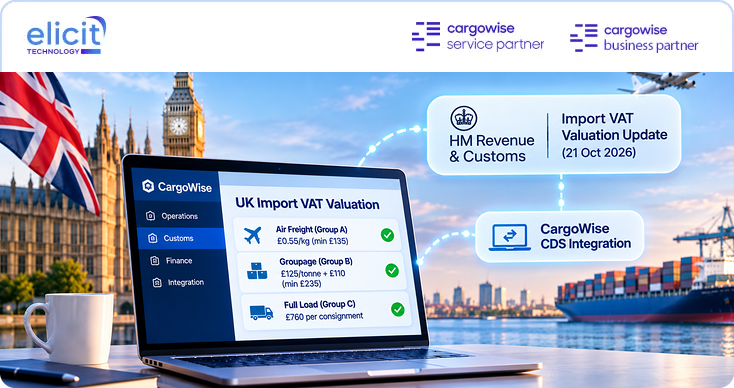
On 21 October 2026, HM Revenue & Customs (HMRC) updated its guidance on import VAT valuation, introducing revised nationally agreed rates for incidental expenses under Method 2 of the Valuation for VAT Addition (VVA) arrangements.
The changes affect eligible air freight, groupage, and full-load consignments. For freight forwarders and customs brokers managing UK customs declarations, they raise an important question: are existing valuation procedures and declaration workflows using the correct rates?
For businesses relying on CargoWise UK customs integration, the update provides an opportunity to review how customs information is collected, calculated, validated, and transmitted to HMRC’s Customs Declaration Service (CDS).
Understanding the new rates is the first step. Ensuring they are applied correctly within the customs declaration process is equally important.
What has HMRC Changed in UK Import VAT Valuation?
The customs value of imported goods and the value used to calculate import VAT are not necessarily the same.
Under HMRC requirements, the import VAT value begins with the customs value used for duty purposes. Certain additional costs and applicable duties must then be included.
These additions can involve transportation, insurance, handling, storage, customs clearance, and other incidental expenses incurred up to the relevant UK destination.
Businesses may use different methods to calculate the incidental expenses included in the import VAT value.
Method 1 uses actual costs, while Method 2 permits eligible businesses to use nationally agreed rates. Method 3 allows an individually negotiated arrangement where the other methods are inappropriate or impractical.
The October 2026 update revises the nationally agreed rates used under Method 2.
These amounts are not new customs duties or changes to the VAT percentage. They affect the value on which import VAT is calculated.
The revised guidance is particularly relevant to businesses using simplified incidental expense calculations rather than actual costs.
What are the Updated HMRC Method 2 Rates for Air, Groupage, and Full-Load Freight?
HMRC has revised the nationally agreed rates across three freight categories.
| Freight category | Updated Method 2 rate |
| Group A – Air freight | £0.55 per chargeable kilogram, with a minimum of £135 per consignment |
| Group B – Surface freight groupage or consolidation | £125 per gross weight tonne plus £110 per consignment, with a minimum total addition of £235 |
| Group C – Surface freight full loads | £760 per full-load consignment |
These figures represent estimated UK incidental expenses for eligible consignments.
For air freight, the calculation uses whichever is greater: the chargeable-weight amount or the £135 minimum.
For example, a shipment weighing 400 chargeable kilograms produces an addition of £220.
A smaller shipment weighing 100 chargeable kilograms produces £55 using the weight-based calculation. Since this is below the minimum, the applicable addition is £135.
For groupage consignments, both the weight-based and fixed components must be considered.
A consolidated shipment weighing two gross tonnes would have a calculated addition of £360: £250 for delivery and handling, plus £110 for other ancillary expenses.
For eligible full-load consignments, the nationally agreed addition is £760 per consignment.
Importantly, HMRC states that Method 2 rates can only be used for UK incidental expenses where freight to the UK border has already been separately distinguished. The qualifying conditions must therefore be checked before applying the simplified rates.
Why does this Update Matter for CargoWise UK Customs Integration?
CargoWise users may manage shipment information, customs-related data, and declaration processes within connected operational workflows.
For UK customs declarations, the Customs Declaration Service is the HMRC system used for import and export filing.
A CargoWise CDS Integration can support the movement of relevant information between CargoWise and the UK customs declaration environment.
However, integration does not remove the need for accurate customs valuation.
The revised HMRC rates make it important to examine how a business determines the import VAT value before a declaration is submitted.
Consider a freight forwarder that has established procedures for calculating incidental expenses on consolidated imports.
If those procedures still use previous nationally agreed rates, the resulting import VAT value may not reflect the October 2026 guidance.
The issue may originate in a calculation worksheet, a manual entry procedure, a custom workflow, or an integration mapping.
The correct response depends on how the business currently prepares its customs declarations.
CargoWise users should therefore review the entire valuation process rather than assume the integration automatically applies updated HMRC guidance.
How should CargoWise Users Review Their Customs Valuation and Declaration Workflows?
A reliable customs declaration depends on accurate information being available at the correct stage of processing.
For freight forwarders using CargoWise, several areas deserve attention following the HMRC update.
Identify the valuation method being used. Determine whether the business uses actual incidental expenses under Method 1, nationally agreed rates under Method 2, or an individual arrangement under Method 3.
Check the freight category. Where Method 2 is applicable, confirm whether the consignment belongs to Group A, B, or C.
Review freight and incidental expense information. Ensure the costs used for customs valuation and import VAT valuation are distinguished appropriately. In particular, verify whether freight to the UK border has been separately identified where Method 2 rates are used.
Examine calculation procedures. Identify any spreadsheets, operational instructions, configured calculations, or integration processes that may rely on earlier rates.
Test declaration scenarios. Use representative air freight, groupage, and full-load shipments to assess whether the relevant information is calculated and transferred correctly.
Review rejected or amended declarations. Examine recurring valuation discrepancies and determine whether the issue originates from source data, user procedures, or system mapping.
These reviews can help customs teams identify where updates may be required before relying on revised procedures in live operations.
The objective is not to introduce unnecessary changes. It is to confirm that the business’s existing customs processes reflect the applicable HMRC requirements.
How can CargoWise CDS Integration Support More Consistent UK Customs Declarations?
Customs declarations involve information from several operational sources.
Shipment records, commercial invoices, transport costs, tariff classifications, importer details, and customs procedures may all contribute to the information required for filing.
When this information is entered separately into multiple systems, teams may spend additional time checking consistency and correcting discrepancies.
An appropriately designed CargoWise CDS integration can help reduce duplicate data entry and support structured information exchange.
Elicit Technology’s CDS integration services focus on connecting CargoWise with the UK Customs Declaration Service through requirements analysis, data mapping, configuration, testing, and submission monitoring.
For example, the integration process may involve mapping relevant CargoWise information to the data elements required by CDS and applying suitable validation rules.
Where customs valuation information is involved, the mapping must reflect the applicable declaration requirements and the customer’s valuation procedures.
The integration should also support the identification and review of submission errors.
However, an electronic connection does not independently determine whether a business has selected the correct VAT valuation method.
That responsibility requires appropriate customs knowledge, accurate supporting information, and validated operational procedures.
A successful integration combines reliable data movement with the correct customs process.
What are the Risks of Using Incorrect Import VAT Values in UK Customs Declarations?
Import VAT valuation errors can create compliance and operational problems.
If the declared value does not reflect the applicable requirements, customs teams may need to investigate discrepancies or correct affected declarations.
The consequences depend on the circumstances, including the valuation method used, the importer’s VAT status, and whether additional tax is due.
For freight forwarders and customs brokers, inaccurate valuation information can also increase administrative work.
An employee may need to review the commercial invoice, confirm freight charges, contact the importer, and check the calculation before determining the appropriate correction.
These activities consume time and can complicate customer communication.
The revised Method 2 rates also matter for businesses estimating import costs.
Where the simplified addition increases the import VAT value, the amount of VAT calculated may increase accordingly.
However, the ultimate financial impact depends on the applicable VAT rate and the importer’s entitlement to recover import VAT.
Accurate valuation remains important regardless of whether the importer can recover the tax.
For CargoWise users, maintaining consistent source data and reviewing the relevant declaration procedures can help reduce avoidable discrepancies.
How can CargoWise Integrations Help Freight Forwarders Manage Changing UK Customs Requirements?
The October 2026 update illustrates a broader challenge for logistics businesses: customs requirements continue to evolve after electronic filing systems have been implemented.
The United Kingdom has already completed its transition from the legacy CHIEF system to CDS.
Freight forwarders must therefore manage customs declarations within the current CDS environment while keeping their procedures aligned with changing HMRC guidance.
For organizations using CargoWise, this may involve reviewing data mapping, validation requirements, operational instructions, and connected customs applications.
Some businesses connect CargoWise directly with their CDS filing environment through an integration solution.
Others use third-party customs software, such as ASM Sequoia, as part of their declaration process.
In those environments, CargoWise ASM Sequoia Integration may help reduce duplicate entry between CargoWise and the third-party customs platform.
The appropriate integration approach depends on the existing technology environment and operational requirements.
Businesses should also consider how changes are tested before deployment.
A revised valuation procedure may affect several shipment categories. Testing should therefore include representative declarations and relevant exceptions, not only a single successful transaction.
Ongoing monitoring and maintenance are important because a working integration must continue to support the business as customs requirements change.
How can Elicit Technology Support CargoWise UK Customs Integration?
Responding to customs changes requires more than updating a calculation.
Freight forwarders need to understand the regulatory requirement, determine how it affects their operational processes, and identify whether their CargoWise environment requires configuration or integration changes.
As a CargoWise Service Partner with Gold Customs competency, Elicit Technology supports logistics businesses with customs-related configurations, declaration workflows, and system integrations.
Our CargoWise Customs Integration Services help freight forwarders connect their operational environments with relevant customs filing platforms.
For businesses handling UK imports, Elicit can assist with reviewing CargoWise CDS integration requirements, evaluating declaration data mapping, and identifying areas where existing workflows may need improvement.
Following the HMRC import VAT valuation update, a practical review may involve checking how relevant costs are captured, whether declaration data is transferred consistently, and whether existing calculation procedures need adjustment.
Where changes are required, they should be assessed and tested against the applicable HMRC guidance before being introduced into production.
Our objective is to help customers maintain more consistent customs processes while reducing unnecessary manual work and improving the reliability of connected operations.
Elicit Technology’s CargoWise expertise combines customs process knowledge with integration and workflow capabilities to support businesses managing evolving regulatory requirements.
Conclusion: Is Your CargoWise UK Customs Integration Ready for the Updated HMRC Valuation Rules?
HMRC’s October 2026 import VAT valuation update introduces revised nationally agreed rates for eligible air freight, groupage, and full-load consignments.
For freight forwarders and customs brokers, the immediate priority is understanding when these rates apply and ensuring the correct import VAT value is used in customs declarations.
For CargoWise users, the update also highlights the importance of reviewing customs workflows and integration processes.
Accurate customs filing depends on more than transmitting information electronically. The underlying data, valuation procedures, and declaration mapping must also reflect current requirements.
As UK customs regulations and operational expectations evolve, businesses benefit from maintaining a CargoWise environment that can accommodate necessary changes without unnecessary disruption.
Are your CargoWise customs workflows aligned with the latest HMRC valuation requirements?
Elicit Technology can help you review your UK customs integration, assess existing declaration processes, and identify suitable configuration or integration improvements.
Book a Consultation with our CargoWise specialists to discuss your UK customs requirements.