




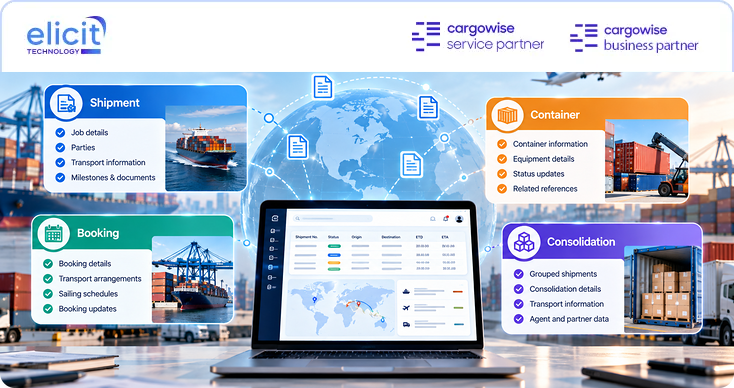






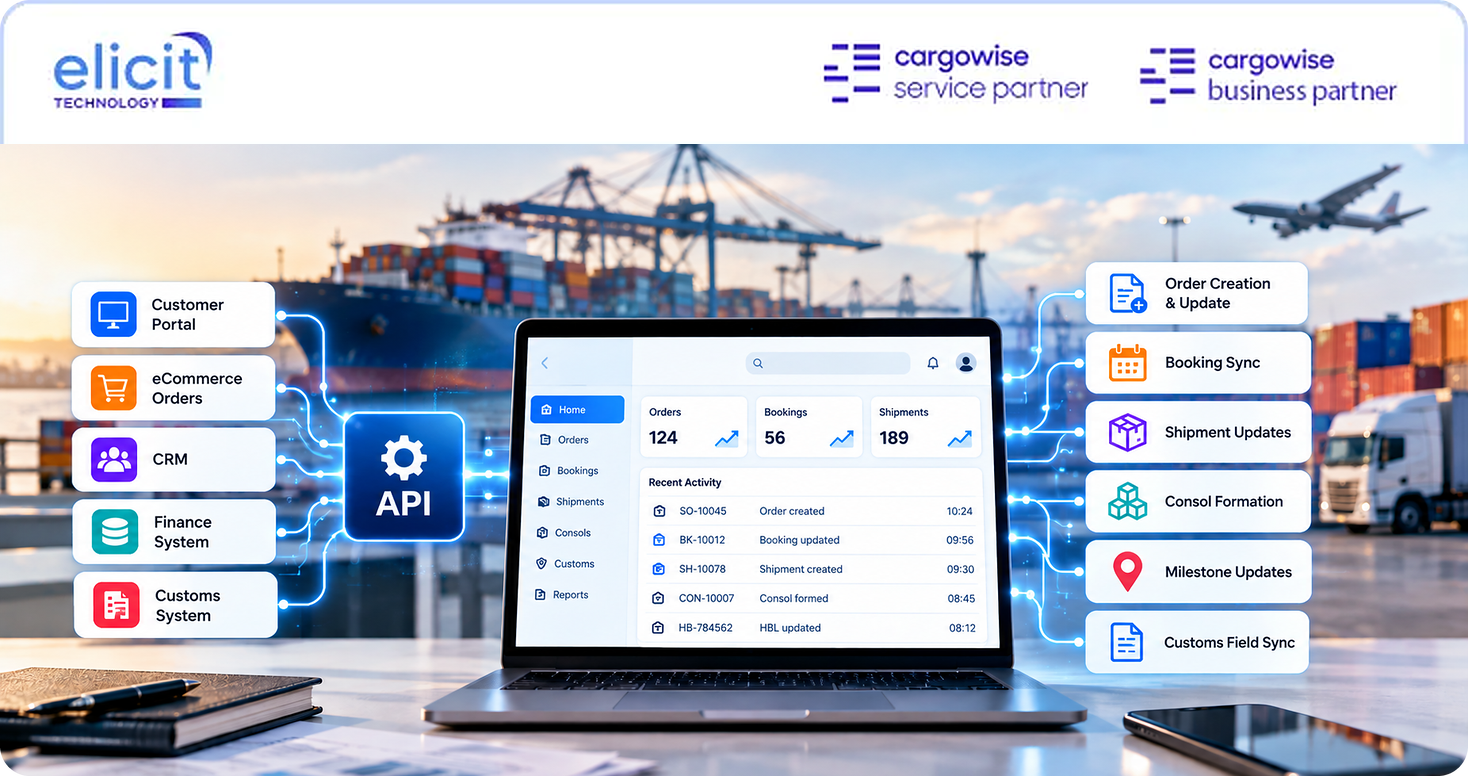
CargoWise holds an enormous amount of your operational data, orders, bookings, shipments, consols, milestones, customs fields, and documents. The problem for most freight forwarders isn’t that the data isn’t there. It’s that it’s trapped. Your customer’s order system doesn’t talk to it. Your finance platform needs the numbers re-keyed. Your customer portal shows tracking that someone updated by hand an hour ago. Every one of those gaps is a person copying data from one screen to another, and every copy is a chance to be slow, wrong, or both.
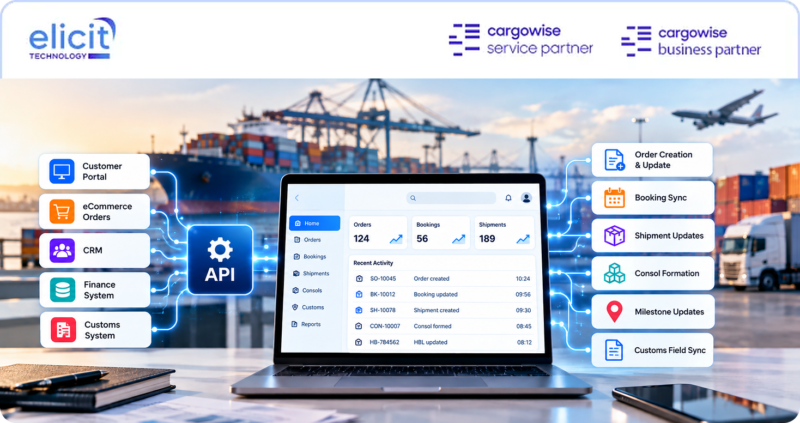
That’s the gap CargoWise APIs close. Instead of staff acting as the bridge between CargoWise and the systems around it, APIs let data flow automatically in both directions, orders in, tracking out, documents both ways. This guide explains how CargoWise API services actually work, walks through all 11 core APIs and who needs each, and flags one deadline you can’t afford to ignore.
What is CargoWise API Integration, and How does eAdaptor Fit In?
CargoWise exchanges data with outside systems primarily through eAdaptor, its integration gateway. In simple terms, eAdaptor pairs an inbound service that lets external systems push, query, add, and update records in CargoWise, with an outbound service that emits messages automatically when workflow milestones fire. So data doesn’t just go into CargoWise; CargoWise also pushes events back out the moment something happens.
The data itself moves as Universal XML — CargoWise’s standardized schemas such as Universal Shipment (which covers forwarding shipments, customs declarations, transport legs, parties, and charges), Universal Event, and Universal Transaction. This matters because it means a well-built integration speaks CargoWise’s native language rather than bolting on a fragile workaround.
The newer eAdaptor Next gateway adds modern security — OAuth2, JWTs, and certificate-based identity and encryption, which is where the deadline comes in (more on that below). The practical takeaway: raw Universal XML is powerful but technical, and access is gated behind WiseTech accreditation, which is exactly why most forwarders work with a certified partner rather than building it in-house.
Why do Freight Forwarders Need CargoWise APIs?
The case for API integration through eAdaptor comes down to four recurring pain points:
- Manual re-keying. The same order, booking, or party detail typed into two or three systems wastes hours and introduces errors in data that customs and customers depend on.
- Stale information. When tracking and milestones are updated by hand, your customer portal is always a step behind reality.
- Data silos. Finance, CRM, customs, and operations each hold a version of the truth, and reconciling them is its own job.
- Scaling cost. Without automation, more volume means more headcount just to move data between systems.
APIs attack all four by making the data transfer a byproduct of the event rather than a separate task. Now let’s look at the specific tools.
The 11 Core CargoWise APIs — and Who Needs Each
Elicit groups these into Order & Shipment APIs (the records that define the job) and Workflow & Data Sync APIs (the events and documents that keep everything current).
Order & Shipment APIs
1. Order Creation & Update API — Creates and updates orders in CargoWise automatically as they arrive from your customers’ systems, cutting manual re-entry. Essential for forwarders whose clients send high volumes of orders from their own ERP or e-commerce platforms.
2. Booking Creation & Update API — Syncs booking details between CargoWise and your booking sources in real time, keeping schedules accurate. Valuable where bookings originate outside CargoWise and change often.
3. Shipment Creation & Update API — Builds shipment records and keeps them current automatically across the shipment lifecycle. The backbone for anyone keeping shipment data aligned across multiple platforms.
4. Consol Formation API — Groups shipments into consolidations via API, removing manual grouping work. A real time-saver for high-volume LCL and co-load operations.
5. House Bill Number Update API — Syncs and updates house bill numbers automatically as documents finalize, keeping documentation consistent. Critical for NVOCCs and forwarders where HBL numbers must match across systems.
6. Consignor & Consignee Update API — Keeps party details current across CargoWise and connected systems without double entry. Reduces costly party-data mismatches on customs-critical records.
7. Milestone Update API — Pushes shipment milestones (e.g. customs cleared, delivered) out automatically as events occur, keeping status visibility accurate in real time. The engine behind proactive customer updates and live portals.
Workflow & Data Sync APIs
8. Customs Field Update API — Syncs customs-related fields automatically, reducing the risk of compliance data going stale or mismatched. Important wherever customs data is maintained in a connected broker or compliance system.
9. Document Upload API — Uploads and attaches documents — invoices, packing lists, house bills — to the correct job automatically, instead of one by one. Eliminates a huge manual-filing burden for document-heavy operations.
10. Job Management API — Keeps job-level data synchronized across systems so your team works from one source of truth. Where the Milestone API tracks events, this keeps the whole job record aligned.
11. Tracking API — Pushes real-time tracking data out of CargoWise into customer portals or partner systems automatically. The piece that powers self-service visibility for your customers.
Milestone Update API vs. Job Management API: What’s the Difference?
This trips people up, so it’s worth being precise. The Milestone Update API publishes specific status changes as they happen, such as customs clearance and delivery. The Job Management API keeps the broader job record synchronized across systems. One tracks events; the other keeps the full job aligned. Most connected operations use both: milestones for real-time customer updates, job management for a consistent master record.
The Deadline You can’t Ignore: eAdaptor Next by January 2027
Here’s the timely part. CargoWise is phasing toward eAdaptor Next, with a migration cutoff that flags for January 2027. If your current integrations run on the older eAdaptor, they will need to be assessed and transitioned to the Next gateway, with its OAuth2 and certificate-based security, before that window closes. This isn’t a “nice to have later” project; integrations that aren’t migrated risk disruption. If you rely on any CargoWise API connection today, now is the time to assess what you have and plan the move, rather than scrambling at the deadline.
How should You Approach a CargoWise API Project?
A reliable integration follows a clear sequence rather than wiring endpoints ad hoc:
- Data flow mapping — identify which systems need to talk to CargoWise, what data moves, and in which direction.
- API selection & design — determine which of the 11 modules fit your actual needs.
- Secure connection build — set up authentication, encryption, and endpoints so data moves safely.
- Field & logic mapping — map fields (house bill numbers, consignor/consignee details, customs fields) so data lands correctly on both sides.
- Testing against live data — validate every connection against real orders, bookings, and shipments before go-live.
- Monitoring & support — watch performance and adjust as volumes, systems, and partners change.
Skipping the mapping and testing stages is how integrations end up pushing wrong data faster the opposite of the goal.
How Elicit Technology Helps?
Building raw Universal XML integrations requires WiseTech accreditation and real CargoWise depth, which is why most forwarders partner rather than build. As a certified CargoWise Service Partner, recently among the first partners worldwide to achieve PAVE certification and CargoWise Gold Customs Competency, Elicit Technology delivers all eleven API modules, plus eAdaptor Next setup, middleware creation, and integration of legacy systems with CargoWise Next. The result is connections that move your data safely and accurately, maintained as your systems and volumes evolve.
Conclusion
CargoWise is only as valuable as it is connected. The eleven core APIs, from order, booking, and shipment creation through milestones, customs fields, documents, and tracking, are what turn CargoWise from a data silo into the hub of a connected operation, with eAdaptor and Universal XML doing the work underneath. With the eAdaptor Next migration deadline approaching in January 2027, the smart move is to map your integration needs now and build on the modern gateway from the start.
Ready to connect CargoWise to the rest of your business? Talk to Elicit Technology’s certified CargoWise API team, and we’ll map the right APIs for your operation and your eAdaptor Next transition, before the deadline forces the decision.