







Freight forwarders rely on accurate shipment, booking, container, and consolidation information to coordinate cargo movements across customers, overseas agents, carriers, and internal teams. But when these parties use different systems, maintaining consistent information becomes a challenge.
A booking may be confirmed in one application while the shipment details remain unchanged in another. Container information may arrive separately from consolidation records, leaving operations teams to reconcile references and updates manually.
CargoWise Universal XML mapping addresses the structure of these information exchanges. It provides a standardized way to represent freight forwarding data for supported integrations between CargoWise and connected systems.
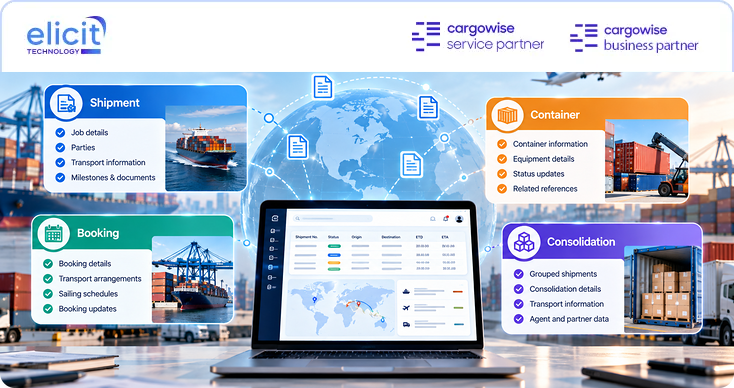
WiseTech Global provides four dedicated Forwarding Module Mapping Guides covering shipments, bookings, containers, and consolidations. Each addresses a different area of freight forwarding operations.
Understanding their business relevance can help freight forwarders identify integration requirements. However, evaluating mappings, configuring interfaces, and managing updates requires specialized CargoWise expertise.
As an official CargoWise Service and Business Partner, Elicit Technology helps logistics businesses assess these requirements and plan integrations suited to their operational environment.
What is Universal XML Mapping in CargoWise?
Universal XML is a structured data format used to exchange information between CargoWise and compatible external applications.
Within freight forwarding, different records represent different parts of a cargo movement. A shipment contains job-level information, a booking captures transport arrangements, a container represents equipment-related information, and a consolidation brings together related cargo movements.
Although these records are connected operationally, they are not interchangeable.
Universal XML mapping establishes the relationship between supported information in CargoWise and the corresponding data structures used for integration.
This matters when businesses connect CargoWise with customer platforms, overseas agent systems, middleware, and other logistics applications.
For example, a freight forwarder receiving consolidation information from an overseas agent may need more than a master reference. It may also need associated shipment, container, and routing information to maintain a useful operational record.
The relevant mapping guide helps define the scope of information available for that integration.
Universal XML mapping is not simply about transferring data. It is about preserving the meaning and relationships of freight forwarding records across connected systems.
For a broader overview, read Elicit Technology’s article on CargoWise XML, EDI and API integration.
What are the Four CargoWise Forwarding Module Mapping Guides?
The four guides focus on distinct forwarding records and the information associated with them.
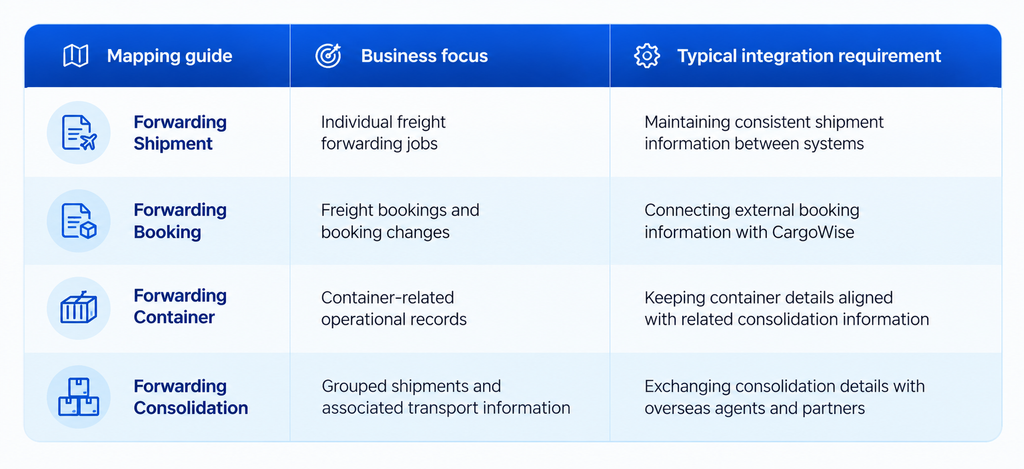
These guides are related, but a business may need one or several depending on its operational requirements.
Why is the Forwarding Shipment Module Mapping Guide Important?
The shipment is one of the central records in freight forwarding operations.
It connects the movement of cargo with the parties involved, transport arrangements, references, documentation, and operational milestones.
When a forwarder exchanges shipment information with a customer or partner system, accuracy is essential.
A customer may identify a shipment using its purchase order number, while the forwarder uses a CargoWise job reference. An overseas agent may use another reference to identify the same movement.
If these relationships are not properly considered, employees may spend time investigating duplicate records, missing updates, or conflicting shipment information.
The Universal XML Forwarding Shipment Module Mapping Guide is relevant to businesses seeking to exchange shipment-related information between CargoWise and external systems.
Where does Shipment Mapping Add Business Value?
Consider a freight forwarder handling international shipments for a manufacturing customer.
The customer manages its purchase orders and delivery requirements in an ERP system. The freight forwarder manages shipment execution in CargoWise.
Both parties need consistent shipment information, but they use it for different purposes.
A properly planned integration can reduce repeated data entry and support more consistent shipment references and operational updates.
Shipment mapping becomes particularly relevant for businesses managing large shipment volumes, multiple customers, or connections with several overseas agents.
The objective is to establish reliable information exchange without disrupting the operational controls already maintained in CargoWise.
How does the Forwarding Booking Module Mapping Guide Support Booking Accuracy?
Freight bookings can change several times before cargo departs.
Customers may revise cargo quantities, carriers may amend sailing schedules, and freight forwarders may need to update booking references or transport arrangements.
When booking information is managed in more than one system, every change creates another opportunity for inconsistency.
The Universal XML Forwarding Booking Module Mapping Guide addresses the information associated with forwarding booking records.
Its business relevance lies in supporting connections between CargoWise and external booking applications.
Why do Booking Changes Create Integration Challenges?
Imagine a customer submitting a booking request through its own logistics portal.
The freight forwarder receives the request and begins arranging transportation. Later, the customer changes the cargo-ready date.
If the customer’s system and CargoWise are not properly connected, an employee may need to update the booking manually and confirm that both systems reflect the revised information.
This becomes more demanding when hundreds of bookings are handled every week.
Booking mapping is therefore important for businesses seeking to improve information consistency across booking-related processes.
However, not every external booking field will necessarily have an equivalent CargoWise field or support the same update behavior.
An experienced CargoWise integration partner can assess these differences before an interface is developed or changed.
Why does the Forwarding Container Module Mapping Guide Matter for Container Visibility?
Container operations involve more than identifying equipment by its container number.
Freight forwarders also manage container types, release information, pickup arrangements, delivery schedules, empty returns, and associated transport activities.
These details may originate from different parties, including shipping lines, transport providers, depots, and overseas agents.
When container information is maintained separately from the relevant consolidation record, operations teams may struggle to maintain a consistent view of the movement.
The Universal XML Forwarding Container Module Mapping Guide addresses container-related information within CargoWise forwarding operations.
It is particularly relevant where businesses need to exchange container information with connected systems while preserving its relationship with the associated consolidation.
What Problems Can Inconsistent Container Data Create?
Consider an import container scheduled for delivery to a customer’s warehouse.
The transport provider has confirmed a delivery appointment, but the freight forwarder’s system still displays the previous arrangement.
The operations team may need to contact the transporter, check the container reference, confirm the latest delivery date, and update the record manually.
Similar issues can arise when container release information, empty-return arrangements, or equipment details are maintained across disconnected applications.
These discrepancies can increase administrative work and make exception management more difficult.
Container mapping can support better information consistency across the connected systems involved in container operations.
However, container records have relationships with consolidation records, and updates may affect existing information. This makes professional assessment important before introducing or modifying an integration.
The objective is to improve container data availability without creating conflicting records or unintended changes.
How does the Forwarding Consolidation Module Mapping Guide Support Multi-Shipment Operations?
Consolidation is a critical activity for freight forwarders handling multiple shipments under a shared transport arrangement.
A single consolidation may involve several house shipments, containers, transport legs, overseas agents, and operational references.
For example, an overseas agent may arrange a consolidation containing cargo from several exporters.
The destination freight forwarder needs information about the consolidation as well as the shipments associated with it.
If this information arrives through separate spreadsheets or emails, employees may need to recreate records, reconcile references, and check that the correct shipments are linked to the correct consolidation.
The Universal XML Forwarding Consolidation Module Mapping Guide addresses the exchange of consolidation-related information.
The guide covers consolidation records and their relationships with associated shipments, containers, and routing information.
Why is Consolidation Mapping Important for Overseas Agent Networks?
Freight forwarding networks depend on exchanging information between origin and destination offices.
A consolidation arranged at origin may need to be visible to the destination team before the cargo arrives.
This helps the destination operation prepare for upcoming shipments, coordinate documentation, and identify information requiring attention.
When consolidation information is exchanged through an appropriately designed integration, teams can reduce repeated entry and improve consistency between connected systems.
This becomes particularly valuable for NVOCCs, co-loaders, multinational forwarders, and companies managing high volumes of consolidated freight.
The business benefit is not simply faster data transfer. It is the ability to maintain meaningful relationships between consolidation records and the individual shipments they contain.
What Happens When Shipment, Booking, Container, and Consolidation Data do Not Match?
These four forwarding areas are closely connected.
A booking establishes transport arrangements. A shipment represents an individual forwarding movement. A container may carry one or more shipments, while a consolidation brings together cargo moving under a shared arrangement.
When information differs between these records or the systems connected to them, employees must determine which information is correct.
Consider a freight forwarder handling an ocean freight consolidation.
The overseas agent sends revised consolidation details, including a container change. The destination team receives the update, but its customer portal continues displaying the previous container information.
The shipment reference may still be correct, yet the information presented to the customer is inconsistent.
This illustrates why integration requirements should be evaluated across the complete forwarding workflow.
A business may initially believe it needs only shipment integration, but further assessment may reveal that container or consolidation information is also essential.
Selecting an integration based on one isolated record can leave important information gaps.
For this reason, freight forwarders should assess their operational dependencies before deciding which mapping guides are relevant.
Why should CargoWise Universal XML Mapping be Handled by a Certified Service Partner?
Universal XML mapping is a specialized area of CargoWise integration.
The mapping guides describe the relationships between supported data structures and CargoWise forwarding records. However, applying those mappings to an operational environment requires an understanding of both the technology and the freight forwarding processes involved.
Different businesses may use different configurations, customer references, operating procedures, and external applications.
An integration suitable for one freight forwarder may not meet another company’s requirements.
There are also important considerations around record identification, data ownership, existing information, error handling, and the effect of updates.
An incorrectly designed integration can create duplicate records, overwrite important information, or leave connected applications with inconsistent data.
Working with an official CargoWise Service Partner that has the appropriate certified expertise helps businesses evaluate these risks before making changes.
Rather than attempting to interpret technical mapping documentation independently, freight forwarders can engage specialists to assess their requirements and recommend a suitable integration approach.
The goal is to build an integration that supports daily operations while maintaining reliable data and appropriate controls.
How can Elicit Technology Support CargoWise Universal XML Mapping Requirements?
Elicit Technology is an official CargoWise Service and Business Partner with experience supporting CargoWise configuration, integration, and automation requirements.
Our team helps freight forwarders evaluate how information moves between CargoWise and their connected business applications.
For Universal XML mapping requirements, this begins with understanding the operational challenge.
A business may want to exchange shipment records with an overseas agent, connect customer booking information with CargoWise, synchronize container updates, or improve consolidation data exchange.
Each requirement involves different information and operational dependencies.
Elicit can help assess the relevant forwarding modules, review the connected applications, identify data requirements, and determine an appropriate integration approach.
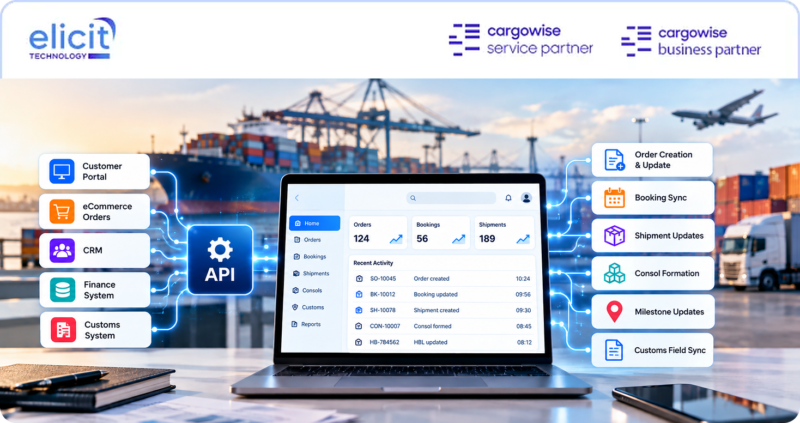
Our CargoWise API integration services also support businesses seeking broader connectivity between CargoWise and their existing systems.
Where required, our specialists can assist with integration development, testing, troubleshooting, and ongoing support.
This allows freight forwarders to focus on their operational objectives while experienced CargoWise professionals handle the technical considerations.
When should Freight Forwarders Consider Reviewing Their Universal XML Integrations?
Not every integration issue requires a completely new system connection.
Sometimes an existing interface no longer reflects how the business operates.
A freight forwarder may have introduced a new customer portal, expanded into another country, changed its consolidation processes, or begun working with additional overseas agents.
These changes can create new information requirements.
An integration review may be appropriate when employees frequently correct transferred records, shipment information differs between systems, container updates are missing, or new business applications need access to forwarding information.
It may also be relevant when a business is reviewing legacy connectivity as part of its broader CargoWise integration modernization.
Elicit Technology can help assess whether existing interfaces continue to meet the business’s needs and identify areas requiring further attention.
Conclusion: Make CargoWise Forwarding Data Work Across Your Connected Systems
Shipment, booking, container, and consolidation information forms the foundation of freight forwarding operations.
When this information is maintained across disconnected systems, employees may spend valuable time checking references, correcting records, and communicating updates manually.
CargoWise Universal XML mapping provides an important foundation for exchanging supported forwarding information between CargoWise and external applications.
However, the four forwarding modules have different responsibilities, and their relationships must be considered when planning an integration.
Freight forwarders do not need to navigate these technical requirements alone.
As an official CargoWise Service and Business Partner, Elicit Technology can help assess your Universal XML mapping requirements and recommend an integration approach aligned with your operations.
Need assistance with CargoWise Universal XML mapping for shipments, bookings, containers, or consolidations? Book a consultation with us to discuss your requirements with our CargoWise specialists.