













Salesforce

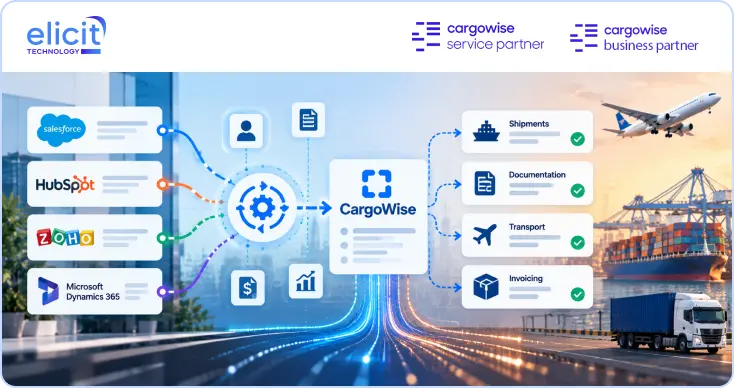
Sync Salesforce data with live shipments.

HubSpot

Align sales activity with operational shipment data.

Zoho CRM

Connect Zoho deals with CargoWise operations.

Microsoft Dynamics CRM

Unify CRM and logistics on one workflow.

This and other CRM integrations in CargoWise

We are always ready with the solution you need.

Share your requirements with us — we'll integrate CRM into CargoWise to fit the way you work.

ICEGATE Integration

Accelerate ICEGATE integration delivery for efficiency, connecting CargoWise to India's national customs gateway for automated declaration filing.

ACE Integration

Accelerate ACE integration delivery for efficiency, connecting CargoWise to the US CBP's Automated Commercial Environment for import filings.

AMS Integration

Optimize AMS integration delivery at scale, automating advance cargo manifest submissions into the US Automated Manifest System.

AES Integration

Accelerate AES integration delivery for efficiency, automating US export declaration filing through the Automated Export System.

CDS Integration

Accelerate CDS integration delivery for efficiency, connecting CargoWise to the UK's Customs Declaration Service.

DMS Integration

Streamline Netherlands customs declaration delivery, connecting CargoWise to Dutch Customs' current DMS platform, which fully replaced AGS in 2024.

MPCI Integration

Automate UAE pre-loading manifest filing, connecting CargoWise to MPCI for mandatory cargo information submission before loading.

ICS2 Integration

Accelerate ICS2 integration delivery for efficiency, meeting the EU's mandatory Entry Summary Declaration requirements across all transport modes.

ASM Sequoia Integration

Accelerate ASM Sequoia integration for efficiency, connecting CargoWise to Sequoia's customs filing platform.

TradeNet Integration

Streamline Singapore customs filing, connecting CargoWise to TradeNet's single window for permits, duties, and Certificate of Origin declarations.

ASYCUDA Integration

Accelerate ASYCUDA integration delivery for efficiency, linking CargoWise to the customs automation system used widely across Africa.

SARS Integration

Accelerate SARS integration delivery for efficiency, connecting CargoWise to South Africa's national customs system.

SISCOMEX Integration

Accelerate SISCOMEX integration delivery for efficiency, connecting CargoWise to Brazil's Integrated Foreign Trade System.

VUCEM Integration

Optimize VUCEM integration delivery at scale, connecting CargoWise to Mexico's single window for foreign trade.

NZCS Integration

Accelerate NZCS integration delivery for efficiency, connecting CargoWise to New Zealand Customs Service's filing platform.

About Us

Discover who powers your CargoWise success.

Careers

Join our global logistics technology team.

Contact Us

Talk to CargoWise experts about your goals.

CargoWise Resources

Your Complete CargoWise Support Destination

From implementation to automation, optimize every process with expert CargoWise guidance.

CargoWise Shortcuts

Work faster with practical keyboard shortcuts.

Free Tools

Use free tools for everyday logistics tasks.

CargoWise Healthcheck

Uncover ways to improve CargoWise performance.

CargoWise Resources

Your Complete CargoWise Support Destination

From implementation to automation, optimize every process with expert CargoWise guidance.

Glossary

Browse key logistics and CargoWise terms.

CargoWise Resources

Your Complete CargoWise Support Destination

From implementation to automation, optimize every process with expert CargoWise guidance.

Incoterms

Understand trade terms for global shipping.

CargoWise Resources

Your Complete CargoWise Support Destination

From implementation to automation, optimize every process with expert CargoWise guidance.

CargoWise ERP Glossary - Key Terms & FAQs

Our CargoWise ERP Glossary Terms provide clear, concise definitions of key terms used in CargoWise, helping users navigate the system with confidence. Along with these definitions, we've included in-depth FAQs to clarify complex concepts, ensuring you get the most out of your CargoWise solutions.

On-Hold Shipments in CargoWise

Last updated: July 28, 2025
Logistics CargoWise
O

CargoWise defines on-hold shipments as freight movements that are put on hold owing to regulatory, financial, or operational problems. This status serves as a precaution, preventing further actions, such as transportation bookings, customs filings, or document generation, until the underlying issue is remedied. Holds can be triggered by missing papers, unpaid invoices, regulatory red flags, or delayed approvals, providing logistics professionals with a single solution for managing disruptions and reducing costly errors.

CargoWise’s hold functionality is designed to be flexible and adjustable. Various sorts of holds can be established depending on workflows, shipment phases, or user-defined rules. Teams can assign holds manually or via automation triggers, and each hold is time-stamped, logged, and auditable within the system. This promotes transparency throughout departments and ensures that stakeholders are promptly notified. Once resolved, the hold can be cleared, and the shipment can continue on its voyage without data loss or duplication, making it an important risk-mitigation technique in global trade.

Frequently Asked Questions

What causes CargoWise to show an On-Hold status?

Shipments may be put on hold owing to delinquent customer payments, missing trade paperwork, compliance difficulties, or delayed internal approvals.

Can a user manually hold a shipment in CargoWise?

Yes, authorized users can use manual holds directly in the system to halt shipment progress when concerns develop that require involvement or review.

Is putting a shipment on hold the end of operations?

CargoWise disables important cargo tasks such as booking, label printing, and customs document generation when on hold to avoid noncompliance or financial loss.

Is it possible to automate on-hold triggers in CargoWise?

Absolutely. CargoWise may automatically identify shipments and set holds depending on specified conditions such as missing fields or past-due payments.

What advantages can an on-hold status bring to logistics operations?

It eliminates risks by ensuring that no shipment progresses until all issues have been resolved, so promoting compliance, financial management, and customer satisfaction.