









Salesforce

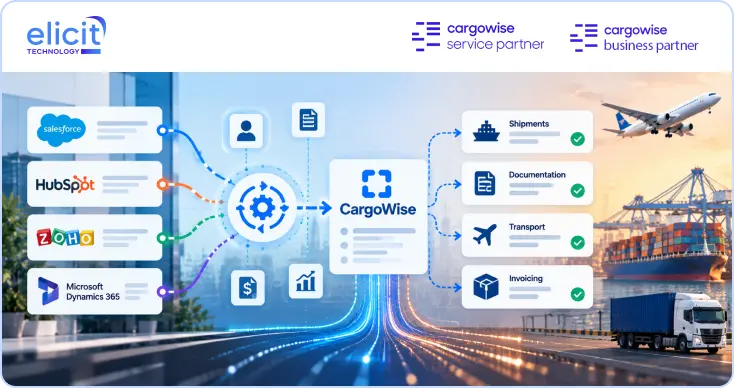
Sync Salesforce data with live shipments.

HubSpot

Align sales activity with operational shipment data.

Zoho CRM

Connect Zoho deals with CargoWise operations.

Microsoft Dynamics CRM

Unify CRM and logistics on one workflow.

This and other CRM integrations in CargoWise

We are always ready with the solution you need.

Share your requirements with us — we'll integrate CRM into CargoWise to fit the way you work.

ICEGATE Integration

Accelerate ICEGATE integration delivery for efficiency, connecting CargoWise to India's national customs gateway for automated declaration filing.

ACE Integration

Accelerate ACE integration delivery for efficiency, connecting CargoWise to the US CBP's Automated Commercial Environment for import filings.

AMS Integration

Optimize AMS integration delivery at scale, automating advance cargo manifest submissions into the US Automated Manifest System.

AES Integration

Accelerate AES integration delivery for efficiency, automating US export declaration filing through the Automated Export System.

CDS Integration

Accelerate CDS integration delivery for efficiency, connecting CargoWise to the UK's Customs Declaration Service.

DMS Integration

Streamline Netherlands customs declaration delivery, connecting CargoWise to Dutch Customs' current DMS platform, which fully replaced AGS in 2024.

MPCI Integration

Automate UAE pre-loading manifest filing, connecting CargoWise to MPCI for mandatory cargo information submission before loading.

ICS2 Integration

Accelerate ICS2 integration delivery for efficiency, meeting the EU's mandatory Entry Summary Declaration requirements across all transport modes.

ASM Sequoia Integration

Accelerate ASM Sequoia integration for efficiency, connecting CargoWise to Sequoia's customs filing platform.

TradeNet Integration

Streamline Singapore customs filing, connecting CargoWise to TradeNet's single window for permits, duties, and Certificate of Origin declarations.

ASYCUDA Integration

Accelerate ASYCUDA integration delivery for efficiency, linking CargoWise to the customs automation system used widely across Africa.

SARS Integration

Accelerate SARS integration delivery for efficiency, connecting CargoWise to South Africa's national customs system.

SISCOMEX Integration

Accelerate SISCOMEX integration delivery for efficiency, connecting CargoWise to Brazil's Integrated Foreign Trade System.

VUCEM Integration

Optimize VUCEM integration delivery at scale, connecting CargoWise to Mexico's single window for foreign trade.

NZCS Integration

Accelerate NZCS integration delivery for efficiency, connecting CargoWise to New Zealand Customs Service's filing platform.

About Us

Discover who powers your CargoWise success.

Careers

Join our global logistics technology team.

Contact Us

Talk to CargoWise experts about your goals.

CargoWise Resources

Your Complete CargoWise Support Destination

From implementation to automation, optimize every process with expert CargoWise guidance.

CargoWise Shortcuts

Work faster with practical keyboard shortcuts.

Free Tools

Use free tools for everyday logistics tasks.

CargoWise Healthcheck

Uncover ways to improve CargoWise performance.

CargoWise Resources

Your Complete CargoWise Support Destination

From implementation to automation, optimize every process with expert CargoWise guidance.

Glossary

Browse key logistics and CargoWise terms.

CargoWise Resources

Your Complete CargoWise Support Destination

From implementation to automation, optimize every process with expert CargoWise guidance.

Incoterms

Understand trade terms for global shipping.

CargoWise Resources

Your Complete CargoWise Support Destination

From implementation to automation, optimize every process with expert CargoWise guidance.

CargoWise ERP Glossary - Key Terms & FAQs

Our CargoWise ERP Glossary Terms provide clear, concise definitions of key terms used in CargoWise, helping users navigate the system with confidence. Along with these definitions, we've included in-depth FAQs to clarify complex concepts, ensuring you get the most out of your CargoWise solutions.

Warehouse Cross-Docking

Last updated: August 14, 2025
Logistics CargoWise
W

Warehousing Cross-Docking is a logistics technique that transfers incoming items straight from the receiving dock to the outbound shipping dock, reducing or eliminating the requirement for long-term storage. This strategy minimizes handling times, storage expenses, and inventory holding, allowing for faster delivery to clients. Cross-docking works especially well for time-sensitive products, including perishable commodities, high-demand retail items, and just-in-time manufacturing components. It improves warehouse operations by optimizing product movement and decreasing the demand for large warehouse spaces.

Typically, the process entails instantly sorting, combining, and routing inbound cargo so that it can be delivered. Cross-docking necessitates precise coordination and real-time information exchange among suppliers, warehouse employees, and carriers. Warehouse management systems (WMS), such as CargoWise, are critical for managing cross-docking operations because they track shipments, manage dock schedules, and optimize routing decisions. Cross-docking, when properly implemented, improves supply chain responsiveness, reduces inventory costs, and increases customer happiness by accelerating order fulfillment.

Frequently Asked Questions

What are the major advantages of warehouse cross-docking?

Cross-docking decreases storage time and inventory holding costs, expedites order fulfillment, and minimizes product handling, lowering damage risk and improving supply chain efficiency.

What types of goods are ideal for cross-docking?

Perishable commodities, high-turnover retail items, and components for just-in-time production are appropriate for cross-docking since they require rapid movement through the supply chain.

How does technology enable cross-docking operations?

Warehouse management solutions such as CargoWise handle incoming and outgoing cargo, coordinate dock schedules, and manage inventory flow in real time, resulting in smooth cross-docking activities.

What are the potential issues with cross-docking?

Cross-docking necessitates strict scheduling and correct inventory data; delays or faults in receipt can interrupt outbound shipments, thus exact coordination and communication are required.

Can tiny warehouses employ cross-docking effectively?

Yes, with adequate planning and technology, even small warehouses can profit from cross-docking by increasing throughput and lowering storage costs; nevertheless, scale and complexity influence implementation.