








Container shipping has always depended on coordination. But in today’s logistics environment, coordination alone is no longer enough, the industry now depends on connected, reliable, and standardized data.
Every shipment moves through multiple stakeholders: shippers, freight forwarders, ports, carriers, customs authorities, inland transport providers, and consignees. Yet despite the scale of modern supply chains, much of the industry still relies on fragmented systems, manual handovers, disconnected integrations, and repetitive data entry.
That’s exactly why the latest collaboration between WiseTech Global and the Digital Container Shipping Association is gaining attention across the logistics industry.
📊 The Industry is Pushing Toward Standardization
Global logistics is becoming increasingly digital, but true connectivity remains a challenge.
Today, container shipping operations often involve:
- Multiple disconnected systems
- Different data formats across stakeholders
- Manual reconciliation between platforms
- Delays caused by inconsistent information
This creates operational friction at every stage of the shipment lifecycle.
Industry analysts continue to highlight that poor interoperability between logistics systems remains one of the biggest barriers to end-to-end supply chain visibility and efficiency.
The demand for standardized digital frameworks is growing because businesses want:
- Faster data exchange
- Better shipment visibility
- Reduced manual processing
- Cleaner integrations between partners
- More scalable global operations
⚙️ Why Open Digital Standards Matter?
The shipping industry is now moving toward a future where information flows more consistently across every participant in the supply chain.
Organizations like the Digital Container Shipping Association (DCSA) are working to establish common digital standards for key logistics processes, such as:
- Shipment bookings
- Bills of lading
- Shipment tracking
- Container visibility
- Freight invoicing
- Customs and compliance documentation
The goal is simple: reduce operational friction by ensuring systems can communicate more effectively with one another.
Instead of re-entering or reformatting data multiple times, businesses can operate with more streamlined and connected workflows.
🔗 Integration APIs: The Real Engine Behind Digital Shipping
A major part of this shift is the use of standardized carrier APIs. Instead of relying on manual updates, emails, or one-off integrations, APIs allow shipping data to move between carriers, forwarders, and logistics platforms in a cleaner, faster, and more consistent way.
Ashley Skaanild, Principal Advisor, Carrier Integration and Transformation at WiseTech Global, highlighted that global logistics visibility depends on clean and complete data. He noted that standardized integrations help customers and carrier partners remove friction at key data handover points, making operations faster and more effective. WiseTech has been using DCSA-based carrier APIs since 2019, and joining DCSA+ formalizes its role in shaping open, interoperable standards for end-to-end container shipping digitalization.
Mariana Bock-Losada, Chief Growth Officer at DCSA, also emphasized that standards only create real value when they are widely adopted. With WiseTech joining DCSA+, the industry gains stronger practical input from a technology provider operating at a global scale, helping ensure that future standards work effectively across real logistics ecosystems.
🚢 Why this Collaboration Matters for the Industry?
As one of the world’s largest logistics technology providers, WiseTech plays a significant role in global freight operations through platforms like CargoWise.
Its growing collaboration with DCSA reflects a larger industry shift toward interoperability and scalable digital ecosystems.
More importantly, this move signals that digital transformation in logistics is no longer just about adopting technology, it’s about ensuring that technology works consistently across the global supply chain.
This is especially important for freight forwarders and logistics providers managing increasingly complex international operations.
🤝 The Real Challenge is Not Technology — It’s Integration
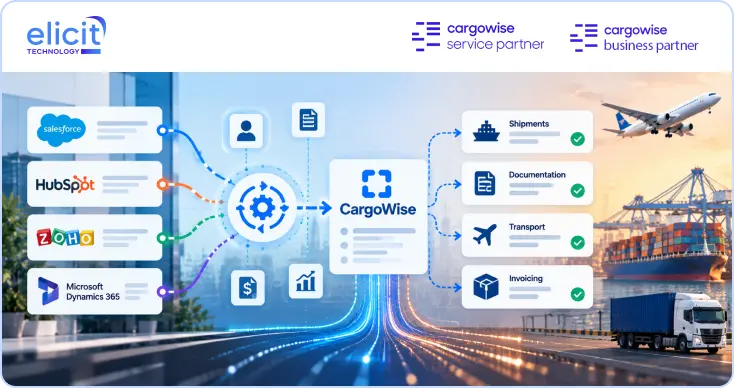
Many logistics businesses already have systems in place. The challenge is getting those systems to work together effectively.
Without proper integration and standardization:
- Teams still rely on manual intervention
- Shipment visibility remains fragmented
- Data inconsistencies continue to create delays
- Operational efficiency improvements stay limited
That’s why successful digital transformation depends not just on platforms, but on how those platforms are implemented and aligned with operational workflows.
📈 Why Forwarders Need the Right CargoWise Expertise?
As digital standards evolve, logistics providers need more than just software access, they need the right expertise to optimise how those systems operate within real-world supply chains.
A properly configured CargoWise environment can help businesses:
- Improve operational connectivity
- Reduce repetitive manual handling
- Strengthen visibility across shipments
- Simplify data exchange with partners
- Support more scalable logistics operations
But unlocking that value requires a strong understanding of both CargoWise capabilities and industry workflows.
This is where the role of an experienced CargoWise service partner becomes critical.
📌 The Key Takeaway
Digital transformation in container shipping is no longer just about technology adoption, it’s about creating connected ecosystems where information flows accurately and efficiently across every stakeholder.
As global standards continue to evolve, businesses need the right systems, integrations, and expertise to fully benefit from this shift.
The future of logistics belongs to organizations that can combine operational knowledge with smarter digital connectivity.
Elicit Technology helps logistics providers optimise CargoWise integrations, workflows, and digital operations to support more connected, scalable, and future-ready supply chain environments.