





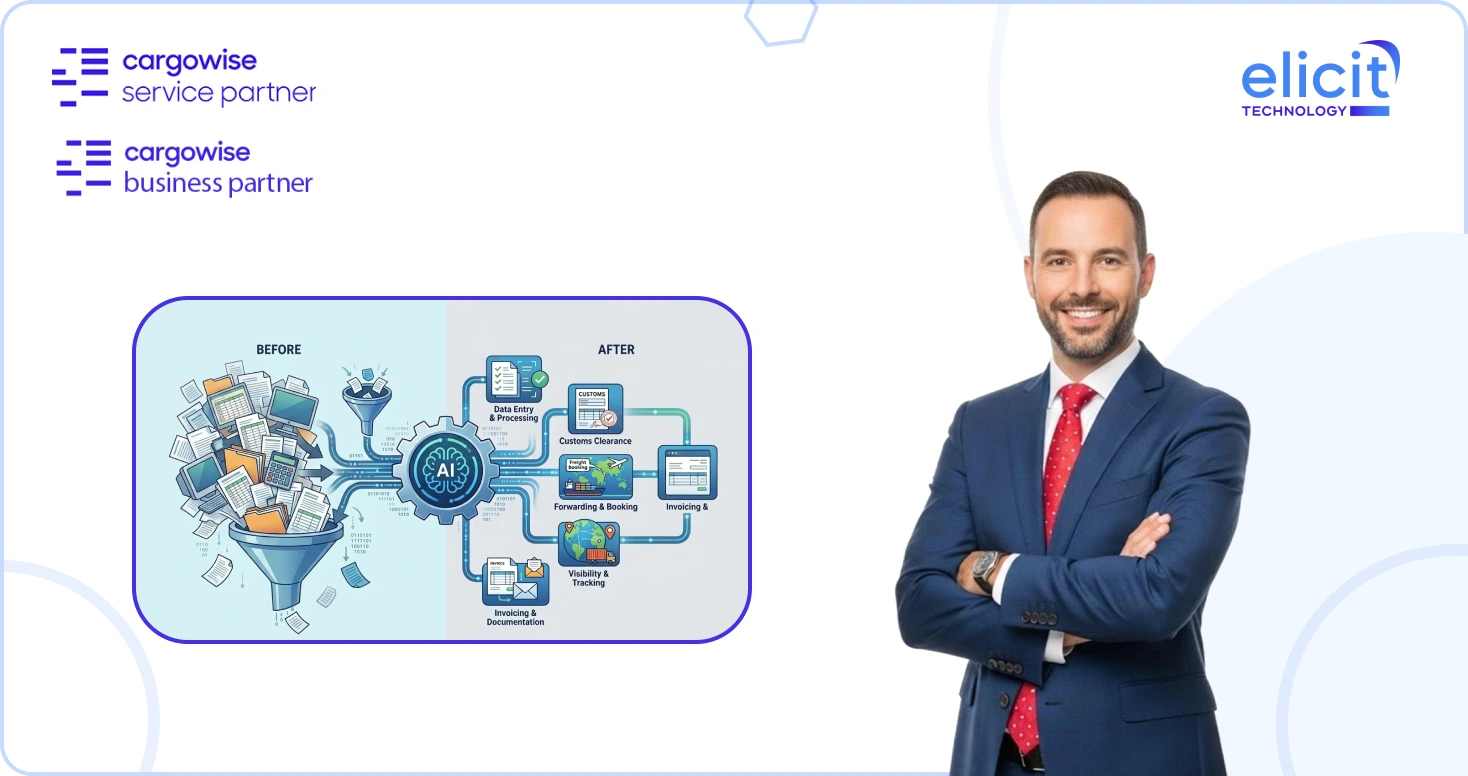
A confirmed booking lands in one inbox. The purchase order arrives in another. A vendor invoice is attached to an email, while shipment details are buried inside a bill of lading, packing list, and pre-alert.
Someone still has to open every document, identify the right fields, verify the information, locate the correct CargoWise job, enter the data, attach the files, and check that nothing was missed.
Do that once, and it seems manageable. Do it hundreds of times every week, and manual processing quietly becomes one of the highest operational costs in the business.
This is where AI-driven automation in CargoWise can make a real difference. Instead of asking employees to process every routine transaction from beginning to end, AI can read incoming documents, extract the required information, validate it against CargoWise data, prepare or create the appropriate record, and direct only the exceptions to users.
CargoWise already provides workflow and automation capabilities across logistics and enterprise processes. WiseTech Global has also expanded CargoWise AI functionality through features such as an AI workflow engine and AI management tools. However, turning these capabilities into reliable business automation still requires careful workflow design, integration, testing, and governance.
What does AI-Driven CargoWise Automation Actually Mean?
AI-driven CargoWise automation is the use of document intelligence, validation rules, integrations, workflows, and artificial intelligence to complete repetitive logistics tasks with minimal manual intervention.
Traditional automation usually depends on predictable, structured inputs. For example, a system can import a spreadsheet when every column appears in the expected place.
Logistics documents are rarely that consistent.
A vendor may send a PDF invoice. A carrier may use a different booking confirmation format. A house bill may place the consignee information in an unfamiliar section. A purchase order may contain dozens of product lines, handwritten notes, or supporting attachments.
AI adds value by interpreting these less-structured inputs. It can identify relevant fields, classify documents, compare extracted data with CargoWise records, and determine whether the transaction is ready to proceed or needs human attention.
The goal is not to remove people from logistics operations. It is to stop skilled employees from spending most of their day copying information between emails, documents, spreadsheets, and CargoWise screens.
WiseTech has similarly emphasized that AI delivers the greatest value when organizations determine which activities technology can own and which decisions still require human judgment.
Why is Manual CargoWise Data Entry Still a Major Problem?
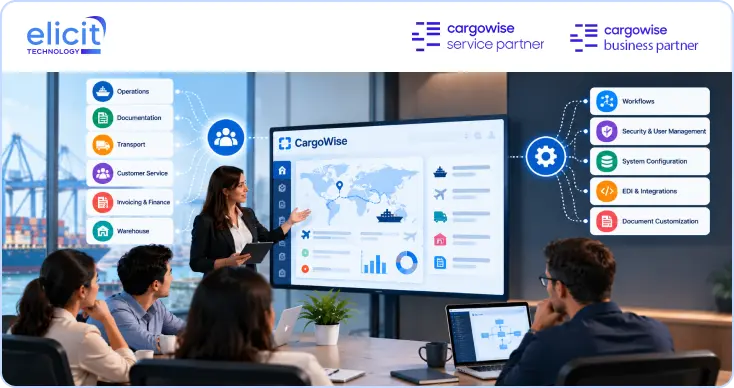
CargoWise can centralize forwarding, customs, warehousing, accounting, transport, bookings, and shipment data. But companies do not gain the full value of that connected environment when information still enters the system manually.
A typical shipment may require data from:
- Customer booking requests
- Quotations and rate confirmations
- Purchase orders
- Master and house bills
- Commercial invoices
- Packing lists
- Carrier confirmations
- Vendor invoices
- Arrival notices
- Warehouse receipts
Each manual touch creates another opportunity for delays, incorrect codes, duplicate records, missing documents, or mismatched financial information.
The impact goes beyond the time spent typing. An incorrect port code may disrupt routing. A wrong organization match can affect documentation. A missed invoice line may distort job profitability. An AP invoice posted without checking accruals may create a financial exception that finance must untangle later.
AI automation addresses the work at its source by improving how incoming information is captured, checked, and introduced into CargoWise.
Which CargoWise Processes can be Automated with AI?
The best automation opportunities are usually processes with high volume, repeated steps, document-heavy inputs, and clear business rules.
Quotation Automation
Preparing freight quotations can require users to collect shipment details, review tariffs, check rate tables, apply surcharges, and format the response.
AI-supported quotation automation can capture origin, destination, cargo type, dimensions, weight, service requirements, and customer information from an inquiry. The data can then be validated and used to prepare a quotation for review.
This helps sales teams respond more quickly while maintaining greater consistency across quotes. Users remain responsible for commercial decisions, unusual cargo, special pricing, and exceptions that require negotiation.
Purchase Order and Sales Order Automation
Purchase orders often arrive from suppliers or customers in different document formats. Manually entering every line item can become a serious bottleneck, particularly for businesses managing high-volume order movements.
AI can extract product details, quantities, values, reference numbers, and vendor or customer information. The information can then be matched against CargoWise master data before the relevant order record is prepared.
Records with complete and validated information can move forward automatically. Unmatched vendors, missing product codes, or quantity differences can be routed to the appropriate user.
Booking Creation
Confirmed quotations and booking requests already contain much of the information needed to create a CargoWise booking.
AI can identify the shipper, consignee, origin, destination, cargo details, service level, routing, and equipment requirements. After validation, the booking can be created or prepared with key information already populated.
Source emails and documents can also be associated with the relevant record, giving the operations team a clearer audit trail.
Shipment Creation Automation
Shipment creation is one of the strongest use cases for AI-driven CargoWise automation because operations teams regularly receive information through pre-alert packs, master bills, house bills, commercial invoices, and packing lists.
Instead of manually reading each document, AI can capture the required shipment and routing data, compare it with existing CargoWise organizations, ports, carriers, and reference records, and prepare the order, shipment, consol, or container information.
The relevant documents can be attached to eDocs while exceptions are sent to users for review.
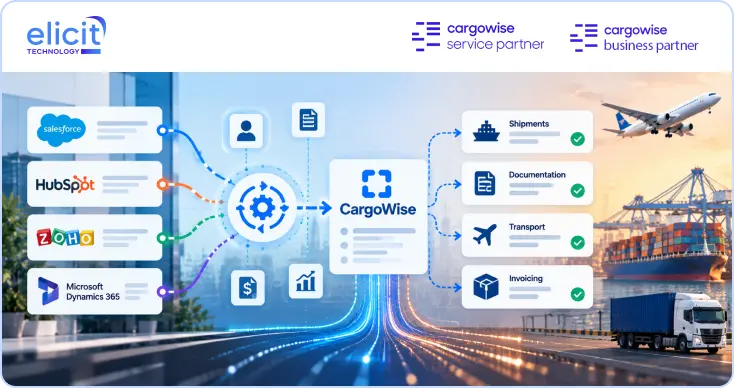
CargoWise itself supports connected management of bookings, shipments, rates, customs, invoices, schedules, tracking, and automation from one platform. The role of a customized AI solution is to improve how external and unstructured information enters those workflows.
AP Invoice Automation
Accounts Payable invoice processing usually involves more than extracting an invoice number and total.
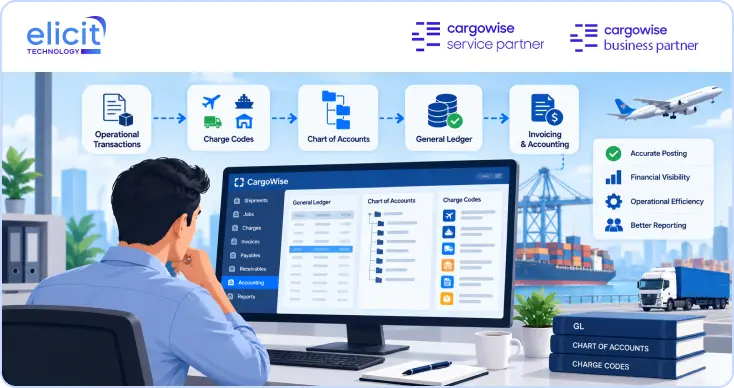
The system may need to identify the vendor, find the correct job, map charge codes, verify tax treatment, compare charges with accruals, detect duplicate invoices, and confirm whether the amount falls within permitted tolerances.
AI can read invoice data from PDFs and other formats, match the information to CargoWise records, compare the invoice with accrued costs, and prepare validated transactions for posting.
Invoices that match the expected data can move through the workflow with little intervention. Differences such as unknown charges, missing jobs, duplicate references, or values outside tolerance can be placed into an exception queue.
This changes the finance team’s role from entering every invoice to reviewing the smaller number that genuinely needs attention.
Accounts Receivable Collection
AI automation can also support activities after an invoice has been issued.
Receivables workflows may use invoice age, customer terms, outstanding value, payment history, and account status to prepare reminders, statements, and follow-up tasks.
Rather than relying on staff to review every debtor manually, the system can prioritize overdue accounts and create consistent follow-up actions. Sensitive customers, disputed invoices, and high-value accounts can still be directed to finance professionals for personal handling.
Transport Job Automation
Transport instructions can be created from shipment records, booking confirmations, delivery requirements, or customer requests.
Automation may prepare transport jobs, capture pickup and delivery information, identify equipment needs, trigger status updates, and coordinate first- or last-mile activities.
The exact level of automation depends on transport-provider connectivity, scheduling requirements, capacity rules, and the quality of the incoming data.
Warehouse Entry Automation
Inbound warehouse activity often begins with purchase orders, packing lists, advance shipment notices, barcodes, and receiving documents.
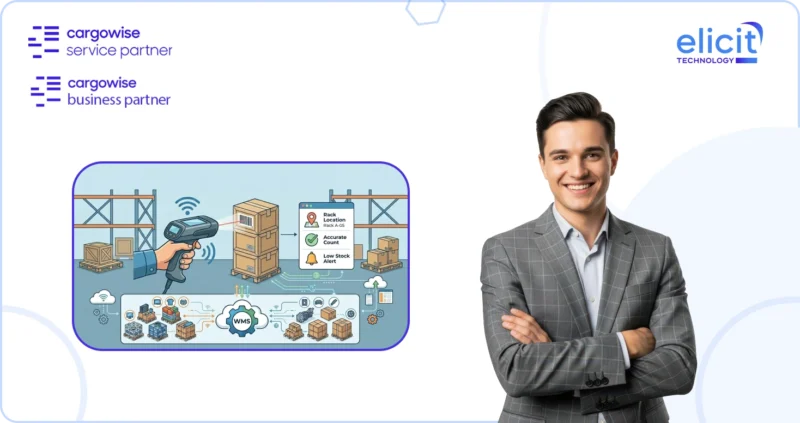
AI and document capture can help prepare warehouse receipts and inventory records without requiring warehouse staff to enter the same information again. Physical quantity differences, damaged cargo, unknown products, or missing references can remain controlled exceptions.
Why is Exception Management More Important than “100% Automation”?
The most useful automation strategy does not pretend that every logistics transaction will always be perfect.
Documents may be incomplete. Customers can use unexpected formats. Organization records may be duplicated. A carrier name might not match CargoWise master data. An invoice may include an unaccrued charge. A shipment may involve dangerous goods, unusual routing, or customer-specific instructions.
A reliable automation should recognize uncertainty rather than silently posting questionable data.
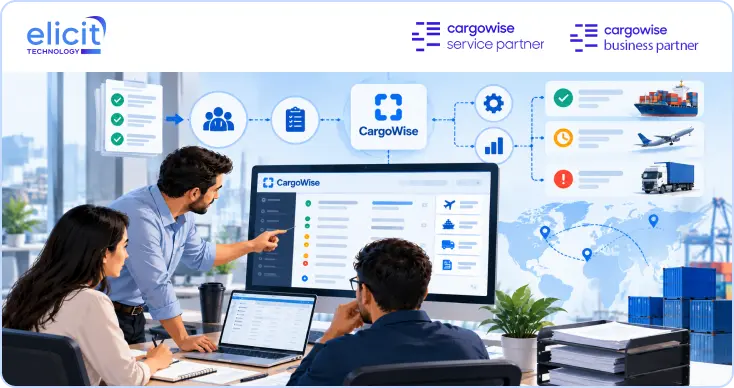
Exception management gives users a focused queue containing only records that require judgment. The system should clearly show what failed validation, what information is missing, and what action is required.
This approach supports high levels of touchless processing while preserving human control where it matters.
What is Needed Before Automating CargoWise?
AI cannot fix weak processes by itself. Automating inconsistent workflows can simply make errors happen faster.
Before implementation, the business should review:
- Master-data quality
- Organization and port records
- Charge-code structures
- Accrual practices
- User permissions
- Document types
- Approval rules
- Exception tolerances
- Workflow ownership
- Reporting requirements
The company must also decide which transactions can be processed automatically, which require approval, and which should always remain under human review.
Clean data is especially important. WiseTech has highlighted that effective AI depends on the quality and consistency of the underlying logistics data, not merely the intelligence of the model applied to it.
Why does CargoWise Integration Matter?
AI may read and understand a document, but the automation still needs a dependable way to retrieve and update CargoWise information.
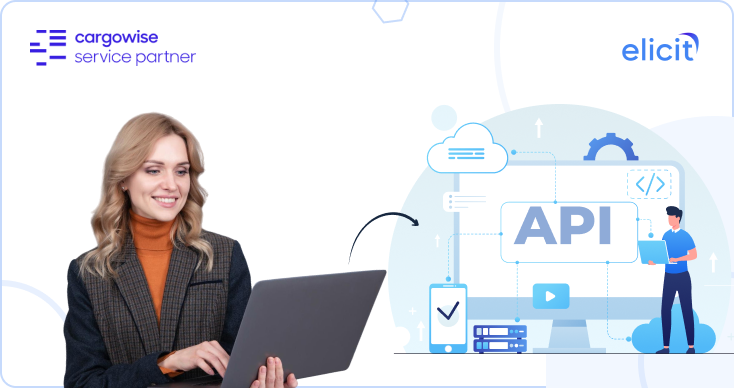
CargoWise eAdaptor, eAdaptor Next, supported APIs, messaging, and middleware can provide the connection between the AI automation layer and the CargoWise environment. CargoWise describes eAdaptor Next as supporting improved traceability, multi-system connectivity, and inbound and outbound messaging.
The integration must be designed to handle:
- Data validation
- Record creation and updates
- Document attachment
- Duplicate prevention
- Message tracking
- Failed transaction retries
- Security and access
- Audit history
- Exception routing
This is why AI automation should not be treated as a standalone document-reading tool. It must be connected to the real CargoWise workflow and governed by the same operational controls as the rest of the business.
How should a CargoWise AI Automation Project Begin?
A successful project should start with one clearly defined operational problem rather than an attempt to automate everything at once.
The process usually begins by documenting the current workflow, transaction volumes, processing time, error points, input documents, CargoWise records, and desired outcome.
A CargoWise Service Partner can then define the scope, determine the appropriate automation and integration architecture, configure the workflows, and test realistic scenarios with users.
User Acceptance Testing should cover both successful transactions and exceptions. Teams need to verify what happens when information is missing, duplicated, inconsistent, or outside accepted tolerances.
After go-live, automation performance should be monitored through processing rates, exceptions, accuracy, failure reasons, and user feedback. These insights can then guide further optimization or expansion into other workflows.
Conclusion
AI-driven CargoWise automation gives logistics companies an opportunity to move beyond basic task automation and address the document-heavy work that still slows down operations.
Quotations, purchase orders, sales orders, bookings, shipments, invoices, collections, transport jobs, and warehouse entries can all become faster and more consistent when AI captures the information, CargoWise validates the business data, and employees focus on exceptions.
However, reliable automation requires more than an AI model. It depends on clean master data, well-designed workflows, appropriate controls, secure integration, accurate field mapping, thorough testing, and ongoing monitoring.
Elicit Technology helps freight forwarders and logistics companies identify the right automation opportunities and turn them into controlled CargoWise workflows. As an official CargoWise Service and Business Partner, Elicit supports AI automation, CargoWise configuration, eAdaptor and API integration, workflow design, User Acceptance Testing, go-live, exception management, and ongoing optimization.
Ready to reduce repetitive CargoWise work and give your team more time for customers and operational decisions? Book a consultation with Elicit Technology to plan an AI-driven CargoWise automation solution built around your business.