













Salesforce

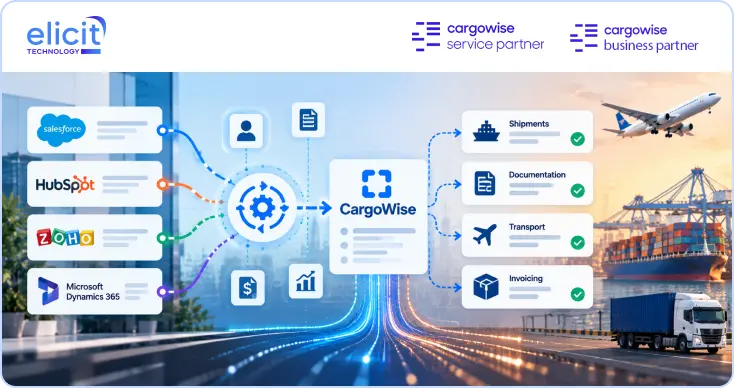
Sync Salesforce data with live shipments.

HubSpot

Align sales activity with operational shipment data.

Zoho CRM

Connect Zoho deals with CargoWise operations.

Microsoft Dynamics CRM

Unify CRM and logistics on one workflow.

This and other CRM integrations in CargoWise

We are always ready with the solution you need.

Share your requirements with us — we'll integrate CRM into CargoWise to fit the way you work.

ICEGATE Integration

Accelerate ICEGATE integration delivery for efficiency, connecting CargoWise to India's national customs gateway for automated declaration filing.

ACE Integration

Accelerate ACE integration delivery for efficiency, connecting CargoWise to the US CBP's Automated Commercial Environment for import filings.

AMS Integration

Optimize AMS integration delivery at scale, automating advance cargo manifest submissions into the US Automated Manifest System.

AES Integration

Accelerate AES integration delivery for efficiency, automating US export declaration filing through the Automated Export System.

CDS Integration

Accelerate CDS integration delivery for efficiency, connecting CargoWise to the UK's Customs Declaration Service.

DMS Integration

Streamline Netherlands customs declaration delivery, connecting CargoWise to Dutch Customs' current DMS platform, which fully replaced AGS in 2024.

MPCI Integration

Automate UAE pre-loading manifest filing, connecting CargoWise to MPCI for mandatory cargo information submission before loading.

ICS2 Integration

Accelerate ICS2 integration delivery for efficiency, meeting the EU's mandatory Entry Summary Declaration requirements across all transport modes.

ASM Sequoia Integration

Accelerate ASM Sequoia integration for efficiency, connecting CargoWise to Sequoia's customs filing platform.

TradeNet Integration

Streamline Singapore customs filing, connecting CargoWise to TradeNet's single window for permits, duties, and Certificate of Origin declarations.

ASYCUDA Integration

Accelerate ASYCUDA integration delivery for efficiency, linking CargoWise to the customs automation system used widely across Africa.

SARS Integration

Accelerate SARS integration delivery for efficiency, connecting CargoWise to South Africa's national customs system.

SISCOMEX Integration

Accelerate SISCOMEX integration delivery for efficiency, connecting CargoWise to Brazil's Integrated Foreign Trade System.

VUCEM Integration

Optimize VUCEM integration delivery at scale, connecting CargoWise to Mexico's single window for foreign trade.

NZCS Integration

Accelerate NZCS integration delivery for efficiency, connecting CargoWise to New Zealand Customs Service's filing platform.

About Us

Discover who powers your CargoWise success.

Careers

Join our global logistics technology team.

Contact Us

Talk to CargoWise experts about your goals.

CargoWise Resources

Your Complete CargoWise Support Destination

From implementation to automation, optimize every process with expert CargoWise guidance.

CargoWise Shortcuts

Work faster with practical keyboard shortcuts.

Free Tools

Use free tools for everyday logistics tasks.

CargoWise Healthcheck

Uncover ways to improve CargoWise performance.

CargoWise Resources

Your Complete CargoWise Support Destination

From implementation to automation, optimize every process with expert CargoWise guidance.

Glossary

Browse key logistics and CargoWise terms.

CargoWise Resources

Your Complete CargoWise Support Destination

From implementation to automation, optimize every process with expert CargoWise guidance.

Incoterms

Understand trade terms for global shipping.

CargoWise Resources

Your Complete CargoWise Support Destination

From implementation to automation, optimize every process with expert CargoWise guidance.

CargoWise ERP Glossary - Key Terms & FAQs

Our CargoWise ERP Glossary Terms provide clear, concise definitions of key terms used in CargoWise, helping users navigate the system with confidence. Along with these definitions, we've included in-depth FAQs to clarify complex concepts, ensuring you get the most out of your CargoWise solutions.

Net Profit per Shipment

Last updated: July 25, 2025
Logistics CargoWise
N

Net Profit per Shipment is a financial statistic used by CargoWise to determine the profitability of individual freight transactions. This indicator gives organizations a detailed picture of how much profit is earned from each shipment after accounting for all associated costs, such as transportation, processing, customs, and fees. By analyzing the profitability of each shipment, businesses can acquire insights into their operational efficiency, pricing strategy, and overall success. It also assists firms in identifying areas where cost reductions or pricing adjustments may be required to increase profitability.

The Net Profit per Shipment indicator is integrated into CargoWise’s financial and reporting tools, enabling real-time tracking and analysis. This tool enables logistics professionals to monitor financial outcomes at the shipment level, resulting in a better understanding of how each transaction affects the bottom line. With this information, firms may make better decisions about pricing, cost management, and overall company strategy, resulting in increased revenue and long-term viability in the competitive logistics business.

Frequently Asked Questions

What is CargoWise's net profit per shipment?

Net profit per shipment is a financial statistic that determines the profitability of individual freight transactions by deducting associated costs from revenue.

How does net profit per shipment benefit logistics companies?

This statistic assists firms in determining the profitability of each shipment, offering vital information on pricing strategies, cost management, and operational efficiency.

What costs are included in the net profit per shipment calculation?

The figure includes all shipment-related costs, including transportation, handling, customs fees, taxes, and other transaction fees.

Can the net profit per shipment be modified in CargoWise?

CargoWise enables firms to tailor financial reporting, including the computation of net profit per shipment, by altering cost elements and price settings as necessary.

Why is the net profit per shipment significant to logistics companies?

This statistic allows logistics organizations to optimize their operations, develop pricing strategies, and uncover possibilities to increase profitability while lowering expenses.