




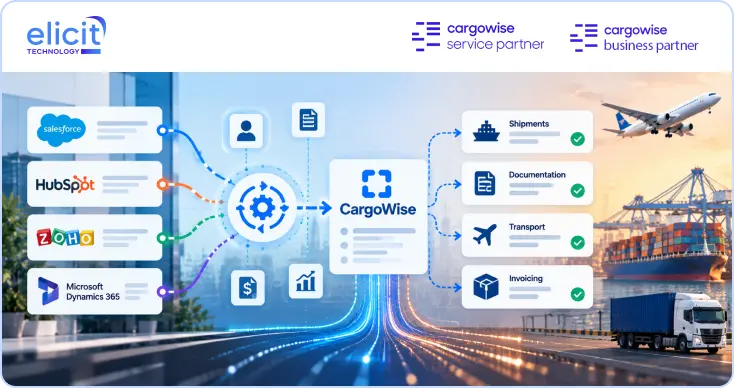









Salesforce

Sync Salesforce data with live shipments.

HubSpot

Align sales activity with operational shipment data.

Zoho CRM

Connect Zoho deals with CargoWise operations.

Microsoft Dynamics CRM

Unify CRM and logistics on one workflow.

This and other CRM integrations in CargoWise

We are always ready with the solution you need.

Share your requirements with us — we'll integrate CRM into CargoWise to fit the way you work.

ICEGATE Integration

Accelerate ICEGATE integration delivery for efficiency, connecting CargoWise to India's national customs gateway for automated declaration filing.

ACE Integration

Accelerate ACE integration delivery for efficiency, connecting CargoWise to the US CBP's Automated Commercial Environment for import filings.

AMS Integration

Optimize AMS integration delivery at scale, automating advance cargo manifest submissions into the US Automated Manifest System.

AES Integration

Accelerate AES integration delivery for efficiency, automating US export declaration filing through the Automated Export System.

CDS Integration

Accelerate CDS integration delivery for efficiency, connecting CargoWise to the UK's Customs Declaration Service.

DMS Integration

Streamline Netherlands customs declaration delivery, connecting CargoWise to Dutch Customs' current DMS platform, which fully replaced AGS in 2024.

MPCI Integration

Automate UAE pre-loading manifest filing, connecting CargoWise to MPCI for mandatory cargo information submission before loading.

ICS2 Integration

Accelerate ICS2 integration delivery for efficiency, meeting the EU's mandatory Entry Summary Declaration requirements across all transport modes.

ASM Sequoia Integration

Accelerate ASM Sequoia integration for efficiency, connecting CargoWise to Sequoia's customs filing platform.

TradeNet Integration

Streamline Singapore customs filing, connecting CargoWise to TradeNet's single window for permits, duties, and Certificate of Origin declarations.

ASYCUDA Integration

Accelerate ASYCUDA integration delivery for efficiency, linking CargoWise to the customs automation system used widely across Africa.

SARS Integration

Accelerate SARS integration delivery for efficiency, connecting CargoWise to South Africa's national customs system.

SISCOMEX Integration

Accelerate SISCOMEX integration delivery for efficiency, connecting CargoWise to Brazil's Integrated Foreign Trade System.

VUCEM Integration

Optimize VUCEM integration delivery at scale, connecting CargoWise to Mexico's single window for foreign trade.

NZCS Integration

Accelerate NZCS integration delivery for efficiency, connecting CargoWise to New Zealand Customs Service's filing platform.

About Us

Discover who powers your CargoWise success.

Careers

Join our global logistics technology team.

Contact Us

Talk to CargoWise experts about your goals.

CargoWise Resources

Your Complete CargoWise Support Destination

From implementation to automation, optimize every process with expert CargoWise guidance.

CargoWise Shortcuts

Work faster with practical keyboard shortcuts.

Free Tools

Use free tools for everyday logistics tasks.

CargoWise Healthcheck

Uncover ways to improve CargoWise performance.

CargoWise Resources

Your Complete CargoWise Support Destination

From implementation to automation, optimize every process with expert CargoWise guidance.

Glossary

Browse key logistics and CargoWise terms.

CargoWise Resources

Your Complete CargoWise Support Destination

From implementation to automation, optimize every process with expert CargoWise guidance.

Incoterms

Understand trade terms for global shipping.

CargoWise Resources

Your Complete CargoWise Support Destination

From implementation to automation, optimize every process with expert CargoWise guidance.

CargoWise ERP Glossary - Key Terms & FAQs

Our CargoWise ERP Glossary Terms provide clear, concise definitions of key terms used in CargoWise, helping users navigate the system with confidence. Along with these definitions, we've included in-depth FAQs to clarify complex concepts, ensuring you get the most out of your CargoWise solutions.

Non-Declared Dangerous Goods (NDDG)

Last updated: July 25, 2025
Logistics CargoWise
N

Non-Declared Dangerous Goods (NDDG) are highly dangerous products or goods that are carried without the correct declaration, labeling, or paperwork needed by legislation. Despite their intrinsic danger, these commodities are frequently missed or misclassified, posing major safety hazards throughout transportation. Whether transported by air, sea, or land, these undetected hazardous materials endanger not only the commodities themselves but also other shipments, the transport vehicle, and the workers handling them. Common instances include combustible items, dangerous chemicals, and explosives that may be erroneously stated or completely absent from freight documents.

Properly identifying and declaring dangerous goods is crucial for maintaining safety and compliance with international and local regulations. Platforms like CargoWise can help manage the transportation of hazardous goods by ensuring that all shipments are appropriately categorized and documented. The system’s advanced tracking, documentation, and regulatory compliance features can flag non-declared dangerous goods, alerting logistics teams to the potential risks and ensuring safer handling. Failure to declare dangerous goods can result in fines, shipment delays, and even accidents, making accurate documentation vital for businesses in the logistics industry.

Frequently Asked Questions

What are the Non-Declared Dangerous Goods (NDDG)?

NDDG refers to dangerous goods that are transported without adequate declaration, creating major safety risks to passengers, cargo, and the transportation system.

Why is it dangerous to transport goods without declaring them?

Transporting goods without declaring them can result in accidents, regulatory violations, and significant environmental damage because necessary safety precautions may not be in place.

How do logistics platforms like CargoWise help with NDDG?

CargoWise helps to ensure that all commodities, especially dangerous ones, are properly classed and declared, thereby avoiding the hazards associated with non-declaration.

What kinds of products are considered dangerous?

Explosives, flammable liquids, toxic chemicals, caustic compounds, and gases are examples of hazardous commodities that pose transportation risks.

What are the implications of failing to declare dangerous goods?

Failure to declare dangerous goods can result in fines, delays, penalties, accidents, and even legal action for violating international shipping standards.