





A container has delivered its import cargo and is now empty.
A few kilometres away, an exporter needs exactly that type of container.
Operationally, bringing those two requirements together sounds straightforward. In reality, the empty container may first travel back to a depot, wait in storage, and later be repositioned again before it can support another shipment.
That extra movement creates cost without moving additional cargo.
According to the CargoWise report Reducing Empty Movements at Scale, around 41% of global container movements are empty, while the industry spends nearly USD 20 billion each year repositioning empty equipment. The inefficiency becomes especially visible inland, where up to 40% of container movements can be empty.
The problem is therefore larger than finding a container.
It is about coordinating containers, trucks, exporters, importers, depots, terminals, carriers, and demand at exactly the right time.
And that is where CargoWise Container Transport Optimization introduces a different way of thinking about landside logistics.
🚢 Why do Empty Containers Keep Moving?
Container shipping works as a network, but many landside decisions are still made separately.
Freight forwarders plan shipments. Importers organise unloading. Exporters request equipment. Trucking providers plan vehicles. Shipping lines manage their container fleets. Depots manage available equipment.
Each participant may make a perfectly reasonable decision based on the information available to them.
The trouble is that what works locally may not be efficient for the wider network.
An importer releases an empty container, but nobody has visibility of nearby export demand. The container is therefore sent back to the depot.
Elsewhere, an exporter requests another empty container from that same depot.
The result can be another truck journey, another depot visit, more handling, greater congestion, and additional fuel consumption.
The CargoWise report highlights how this fragmented coordination can lead to dead legs, unnecessary container park visits, multiple long-haul inland movements, repeated loading and unloading, excess yard buffering, storage congestion, and higher CO₂ emissions.
The real issue is not simply container availability.
It is network visibility and coordination.
🔄 What if the Empty Container Never Needed to Return to the Depot?
This is where two important optimisation models come into the picture: container reuse and container triangulation.
Container reuse happens when the same party importing cargo uses that container for an export shipment instead of returning it to an empty container depot.
That removes an unnecessary step from the container lifecycle.
Container triangulation goes further. Instead of reuse being limited to the same organisation, an empty import container can be matched with export demand from another participant operating within the same inland network.
In simple terms:
An empty container becomes available → nearby export demand exists → the two can potentially be matched.
The opportunity sounds obvious when viewed individually.
At scale, however, it becomes much harder.
Thousands of containers may be moving through different locations, and every possible match needs to account for container ownership, size, type, grade, location, delivery windows, carrier policies, eligibility, transport capacity, and operational timing.
That is far beyond what a transport allocator can consistently evaluate manually.
📍 From Seven Transport Legs to a More Direct Movement
One of the clearest examples in the CargoWise report compares a traditional landside export flow with an optimised one.
In the standard scenario, manual coordination between the trucking yard, empty container park, exporter, and terminal can create up to seven transport legs for a single export shipment.
Those movements include productive journeys, but also empty and dead truck legs.
In the optimised scenario illustrated in the report, container availability, transport capacity, and export demand are coordinated digitally. An import container can instead be connected with nearby export demand, avoiding unnecessary depot movements.
The result shown is an export movement completed with one paid full-container leg, while unnecessary depot visits and dead legs are reduced.
That comparison captures the real opportunity.
Container optimization is not simply about driving a truck along a shorter route.
It is about asking whether some transport movements need to happen at all.
⚙️ How CargoWise Container Transport Optimization Connects the Pieces?
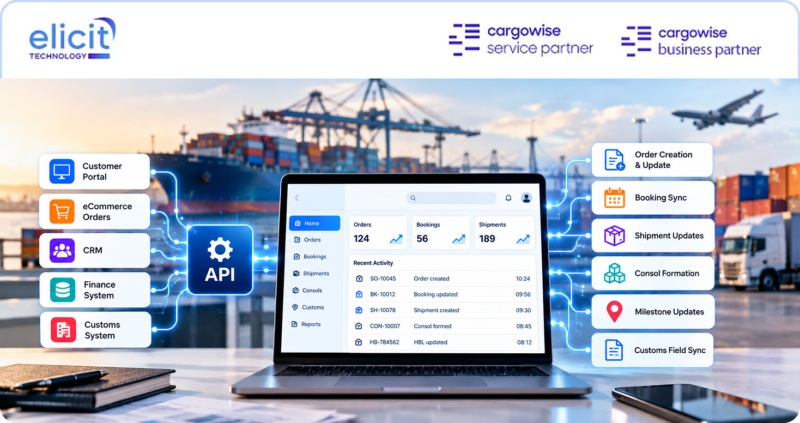
CargoWise Container Transport Optimization provides a digital orchestration layer that brings container availability, shipment demand, transport capacity, and execution together.
The workflow described by CargoWise follows four connected stages.
Booking intake identifies eligible export transport bookings that could potentially be optimised.
Container matching evaluates available import containers against export demand while considering operational requirements and carrier policies.
Transport optimisation looks across multiple jobs to determine more efficient routing, sequencing, and transport allocation.
Execution and visibility then connects the optimised movement with transport providers while capturing and sharing shipment milestones across stakeholders.
CargoWise notes that this process can be initiated with a single click within existing transport booking workflows.
That matters because optimisation cannot remain a separate planning exercise.
For it to create operational value, the decision needs to move from identification → validation → transport planning → execution within the wider logistics workflow.
🧠 Why Algorithms Matter at Network Scale?
Imagine trying to manually compare every available container with every export booking in a large metropolitan logistics network.
It would require evaluating thousands of potential combinations.
Then add container size, owner, type, grade, drop type, delivery timing, vehicle availability, geography, carrier restrictions, and customer requirements.
The number of possibilities grows very quickly.
CargoWise Container Transport Optimization approaches the problem at network level rather than treating each transport booking in isolation.
By continuously analysing container availability, shipment demand, transport capacity, and operational constraints, it can identify reuse and triangulation opportunities that may be almost impossible for individual planners to find consistently.
This moves container allocation away from:
“Where should this container go next?”
towards:
“What combination of container, shipment, and transport movement creates the most efficient outcome across the network?”
That is a much bigger optimisation problem, and potentially a much bigger opportunity.
🌐 Why the Network Behind the Technology Matters?
Algorithms alone are not enough.
They need data.
CargoWise highlights five elements supporting its Container Transport Optimization capability: algorithm-driven global optimization, network density across logistics participants, cross-party orchestration, deep ecosystem connectivity, and the richness of data available through the CargoWise and wider WiseTech landside ecosystem.
The principle is fairly simple.
More connected shipment bookings create more demand visibility.
More visible containers create more potential supply.
More connected transport providers create more execution possibilities.
As those signals come together, optimisation opportunities that were previously hidden inside separate organisations or systems can become visible.
CargoWise describes this as a compounding network effect: as participation across the ecosystem grows, so does the potential to match container supply and demand more efficiently.
📈 Who Benefits from Better Container Utilisation?
The value extends well beyond the freight forwarder.
For freight forwarders and 3PLs, better coordination can mean lower inland transport costs, improved container access, stronger shipment planning, and live visibility.
For shippers, exporters, and importers, it can mean lower detention, storage, and staging costs alongside better equipment availability and reduced shipment-delay risk.
For transport and trucking providers, fewer empty miles can improve fleet utilisation, reduce fuel consumption, increase trip yield, and decrease queueing or idle time.
Shipping lines can benefit from faster equipment turnaround and lower empty repositioning costs, while ports and depots can potentially reduce infrastructure pressure and improve yard utilisation.
At the wider ecosystem level, fewer unnecessary movements can also contribute to lower emissions and more efficient inland capacity utilisation.
That is why the empty container problem should not simply be viewed as a cost belonging to shipping lines.
It affects almost everyone involved in the container journey.
🚀 The Next Step is Coordinated Landside Logistics
Empty container movements will not disappear completely. Trade imbalances, geography, equipment requirements, maintenance needs, and carrier policies will always create some repositioning demand.
But the CargoWise report makes an important distinction:
Many empty movements are not inevitable.
Some are the result of fragmented information and isolated planning.
CargoWise Container Transport Optimization represents a shift from managing those movements one booking at a time towards orchestrating container flows across a broader logistics network.
By bringing together visibility, algorithm-driven planning, reuse and triangulation opportunities, transport execution, and ecosystem connectivity, freight forwarders can start treating empty container movements as an optimization opportunity rather than simply an unavoidable cost of doing business.
🤝 Turn Container Optimization into an Operational Advantage
Advanced CargoWise capabilities deliver the most value when they are aligned with the way your transport operation actually works.
As a Leading CargoWise Service Partner, Elicit Technology can help freight forwarders understand, configure, and optimize CargoWise workflows around container transport, landside execution, visibility, and automation.
If your teams are still coordinating container availability, transport movements, depots, and export demand through fragmented processes, it may be time to look at what connected optimisation can change.